

Down 2 Bone - Artist Statement
from a poem to a dance to a piece of writing
Choreography: Kate Tarlow Morgan
Filmed by: Reeca Soriano
Performed at The Barn, Brattleboro, Vermont
Proprioception. A physical phenomenon that we all have. In Latin, proprius, ‘one’s own’, and capio, capere, to ‘take or grasp’ to grasp oneself. I named this dance Down 2 Bone because of the action of proprioception AT our “folding places”—the joints. At the joints, there are these corrugated nerve-housings called Golgi Bodies that send nerve signals from bone, to tendon, to muscles. Golgi Bodies, which you will hear in this talking score, gauge our connection to gravity and our orientation in space. Proprioception is rhythmic…and it happens absolutely first…when we are born.
The inspiration for this dance started 50 years ago, in 1975, with a poem called Proprioception, by American poet, Charles Olson, last provost of Black Mountain College. I carried this poem around with me, dog-eared it, and…I guess integrated it into my creative muscle – or my GOLGI Body!! Most of the words in the score are mine, however, without Charles’ “poem-manual,” I would not have had the words… or the dance.
…that I am one / with my skin
Plus this—plus this: that forever the geography…
which leans in
on me I compel
backwards…to yield, to
change…
Maximus to Gloucester, Letter 27
1954-7: Olson’s Crisis
In a letter to Robert Creeley in 1954, Olson wrote, “what I was searching for was the simplest [way] to say how we do have this sense of unity with our body,” that is, that we are ‘one / with [our] skin.’[1] The Creeley Letter and subsequently Maximus Letter 27 (above) prove to be sincere foreshadowing of the work to come—PROPRIOCEPTION, a thin volume in brown stapled wrappers on paper of high-linen count, and published by Four Seasons Foundation, San Francisco (1965). This unique essay with its outline of terms and explanatory paragraphs walks the reader through the parts of the body, targeting physiological systems, scientific discoveries, remarks on culture, history, myth and the cosmos. It also creates a poetic rhythm by using prepositions, dashes, parentheses creating composite-concepts of an embodied ‘geography’ of human consciousness.
It was also in 1954 that Olson sat down to create a diagram of a survival plan for Black Mountain College (BMC) at Lake Eden in Black Mountain, NC as one of the true progressive and avant-garde experiments in American education. By the time Olson became rector (the college’s preferred term) he had been teaching there off and on since 1948, assuming formal leadership beginning in 1951. While the 1953 BMC summer session drew crucial, creative figures like Robert Creeley, Robert Duncan, John Cage and Merce Cunningham, it was the Fall semester that much of the remaining students had departed. The property needed care, while living conditions grew harder due to lack of heat and food.
The diagram Olson sketched was typed on onionskin paper creating the appearance of a time-worn record. At its center: the physical campus, with concentric circles spiraling outward into quadrants pointing to varying disciplines, activities, and collaborations: a theater, an academy, magazine, a publishing house, each assigned to cities beyond the home base of the college. He called it a Plan for the Operation of Black Mountain College After 1956, as an effective dispersion of ideas spread across a map of the U.S.. Sarah Ehlers writes:
Olson’s diagram appears as a portent of the college’s lasting influence as the ground on which experimental art would thrive. The curator Helen Molesworth describes the diagram as a “dream picture”[2]—an imagination “of a cosmopolitan college of satellite institutions held together by a centripetal force, a myth at its center: Black Mountain College.[3]
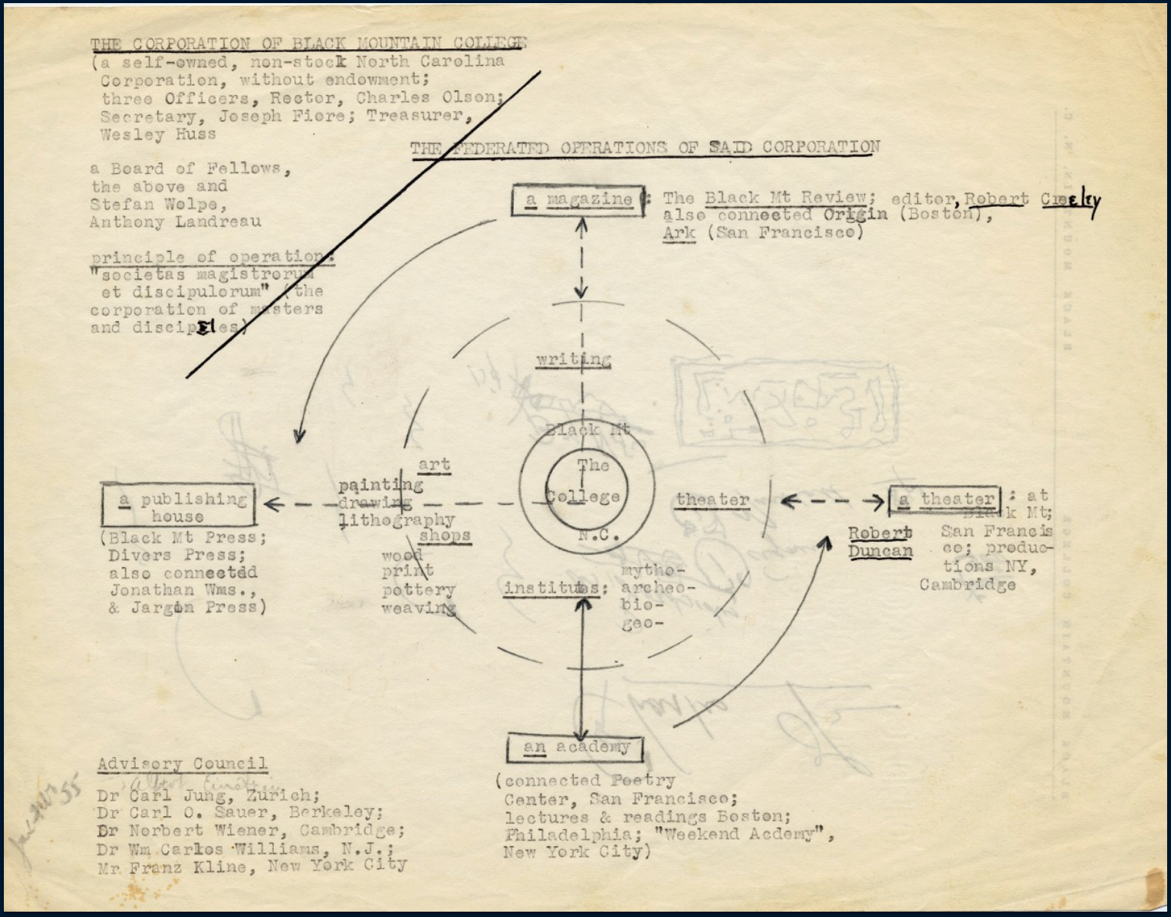
Charles Olson Archives, Storrs-University of Connecticut[4]
The diagram is a map for a decentralized university. Its multi-discipline waystations included four primary knowledges: mytho-, archeo-, bio-, geo- (mythology, archaeology, biology, and geology)—all material that was included in his class “The New Sciences of Man.” In these listed disciplines we can see connections to Olson’s later work Proprioception. This was Olson’s mid-century progressive dream; one that he may have braved alone. Had his predecessors in the progressive education movement been there with him, they would have beaten that same drum.
1794-1906: The Soul and the Synapse
The first consideration of what would become the concept of proprioception happened in 1794. Johann Christian Reil, physiologist, neuroanatomist and psychiatrist coined the word “coenesthesia” which is defined in Webster’s Dictionary as “the vital sense,” or “the undifferentiated complex of organic sensations by which one is aware of the body and bodily conditions” (1945). Coenesthesia was—according to Dr. Reil—one of three entities that informed the Soul. First, was “external sensation” or the perception of the outside world through the senses. Second, was “internal sense” otherwise called “the organ of the soul,” where the abilities of imagination, judgment, and consciousness were housed. And the third was this coenesthesia, or “vital sense.”[6] What was radical about Reil’s discovery was his understanding of a “general sensibility” (gemeingefuhl) or a holism between mental life and sensory activity.
Reil coined the term ‘psychiatry’ and practiced in the field whose name he created. Two of his patients, who couldn’t be at further ends of German culture, were Grimm and Goethe. He also discovered an important part of the brain called the Insular Cortex, cushioned behind the frontal, parietal and temporal lobes beneath the opercula that performs the essential functions of the emotions, homeostasis, and awareness of bodily needs: hunger, pain, fatigue, desire. It was in this innermost part of the brain that calibrated the inner landscape with the outside world. I had not discovered Dr. Reil when I first read Olson’s Proprioception. However, by nature of the “heritage of ideas”[7] (to quote John Dewey), it seems that Olson’s poem reclaims this antique knowledge where the phenomenology of the body shares a line with Olson’s “cosmos.” Lucky for us that these two far-distant pioneers meet in a world where physiology and the soul co-exist.
In between Dr. Reil and Olson, it was neurophysiologist, Charles Scott Sherrington, who coined the word “proprioception” in 1906. He is best known for providing us with the term “synapse;” a word still used to describe the junction where two neurons communicate. It was Sherrington’s study of movement and muscle action that highlighted the two-way conversation between the limbs, torso and spinal nerves. This was when “soul” was removed from what had been Dr. Reil’s “Vital Sense” i.e. the marriage between ‘psyche’ and ‘sense.’
1965: Olson’s 88-line essay & the Golgi Bodies
Proprioception (for Ed Dorn) (1965)
Physiology: the surface (sense—the skin of Human
Universe’) the body itself—proper—of one’s own
‘corpus”: PROPRIOCEPTION the cavity of the body…(Lines 1-3)
Proprioception, from Latin “-proprius,” meaning “one’s own” and the suffix “-ception” from the Latin word “-capere,” which means “to take” or “to seize” is the sense of the relative positioning of neighboring parts of the body. Proprioception indicates whether the body is moving or still, precisely because it orients the body in relation to itself. Unlike the “exteroceptive” senses by which we perceive the outside world, and “interoceptive” senses, by which we perceive pain and the movement of internal organs—“proprioception” is a third distinct sensory modality that provides feedback solely on the status of the body internally.
Today: movement at any cost. Kinesthesia: beat (nik)
the sense whose end organs lie in the muscles,
tendons, joints, and are stimulated by bodily
tensions… (Lines 9-12)
Those “end organs” fire locator messages into the nervous system at the joint-end tendinous fibers and fibrous muscle bundles called “Golgi Bodies.” The maturing fetus practices its Golgi Bodies by pushing against its container (the womb). Once on land, proprioception works like a GPS for center, while gravity becomes the Mother of our physiological tone. Ask yourself, at any given moment, “Do you know where you are?” That is proprioception.
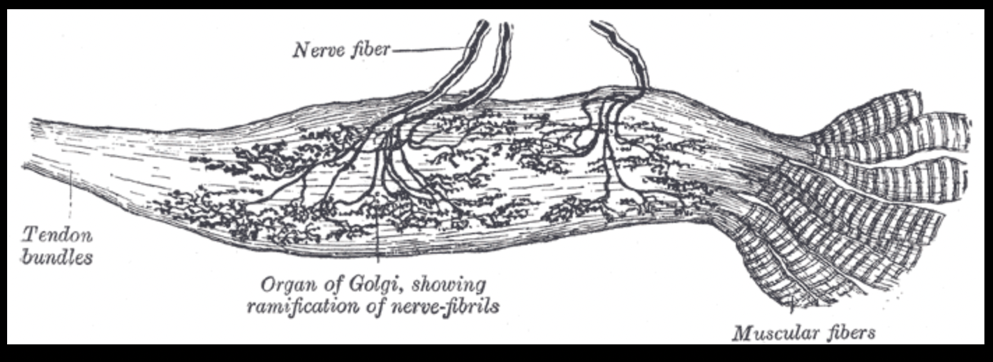
Illustration of the Organ of Golgi, showing ramification of nerve-fibrils, tendon bundles, and muscular fibers. From Gray’s Anatomy, 20th ed. (London: Longmans, Green and Co., 1918), p. 1061. Public domain.
PROPRIOCEPTION: the data of depth sensibility / the ‘body’ of us as
Object which spontaneously or of its own order
Produces experience of, ‘depth’ Viz
SENSIBILITY WITHIN THE ORGANISM
BY MOVEMENT OF ITS OWN TISSUES (Lines 15-19)
Olson’s essay crosses disciplinary bounds by offering a technique for consciousness that includes cognition, the ego, and sensation. Such is the poet who, over the course of his extensive career as state official, archaeologist, frontier pedagogue, and local historian, was also a student of movement. Proprioception, the essay—to me, a poem—presents a theory of knowledge that not only includes the body, but begins with it.
The advantage is to ‘place’ the thing, instead of
it wallowing around sort of outside, in the
THE ‘PLACE’ of universe, like, when the experience of it is intero-
OF THE ceptive: it is inside us/&… (Lines 33-36)
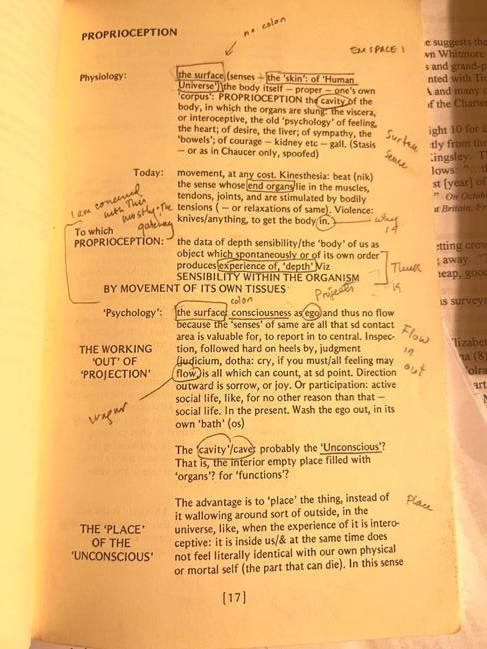
First Page of Proprioception with KTM notes
1975: Bluesuit
“THE PLACE” where I worked in 1975 was Frank Crowley’s Used Books on 4th and Bank Street in Greenwich Village. I had just graduated from Brooklyn College during Open Admissions. Everyone, including Vietnam veterans, was going back to school with tuition at $30 a year. My friend and comrade, Ammiel Alcalay,[8] who also worked at the bookstore, gave me Charles Olson’s poem, Proprioception.[9] For me as a dancer, this was a gift of great import; especially so, with Alcalay’s childhood memories of Olson in Gloucester, Ma., where his artistic family spent their summers.
One morning, I came with bookstore keys to open up and Robert Duncan was sitting in front of the shop on a metal folding-chair he had borrowed from the laundromat next door. I remember his body as he walked around the one-room space, looking at the books on the shelves. He wore a very dapper blue suit, which would become the inspiration for a dance I made at Gloucester Writers Center & The Maud/Olson Library.[10] I called it Bluesuit (2010) and wore one. I put Ammiel atop a tall ladder as orator of words from Proprioception. Over the years, I have dog-eared Proprioception and used it as a kind of ‘primer.’
2010: “the body is a house”
It is 2010, 35 years after my first encounter with Proprioception. Alcalay and I are searching in Olson’s archives at Storrs-University of Connecticut for Alcalay’s generous, and collaborative “chapbook” project: Lost & Found: C.U.N.Y. Poetics Document Series.[11] As our literary conspiracies continued, with myself as consulting editor, we experienced a shining moment, one that can happen in the archives—coming across something so significant, you cannot believe it wasn’t providence: four type-written pages entitled, The Body is A House (written in 1955), unpublished.
Inside the body is a thing as vast and as difficult to experience as the universe. But it has this advantage that it is inside. It can be experienced directly.[12]
This consideration of experience and directness continues to be, for me, the subject of an entire field of study—Somatics—that subsumes all movement arts and sciences ranging from kinesiology to sports and from choreographic techniques to movement therapy. I have come to understand that Olson’s encyclopedic dives into various kinds of knowledge always included the body. Had Olson lived past 1970, he would have recognized new comrades who were inhabiting the post-modern performance work and embodiment explorations.
One in particular, the founder of Contact Improvisation, Steve Paxton (1939-2024), invented the practice called The Small Dance.[13] In clear anatomical language, he invites the mover to sense the places in the body that are continuously moving while “standing” in one place. The essence of proprioception is understood in Paxton’s memorable line, “Dancers must hack their basic movement programs in order to adapt to new movements.”[14] Another way of saying this is, “a dancers’ job is to hack gravity.” Paxton would agree with Olson that proprioception is an act of deep subjectivity, where thinking occupies the whole body. Conversely, moving occupies the whole mind.
The body itself—consciousness (line 81)
1986: “movement changes the mind”
In 1986, with a Masters in Cultural History, I dropped out of the PhD-track in history to work with dance-scholar, movement therapist, and embryologist, Bonnie Bainbridge Cohen at the School of Body-Mind Centering® founded in 1973. For seven years, I was in full-investigative mode conducting “proprioception” of the body systems (bone, muscle, organ, nervous system, circulatory, endocrine, and embryology) as well as the study of the basic neurological patterns—rolling, crawling, creeping, climbing, walking, running, and jumping. During this time, I rented Lee Nagrin’s Silver Whale Gallery as my studio space, at 21 Bleecker Street, to work through a habit of moving and writing that would stretch both standard practices. This work—the body-studies and the studio-time eventually turned into a pedagogy for performance-making. Bainbridge-Cohen has said:
Movement changes the mind,[15]
which, on a thinking body, produces a feedback loop of sensing, feeling, and action[16] that doesn’t prejudice the format or the product of the expression. Both Olson and Cohen considered this, nearly in the same decade, how the moving experience runs tandem with its own narrative. Another unpublished fragment from Olson’s cache illuminates:
Exactness is/movement experienced/
instantaneously narrative is/substantive time spent
thereafter the arrival/is the/eternal.[17]
1930-1965: A Chronology
The still unpublished “Body is A House” (1955) was written during Olson’s time at Black Mountain College, after Projective Verse (1950) and alongside the Maximus poems, which were first published in small presses and later released in three volumes (1960, 1968, 1975). It was not until Olson’s tenure at University of New York, Buffalo, and subsequently, 24 Fort Square, Gloucester, Ma., that he began to fashion Proprioception (published in 1965). These works trace back to an earlier episode in the artist’s career, harking back to the late 1930s, when his 6’7” body studied with Leonide Massine of the Ballet Russe. Olson was given a company contract and performance experience at the Boston Opera House, where he wore a surrealist costume by Chanel in the Bacchanale. Karlien van den Beukel makes note of “the poet’s own formative experiences” that became “central to the dance philosophy in [Olson’s original dance play] Apollonius of Tyana (1951).[18] Later, at Black Mountain College, Olson’s energetic collaborations with dancer/choreographer Katherine Litz, composer Lou Harrison, and artist Ben Shahn in The Glyph (1950-1) are just an example of “substantive time spent,” (to echo the above hand-written note) inside of, and across, multiple disciplines.
“The Body is A House” follows after Olson’s “composition by field” (1950)[19] challenging traditional poetic methods by using active, corporeal terminology to describe the process of writing being “projective” as an energy that travels out to the reader. He called it “the kinetics of the thing.”[20] Thus “projective” is not only mobile, but respiratory as the “line” travels across space and between bodies that breathe words.[21] Bainbridge Cohen would support this:
Visualization, somatization, and embodiment are just words to explore a process. Visualization is about the frontal lobe imaging. Somatization is about feeling it. Embodiment is when you no longer feel it, you just are it.[22]
This is how I understand what it means to be “one with our skin.” In other words Olson’s:
…Data of Depth Sensibility. (Line 15)
1916: The Bureau of Educational Experiments
Seventeen years prior to the founding of Black Mountain College (1933) Lucy Sprague Mitchell founded The Bureau of Educational Experiments (BEE) in 1916, New York City.[23] Upwards of 25 progressive schools joined the BEE across the U.S. to explore a new kind of elementary education with progressive ideals for a democratic community. Interestingly, at the forefront was a group of movers in Physical Ed Departments across the country. One, in particular, Hunter College (founded 1888 as a Normal School, re-named in 1914) was designed to prepare women for teaching careers. My grandmother entered the Phys. Ed. Dept. in 1914. In addition to anatomy/physiology, athletics, and postural health, she took a course called “Natural Activities,”[24] which included non-technical, expressive moving to music.
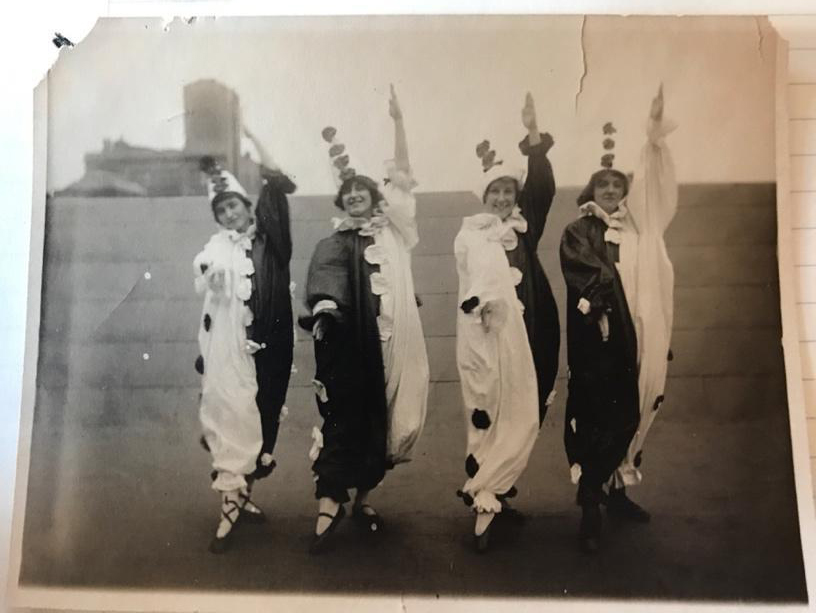
Physical Education Students on the roof of Hunter College, NYC, 1914 ©2026. The Author’s grandmother, Eva Tarlow Zuckerman (far left). E.T., Zuckerman Private Collection
In the first decade of the 20th century, Progressive educator John Dewey moved from his Laboratory School in Chicago, Ill., and settled at Teachers College/Columbia University as chairman of the Philosophy Department,1904-30. Progressive ideas spread like wildfire across many disciplines and practices, producing a new kind of teaching called “the informal method,” and based on four points:
- Education is a Development
- Learning is a Process
- There is the Worth of the Individual Person
- Flexibility of Procedure – The ability to shift to needs, desires and differences.[25]
John Dewey’s influence in American education for more than 120 years is distinct. His keen insights into the importance of the body in the house-of-learning rephrased Jean-Jacques Rousseau’s vigorous platform against 18th century educational practices and put them to use in the Progressive Era. The goal was “natural” development[26] including those “Natural Activities” as such, and according to these three values:
- Health and Vigor.
- Physical Mobility
- Regard for Individual Differences
1914-1919: City and Country School and The Motor Life
One of Dewey’s students was educator and carpenter Caroline Pratt who chose Greenwich Village—at the time, a diverse, multi-class neighborhood, with affordable housing for the American avant-garde—to start an elementary school in 1914 that she called The Play School. By 1919, with an increase in attendance, her students re-named the school: City and Country School (C&C).
Pratt’s school was one of the first to affiliate with the BEE. With Mitchell’s financial support, she fashioned a “physio-geography” of indoor/outdoor spaces where the activities of a working city were modeled within the school: a post office, a sign painting studio, a printing shop, a newspaper and rooms designated only for wooden block cities. Her invention was called The Jobs Program and previewed what was to become a guiding principle at Black Mountain College: living, learning, working. In 1940, Dewey writes a letter to BMC co-founder Theodore Dreier:
I hope, earnestly, that your efforts to get adequate support for Black Mountain College will be successful. The work and life of the College (and it is impossible in its case to separate the two) is a living example of democracy in action.[27]
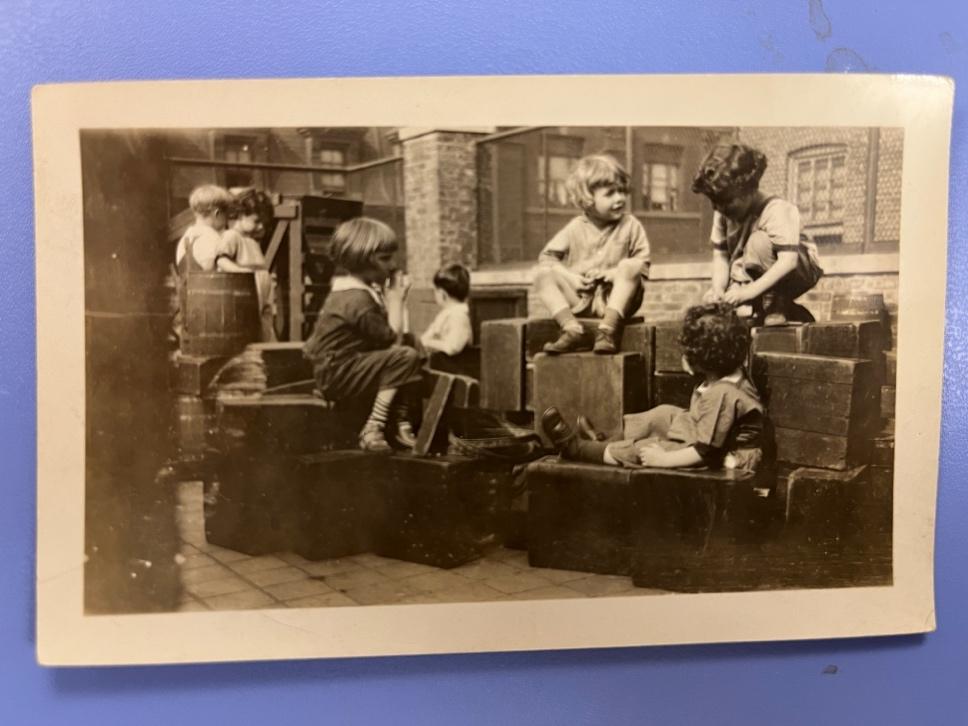
Photo: from City and Country School Archives, 1928, children on the Roof Yard with large outdoor wooden Blocks designed by Dr. Milton Levine based on Caroline Pratt’s indoor Unit Blocks.
Today, more than 110 years later, children aged 3-13 still traverse up and down 8 staircases, and through passageways and yards connecting four buildings. The entire plant remains, making not-moving impossible. In Pratt’s own words: “for children to have a thoroughgoing motor life.”[28] Integral to Pratt’s progressive experiment in the motor life was Rhythms that still happens in a large empty room, with a grand-piano, Swedish wooden bars for climbing, and an absolute rule of “shoes off.” This was where Ruth Doing, purveyor of Natural Activities, and founder of the School for Rhythmic Education, would teach all children at the school, including my mother.[29]
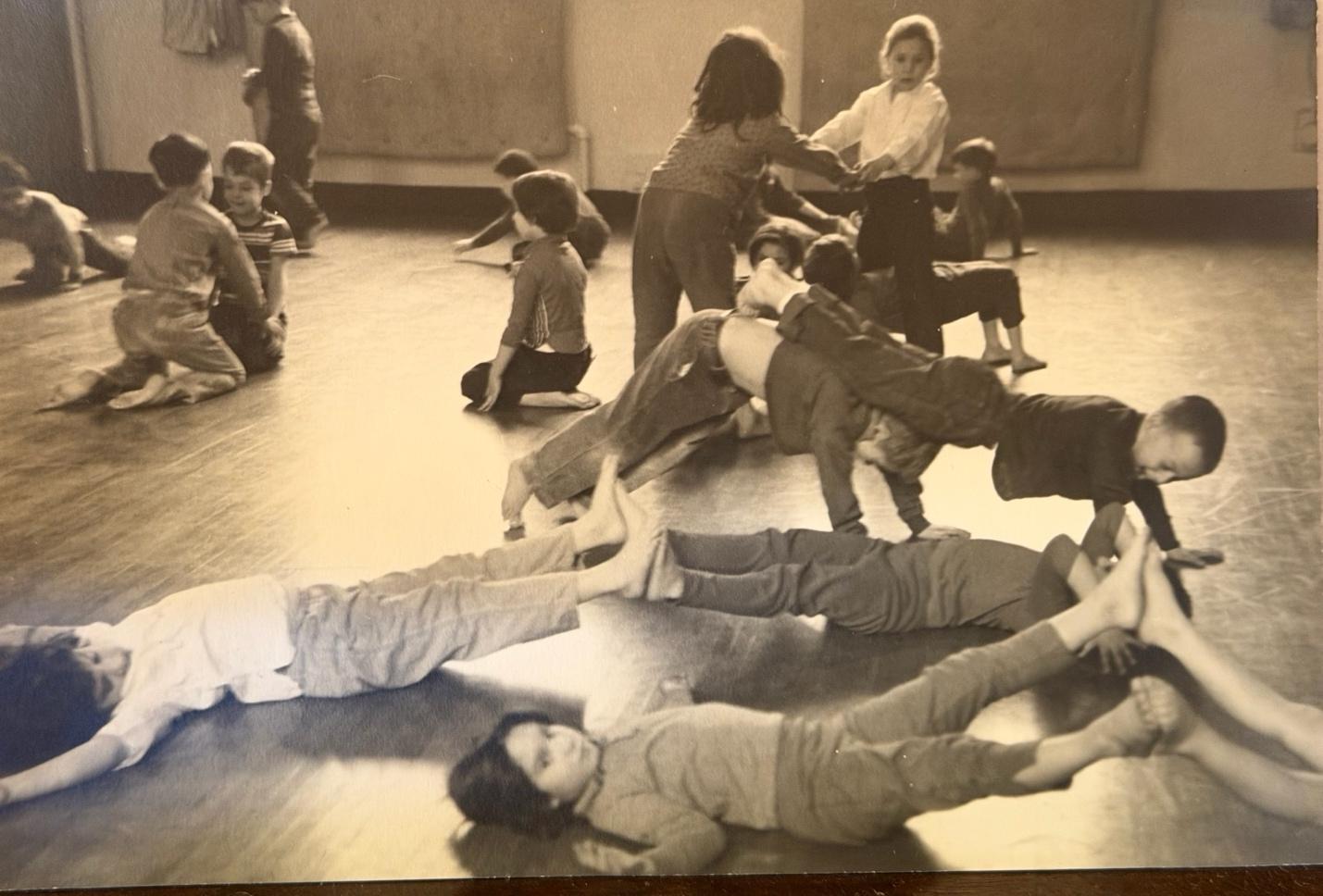
City and Country School, Rhythms Class, Brooklyn Bridge Curriculum, 1963. Photo from the author’s Second Grade class. The author kneels alone, at center of photo. Private Collection.
I was also a Rhythms kid at City and Country School (see picture above, kneeling at center of photo). Classes began with little direction, as the children ran in with bare feet, each body finding its own relationship to pulse, phrase, gravity, and other bodies. Eventually, spontaneous somatic investigations would unfold from one or two words of the teacher’s prompts. The idea is to leave the child alone because as a teacher you have provided the environment for the work to be done. In Doing’s words:
We cannot start with a regimented curriculum and hope to work backwards to spontaneous invention…The child’s job is to initiate the activity, attack his media, and develop his techniques as he proceeds, and the teacher’s job is to preserve that atmosphere of detached absorption within which creative effort flourishes and becomes operative. [30]
Olson’s statement during the faculty meeting in 1951 carries a similar tone and moral commitment to this heritage.
The state of the usual American education is not admitting that the individual is more complex than any curriculum. [And for that reason,] students came here [to BMC] because they are interested in knowledge, [not because of a] chronological order of studies…[31]
As a young artist, first reading Proprioception and learning about Black Mountain College, it was impossible for me not to equate my elementary school with Black Mountain College. Those ideas were spreading back then, fueled by a heritage of ideas—practical philosophy, child development, democratic communities, and social responsibility. Two schools: Caroline Pratt’s passionate educational mission and Charles Olson’s last-ditch-effort to preserve a vision in a decentralized form. Both educators working from a rigorous epistemology based on process and action, inside of schools that breathe. Thus, Olson’s 1954 Plan was, precisely, to survive the Idea of Black Mountain College, just not necessarily the Place.
I was born in 1954. My place was City and Country School. And, I became a Rhythms teacher after I discovered Proprioception, by Charles Olson.
2026: A Heritage of Ideas
The phrase “a heritage of ideas” comes from a passage in John Dewey’s lesser-known treatise, “A Common Faith,” (1934). It goes like this:
Ours is the responsibility of conserving, transmitting, rectifying and expanding the heritage of values we have received that those who come after us may receive it more solid and secure, more widely accessible and more generously shared than we have received it. Here are all the elements for a religious faith that shall not be confined to sect, class, or race. Such a faith has always been implicitly the common faith of mankind. It remains to make it explicit and militant.[32]
These resonances between Dewey’s moral imperative and Olson’s passionate commitment to Black Mountain College are palpable.[33] So too is the relationship between those 18th century beliefs—“the vital sense”—and the radical, yet nuanced practices at a school with barefoot moving and block-building children. Olson’s mid-century essay (1965) was a truly powerful aftermath from his 1954 plans for a dream-institute that might spread itself across the country! Could it be that the Informal Method of those early educators has somehow infused our past just enough for us to re-use it?
Our antecedents belong to us. They lie beneath the Opercula.[34]
This would mean that I recognize both Olson and Bainbridge-Cohen as die-hard Progressives. Two moving scholars, in their refusal to dictate or govern, would rather fertilize and invest, while picking up those fragments of an original revolution: of what is fundamental to the humanistic drive for “a thoroughgoing motor life.”[35] To “make explicit and militant”[36] the demand for vibrant, interdisciplinary study of ‘self,’ of ‘place,’ and of the ‘people’ who compose in the Field by:
The universe flowing in
Inside (Lines 87-88)
[1] Murray, Molly. “Dance and Poetry in the Collaborative Communities of the Post-War American Avant-Garde: The New York School, Black Mountain College and the Judson Dance Theatre.” PhD diss., University of Sheffield, (2015: 48).
[2] Helen Molesworth, “Imaginary Landscape,” Leap Before You Look: Black Mountain College, 1933-1957, ed. Helen Molesworth (New Haven: Yale University Press, 2015), 51.
[3] Ehlers, Sarah. “A Plan for Black Mountain College.” Aydelotte Foundation, Swarthmore College (2022). https://aydelotte.swarthmore.edu/publications/a-plan-for-black-mountain-college/
[4] Author located map at Storrs-University of Connecticut.
[5] Olson’s statements on the matter in “Minutes of a Meeting of the Black Mountain College Faculty, 1951”, Olson: The Journal of the Charles Olson Archives 2 (Fall 1974)
[6] Starobinski, Jean. “The Natural and Literary History of Bodily Sensation.” In Fragments for the History of the Human Body, Part Two, edited by Michel Feher, Ramona Naddaff, and Nadia Tazi. New York: Zone, 1989, p. 355.
[7] Dewey, John. A Common Faith. New Haven: Yale University Press, 1934.
[8] Ammiel Alcalay’s works include: cairo notebooks (1993); After Jews and Arabs (1995); from the warring factions (2002); Scrapmetal (2007); A little History (2011); Neither Wit, nor Gold (2013); A Bibliography (2020); Controlled Demolition (2025); Follow the Person (2026).
[9] Olson, Charles. Proprioception. San Francisco: Four Seasons Foundation, 1965.
[10] Gloucester Writers Center & Maud/Olson Library, Gloucester, MA. Founded 2010 in the home of Gloucester poet Vincent Ferrini.
[11] Lost & Found: The CUNY Poetics Document Initiative has, since 2010, matched CUNY scholars with archives of known and unknown writers and artists of the 20th century. https://lostfoundpoetics.commons.gc.cuny.edu/
[12] Olson, Charles. “The Body is a House.” Unpublished essay, 1955, p. 2. Charles Olson Papers. Thomas J. Dodd Research Center, University of Connecticut Libraries, Storrs.
[13] Paxton, Steve. “The Small Dance” (audio recording, 5:41). SoundCloud. https://soundcloud.com/the-amam/audio-recording-of-steve-paxton-guiding-the-small-dance
[14] Paxton, Steve. Gravity. Burlington, VT: Contredance Editions, 2018.
[15] Author’s personal Teaching Notes, unpublished, from the School for Body-Mind Centering®, written by Bonnie Bainbridge Cohen.
[16] Cohen, Bonnie Bainbridge. Sensing, Feeling and Action: The Experiential Anatomy of Body-Mind Centering. Northampton, MA: Contact Editions, 1993.
[17] Olson, Charles. “Hand-Written Notes, Book #1.” N.d. Charles Olson Papers. Thomas J. Dodd Research Center, University of Connecticut Libraries, Storrs.
[18] van den Beukel, Karlien. “Why Olson Did Ballet.” In Contemporary Olson, edited by David Herd. Manchester: Manchester University Press, 2015, pp. 286–296. https://www.manchesterhive.com/display/9781526110794/9781526110794.00033.xml
[19] Olson, Charles. “Projective Verse.” Poetry New York, no. 3 (1950).
[20] Ibid.
[21] Sénac, Jean (1926–1973), Algerian-French poet, whose corpopoèmes explored the concept of corps total (total body) in the late 1960s and early 1970s. His notable publication from this period is Avant-corps (1968). Both Olson and Sénac were somatic writers well ahead of their time. Note: Sénac was assassinated in Algiers on August 30, 1973.
[22] Cohen, Bonnie Bainbridge. Class notes, School for Body-Mind Centering®, 1998.
[23] Mitchell founded the Bureau of Educational Experiments in New York in 1916, which later became Bank Street College of Education (1930).
[24] Eva Tarlow Zuckerman. College Transcript, Hunter College, 1920. Private Collection.
[25] Schwendener, Norma. A History of Physical Education in the United States. New York: A.S. Barnes and Company, 1942.
[26] Rousseau’s three factors in “educative development”: (a) good function of the organs, (b) the physical activity of these organs, and (c) their direct interaction with the environment. Dewey adapted these principles for the 20th century in Democracy and Education (1916) and related works.
[27] Fisher, Jonathan. “The Life and Work of an Institution of Progressive Education: Towards a History of Black Mountain College, 1933-49.” The Journal of Black Mountain College Studies Volume 6 (2014).
[28] Pratt, Caroline. Unpublished manuscript, 1935. City and Country School Archives, NYC.
[29] Ruth Doing taught Rhythms at City and Country School from 1921–40. After her, Sylvia Miller taught from 1940–1972; Joan Z. Morgan [the author’s mother] from 1968–2001.
[30] Doing, Ruth. “Rhythmic Education.” Progressive Education (1927). Privately owned pamphlet.
[31] Olson, Charles. “Minutes of a Meeting of the Black Mountain College Faculty, 1951.” Olson: The Journal of the Charles Olson Archives 2 (Fall 1974), pp.20-21.
[32] Dewey, John. A Common Faith. New Haven: Yale University Press, 1934, p. 87.
[33]The connection between child labor law enforcement and rising school enrollment is well-documented. In New York City between 1910 and 1920, the school-age population grew from approximately 6,000 to 20,000. (The Rhythms Book, by KT Morgan, in publication, 2026)
[34] As part of the 18th century discoveries: the opercula is the innermost part of the brain that calibrates the inner landscape with the outside world. (see Dr. Reil-Proprioception section)
[35] Pratt, Caroline. Ibid.
[36] Dewey, John. Ibid. see Footnote #38.
Kate Tarlow Morgan, New York City–born dancer, writer, and urban archaeologist, has lived in rural New England since 1998. Her interest in local place was jumpstarted at twenty by Gloucester poet Charles Olson’s A Special View of History. Her book Circles and Boundaries (Factory School Press, 2011) is her own “special view” of New York City. Her ten-year research and performance project “Red Train/Blue Brain,” about the NYC subway 1991-2001), and her re-enactment of New England’s mining industry, “Walking in the Water” (2006), are direct products of the “Dogtown” technique, as are her later works “The Proprioception Panel,” “Bluesuit,” “Invisible Stories,” and “An Evening with Monsieur Teste,” produced at the Gloucester Writers Center and MAGMA.Center. For more than two decades Morgan was editor-in-chief of Currents Journal for the Body-Mind Centering Association and an editorial consultant for Lost & Found: CUNY Poetics Document Initiative. Currently, as sole archivist of The Rhythms Fundamentals, a body of work based on the study of human and animal movement, she is writing a 100-year history of the hotbed of somatic educators in New York City who took part in the radical reforms of the Progressive Era.
Cite this article
Morgan, Kate Tarlow. “because ‘Proprioception.’” Journal of Black Mountain College Studies 17 (2026). https://www.blackmountaincollege.org/journal/volume-17/morgan/.