

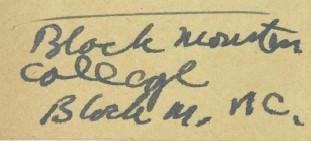
Langston Hughes’s handwritten memo to himself reads “Black Mountain College, Black Mt NC.”, Yale University, Beinecke Rare Book and Manuscript Library, James Weldon Johnson Collection, Langston Hughes Papers Box 15, Folder 343.
In 1949, Black History Month lasted only a week. During that week, poet Langston Hughes spoke to 600 people in Winston-Salem, met a sixteen-year-old Eunice Waymon (later known as Nina Simone) in Asheville, and then continued by train to Wilson, NC, where G.K. Butterfield, Sr. drove him into town. Hughes then headlined a poetry reading in Washington, D.C. and, before arriving back at his home in Harlem, ended his arduous week as the keynote speaker at the nation’s largest Black History Week gathering in Boston (a three-day event). In between these five stops, he gave a sixth previously unknown talk during an overlooked visit: on Monday, February 7, 1949, Langston Hughes stayed overnight at Black Mountain College.[1] To fulfill a packed program of engagements in each of these six cities (over a mere eight days), Hughes would cover a staggering 1,808 miles by train.[2] Most of the travel occurred overnight so that Hughes could speak and preside at multiple events each day.
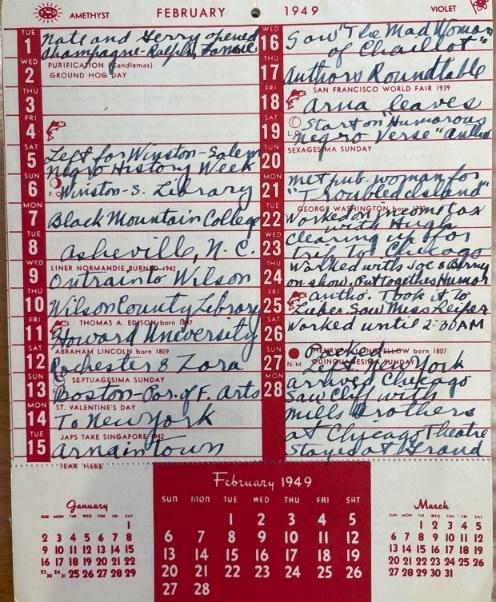
Langston Hughes’s personal calendar for February 5-9, 1949, shows his visits through North Carolina (by train from New York) to Winston-Salem, Black Mountain College, Asheville, and Wilson, before headlining events in Washington, D.C., and Boston. Yale University, Beinecke Rare Book and Manuscript Library, James Weldon Johnson Collection, Langston Hughes Papers, Box 489, Folder 12420.
High schools, libraries, and colleges across America were observing “Negro History Week” in 1949. Started by Black historian Carter G. Woodson twenty-three years earlier, the event had now gained traction in post-WWII America. To honor two key figures, Woodson deliberately selected the week of February that spanned the birthdays of both Fredrick Douglass and Abraham Lincoln. The seven-day window slowly expanded into a month-long celebration in the late 1960s, but it was not fully recognized as such until the bicentennial year of 1976.[3]
Between 1944-49, Black Mountain College attracted at least eleven Black students, employed five Black faculty, and hosted several other brown and beige guests. As early as 1943, Josef Albers himself delivered a lecture on Egyptian and African sculpture in his earnest effort to commemorate “Negro History Week.” [4]
Hughes recognized the popularity of “Negro History Week” and sought out growing literary and cultural centers such as North Carolina as ideal places to both reach his audience and launch new publications. After all, he had been in the state several times before, including six years earlier, when Raleigh librarian Mollie Huston Lee invited him to speak at her own Richard B. Harrison Library on December 1, 1943.[5]
Winston-Salem
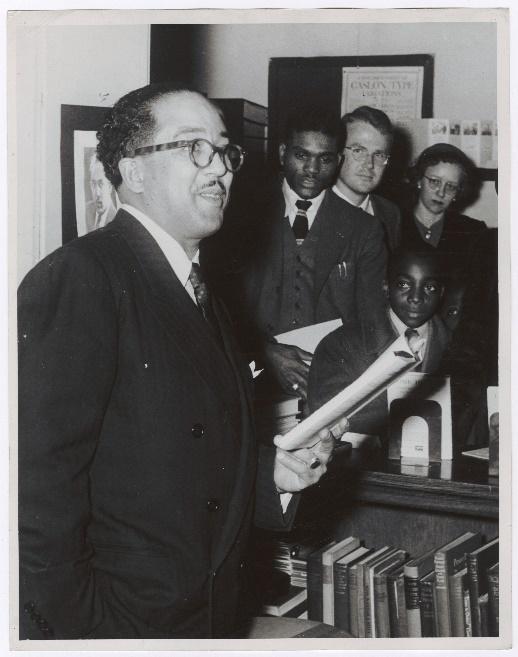
Langston Hughes reading from One-Way Ticket during one of the five relays set up to accommodate the 600 people who showed up for the event in Winston-Salem, NC, on February 6, 1949, Yale University, Beinecke Rare Book and Manuscript Library, James Weldon Johnson Collection, Langston Hughes Papers Box 489, Folder 12419.
Why BMC? One-Way Ticket
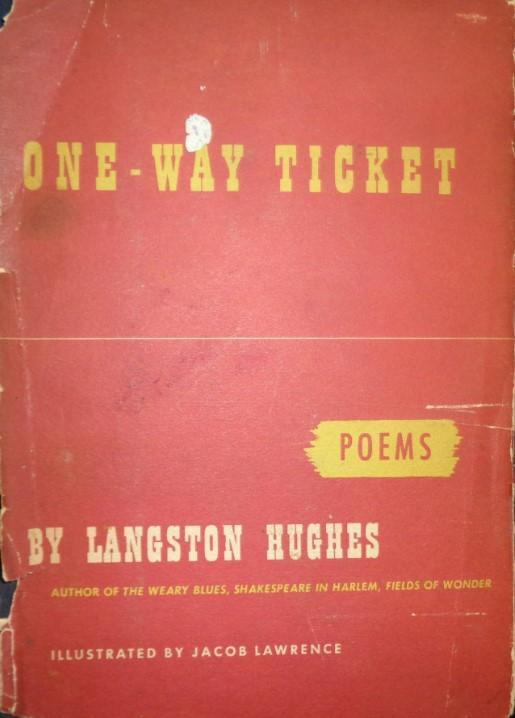
First edition dust jacket of Langston Hughes’s book of poems One-Way Ticket featuring illustrations by Jacob Lawrence (1949).
Hughes learned about the campus from both singer Carol Brice, a Black woman contralto who taught at the Summer Music Institutes in both 1945 and 1947, and Roland Hayes, who spent the first week of August of 1945 on campus.[7] Drawing over 300 community members from around Buncombe County, Hayes’s integrated concert on August 4 of 1945 (with Reginald Boardman accompanying him on piano) may have been the single-largest community event held in the college’s history.[8]
Before coming, Hughes also spoke to painter Jacob Lawrence.[9] Lawrence had been personally invited to the college’s third annual Summer Institute. Though he enjoyed every aspect of life at Black Mountain College from July 2 through August 28, 1946, neither he nor his wife Gwendolyn Knight ever left the campus. They were fully aware they were in the deep South. As Knight recalled: “I certainly knew that I was not going to go anywhere but to that campus. Which is what happened. We never left that campus to go into Black Mountain or into Asheville.” [10]
Jacob Lawrence illustrated Hughes’s current book of poetry. Its title, One-Way Ticket, was inspired in part by Lawrence’s The Migration Series, a series of 60 tempura paintings on wood completed by Lawrence in 1941.
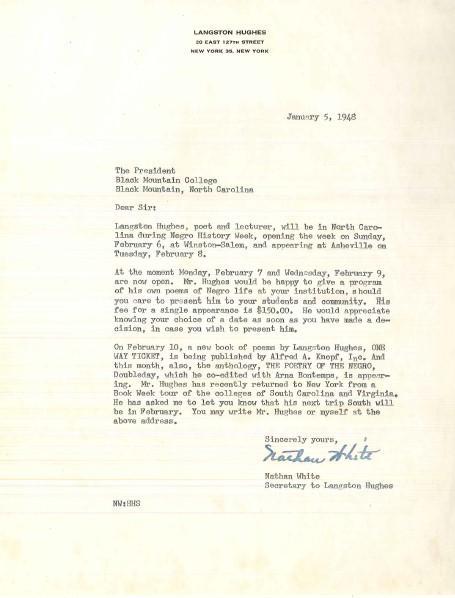
Nathan White’s initial (but misdated) letter of interest to Black Mountain College, January 5, 1949, Western Regional Archives, State Archives of North Carolina, DC 1956.50 General Correspondence, Dreier, Black Mountain College, Hughes, Langston, 1948-49.
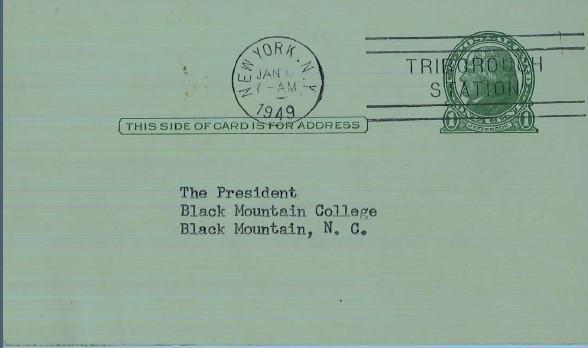
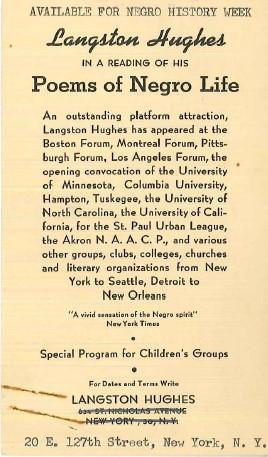
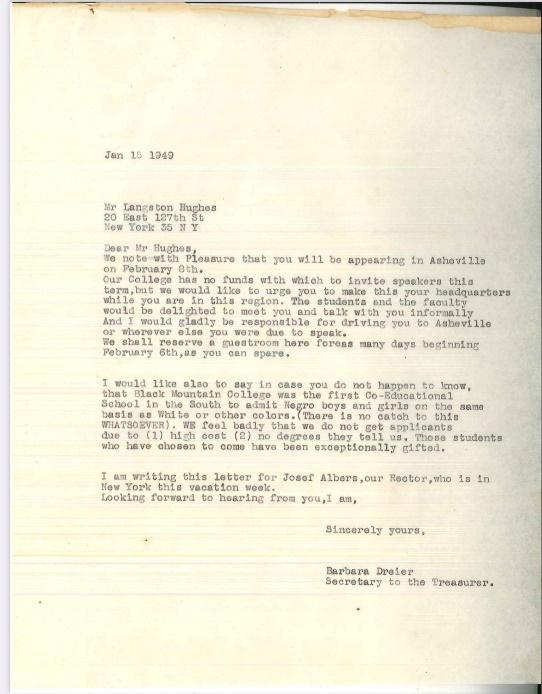
January 15, 1949, letter from Barbara Dreier to Langston Hughes announcing plans to house Hughes on campus and drive him to Asheville. Western Regional Archives, State Archives of North Carolina, DC 1956.50 General Correspondence, Dreier, Black Mountain College, Hughes, Langston, 1948-49.
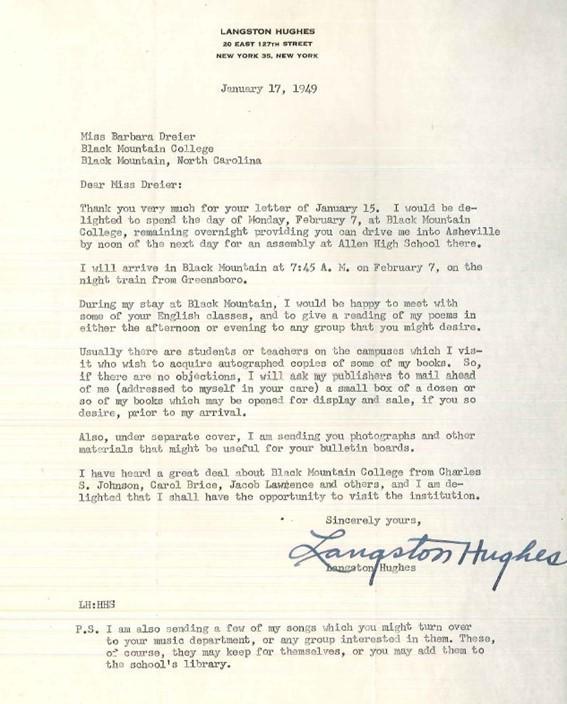
January 17, 1949, letter from Langston Hughes to Babara Dreier confirming materials he is sending (including a few original songs) in advance of his upcoming visit to Black Mountain College on February 7, 1949. Western Regional Archives, State Archives of North Carolina, DC 1956.50 General Correspondence, Dreier, Black Mountain College, Hughes, Langston, 1948-49.
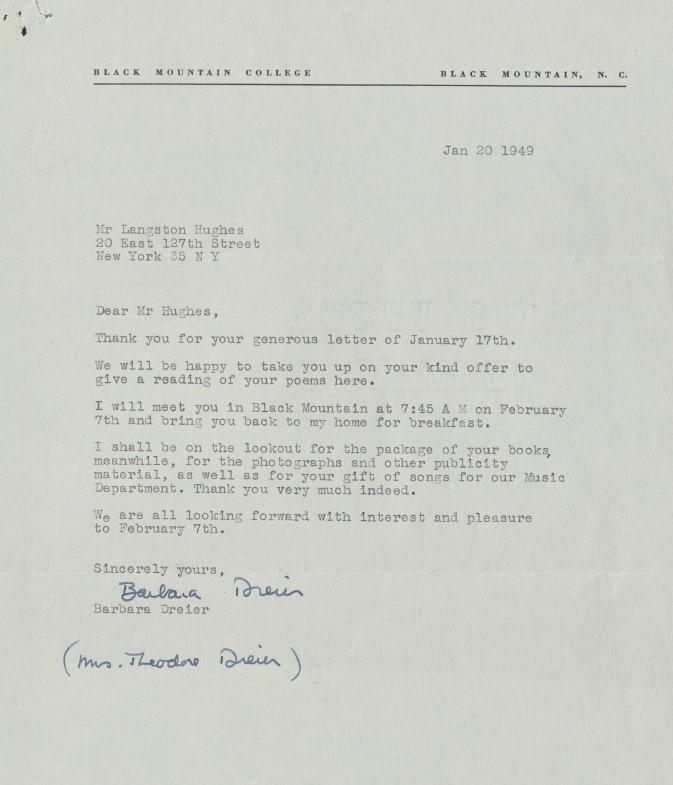
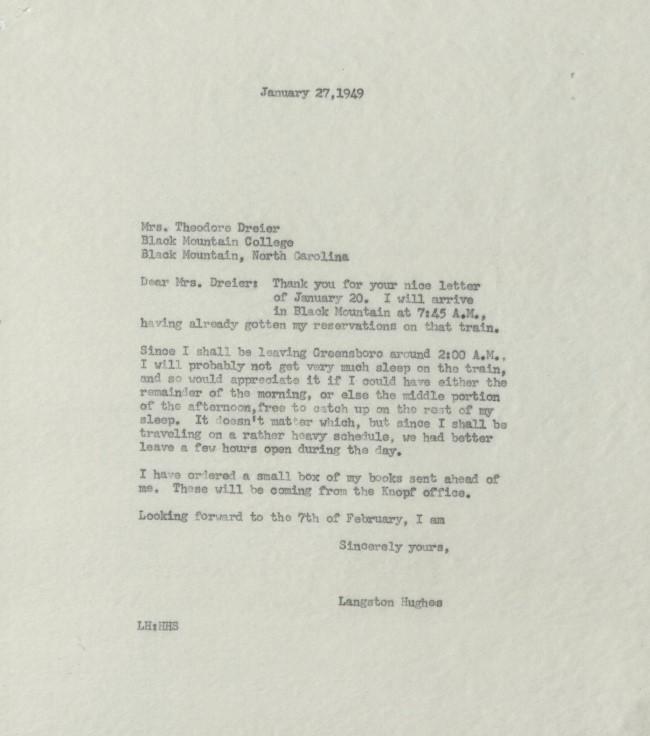
Around January 17, 1949, either Hughes or White also sent brochures to Black Mountain College reminding them that he was worth inviting. One brochure informed campus readers that his works had been translated into eight languages. Another named Hughes “the poet laureate of the Negro race in America.” Hughes’s current interest in popular music was evident as the flier announced that the “Internationally Known Negro Poet” has had his songs both sung by Roland Hayes and featured in performances by Duke Ellignton.[13]
With Director Ted Dreier away at the moment this missive arrived, Barbara Dreier responded diligently in her roles as both Secretary to the Treasurer and the most accomplished advocate for the college. She responded to Hughes’s standard stipend request of $150 [about $1,800 in 2026] with a counteroffer: would Hughes instead accept free room and board for as long as he wished to stay and make the college his “headquarters?”[14]
He agreed. With that, a tired Langston Hughes was on his way to Black Mountain College.
Train

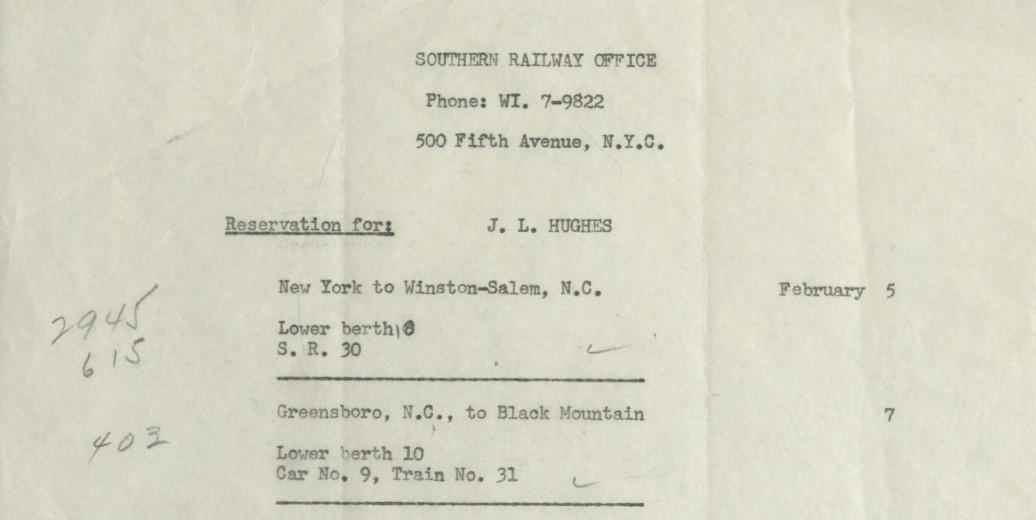
Hughes’s personal itineraries for traveling through North Carolina during Negro History Week in 1949,Yale University, Beinecke Rare Book and Manuscript Library, James Weldon Johnson Collection, Langston Hughes Papers, Box 480, Folder 12048.
Hughes wrote of this trip: “It always seemed like a miracle to me that ticket sellers, even in the north, never fail to sell Negros the end berths on Pullman cars, even when the births are ordered by phone. How they can always tell over the phone that one is colored— and give you Lower 2— is beyond me. But they do.”[16] Meticulous, Hughes noted that Car NO. 9 (and train #31) delivered him through Greensboro via the Southern Railway.[17]
Barbara, known affectionately as “Bobbie,” worked hand in hand with her husband Theodore Dreier, who was a Harvard trained engineer formerly employed at GE. As one of two original co-founders of the college itself, Ted and his family were now under immense stress. Ted had been forced to resign days before. He would officially resign eleven days after Hughes’s visit, but he and his wife were remaining until interim director N.O. Pittenger’s expected arrival in April.[19]
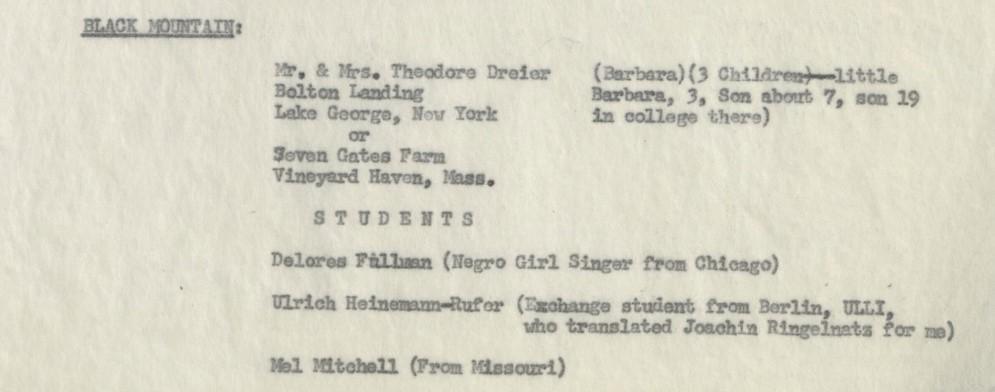
Hughes’s personal typed notes made after visiting Black Mountain College during Negro History Week in 1949. Yale University, Beinecke Rare Book and Manuscript Library, James Weldon Johnson Collection, Langston Hughes Papers, Box 480, Folder 12048.
Hughes unpacked the dozen books he had sent ahead of his arrival. Among the distinguished audience, art student Robert Rauschenberg likely would have attended. Commuting to campus only once every few weeks in the academic year 1948-49, it is unlikely poet Charles Olson was on hand during Hughes’s visit.[21]
Where Did Hughes Sleep?
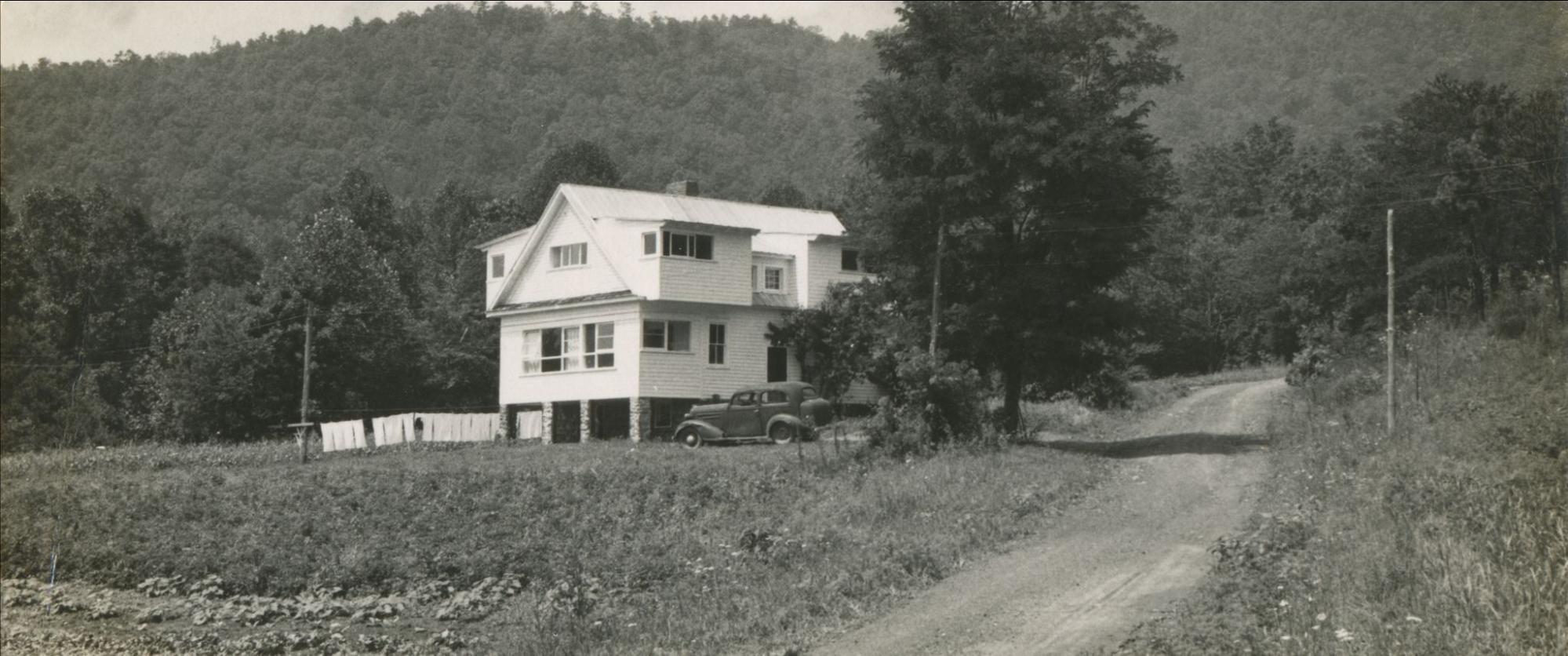
View of Farmhouse and Mountains at Black Mountain College. Photograph by Miriam (Mim) Sihvonen. Collection of Black Mountain College Museum + Arts Center. Gift of the Artist.
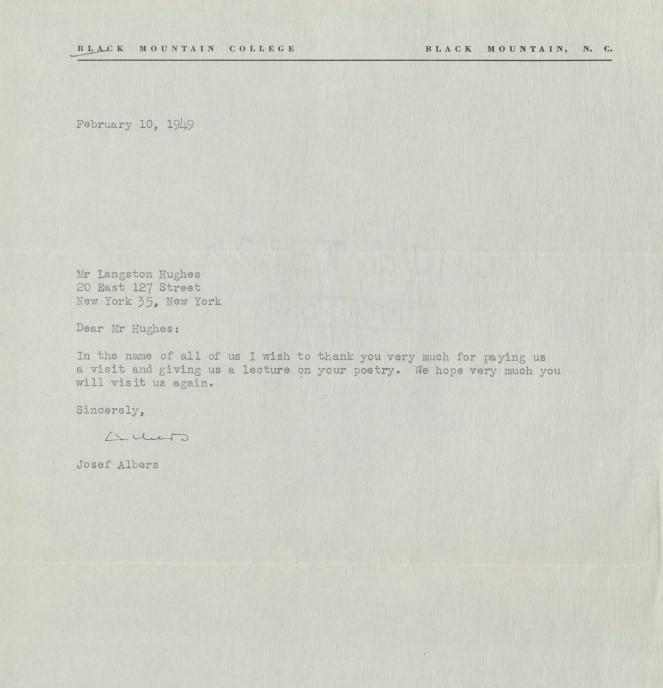
Three days after Hughes was on campus, Josef Albers officially thanked Hughes for “giving us a lecture on your poetry,” February 10, 1949, Yale University, Beinecke Rare Book and Manuscript Library, James Weldon Johnson Collection, Langston Hughes Papers, Box 15, Folder 343.
Three days after Hughes was on campus, Josef Albers officially thanked Hughes by letter. He wrote: “In the name of all of us I wish to thank you very much for paying us a visit and giving a lecture on your poetry.”[23] Given Josef Albers’s affinity for the performance lecture format, it is fascinating to imagine Hughes being asked to write, revise, or even “perform” a poem during his talk.[24] Albers had insisted that photographers Josef Breitenbach and Beaumont Newhall demonstrate their craft during separate lectures in the campus Dining Hall. Famously, John Cage was cajoled into doing the same, with a mock duel breaking out in the summer of 1948 after he declared (to the fury of Erwin Bodky) that “Beethoven was an error.”[25]
During his overnight visit, Hughes met Delores Fullman, the only Black student currently on campus. Hailing from Chicago, she likely performed a song as she was studying singing.
With the Dining Hall featuring its own piano, perhaps Hughes taught Delores Fullman to sing one of his songs. It is noteworthy that Hughes described her as “a delightfully jovial Negro girl from Chicago with a beautiful voice concentrating on music.”
Cornelia Williams would have been another possible musical contributor to Hughes’s impromptu program. Since joining the college as a cook in 1945, she had become a respected singer and pianist, all while serving as the Dean of Women’s Studies.
Improvisational and performative lectures were standard practice for a man already known internationally as the poet laureate of Harlem. His own multi-modal way of working between music, language, and the visual arts predicted the college’s approach to creativity would be a perfect fit for his aesthetic. In fact, for the very event Hughes was holding on the following day at Asheville’s Allen School, he told his host he could not even offer an official list of the poems he would read: “lecturing as much as I do, I don’t repeat the exact sequence every night since I do not wish to fall into a rut.”[26]
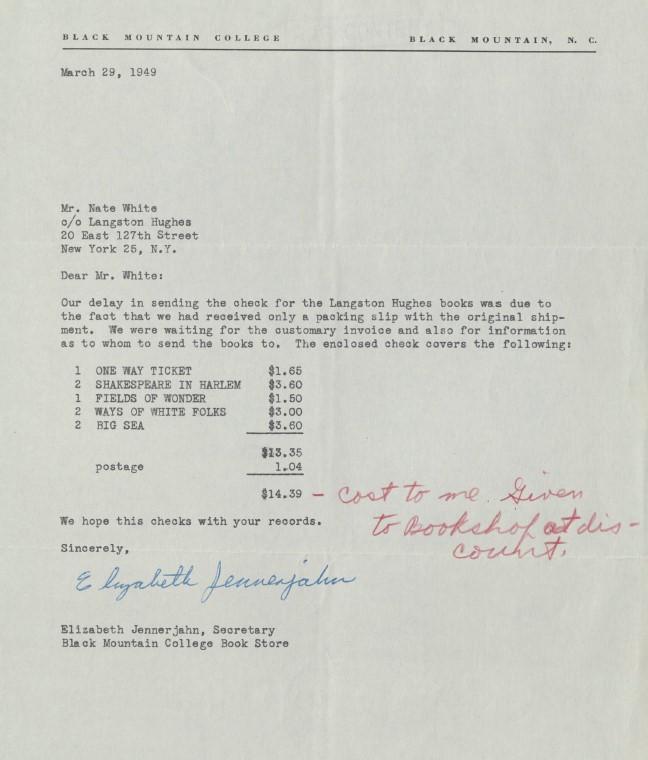
Elizabeth Jennerjahn’s March 29, 1949, letter to Hughes’s assistant Nate White with an enclosed check of $14.39 for payment on the books Langston Hughes sold while he was at Black Mountain College, Yale University, Beinecke Rare Book and Manuscript Library, Langston Hughes Papers, Box 15, Folder 343.
In addition to his newly published book of poems One-Way Ticket, Hughes also sent ahead “a few of my songs which you might turn over to your music department, or any group interested in them. These, of course, they may keep for themselves, or you can add them to the school’s library.”[31] With the college’s library being heavily pilfered during its last few years, none of Hughes’s donations have surfaced.[32]
Which songs did Hughes send?
Though he was a poet, Hughes also wrote in many other genres. No year found Hughes trying to publish his own original songs more than 1949.[33] By the end of the year, he would send out over sixty-one of his original lyrics to musicians such as Margaret Bonds. Father of the Blues W.C. Handy composed music for Hughes’s “Golden Brown Blues.” Broadway’s Kurt Weill used his songs throughout Street Scene (1947), and both Marian Andersen and Duke Ellington recorded Hughes’s lyrics as well. By 1960, forty-five of Hughes’s lyrics would be recorded by over a dozen different artists.
Burl Ives was recording Hughes’s song “Red Sun Blues” in the studio and performing it during his standard set at the Persian Room in New York’s Plaza Hotel throughout 1949.
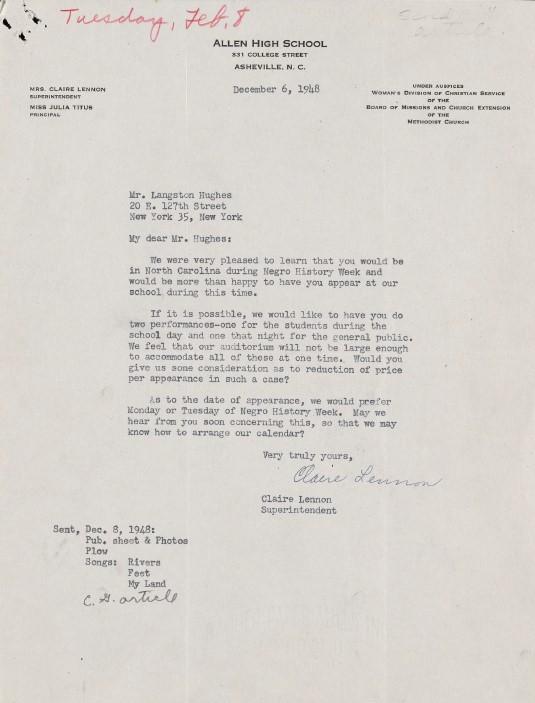
Langston Hughes’s copy of a letter from Allen School Superintendent Claire Lennon on January 5, 1949, lists three songs he sent in reply. “The Negro Speaks of Rivers” is a musical setting for Hughes’s most famous poem from 1921. It had even been recorded by Marian Anderson. “At the Feet of Jesus” is a spiritual song adapted from Hughes’s poem “Feet o’ Jesus” (1926), and “This is My Land” was first recorded in 1945. The songs (along with an article about Negro History Week by Carter G. Woodson and a chapbook of Hughes’s long poem “Freedom’s Plow”) are listed at the bottom of Hughes’s personal copy of the letter located at Yale University, Beinecke Rare Book and Manuscript Library, Langston Hughes Papers, Box 5, Folder 101.
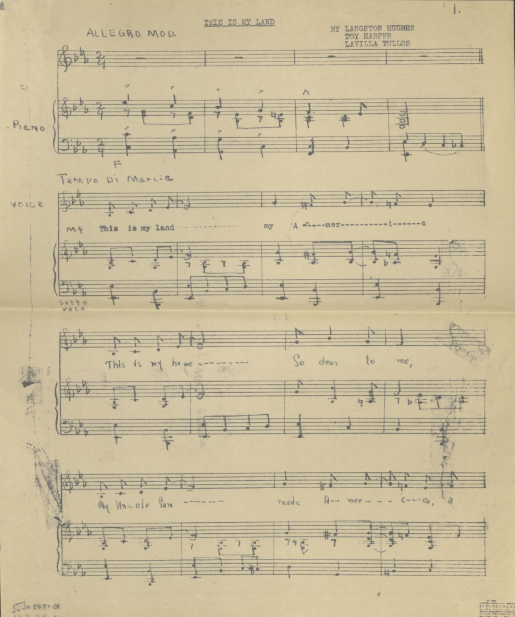
Music for Hughes’s song “This is My Land,” located at Yale University, Beinecke Rare Book and Manuscript Library, Langston Hughes Papers, Box 400, Folder 8009.
Hughes was so invested in having his lyrics recorded that six months later in August he organized a personal portfolio of music into eight separate files that contained eighty-five of his original lyrics. A different set of eight tunes went out to Dorothea Freitog in October, with the poet trying to cross his blues poetry back over into its original medium with titles such as “Lulu Blues,” “Grass Widow Blues,” “Sorry Blues,” “House Rent Blues,” and “Do You Blues.” The week before Thanksgiving, eighteen lyrics were handed to composer Albert Hauge for arranging and Dots Johnson received another nine tunes to choose from in March of 1950.
Hughes’s drive to hear his lyrics performed started organically when various musicians started recording several of his published poems. With Father of the Blues W.C. Handy composing music for his “Golden Brown Blues,” and both Marian Anderson and Duke Ellington turning his ink into wax, Hughes immediately jumped at the possibilities.
Hughes’s devotion to crafting song lyrics was intense. He studied three popular songs of the era by counting syllables, creating charts of rhymes, and adding measured dashes between words when typing out syncopations in delivery. His intricate study of Hoagy Carmichal’s “Georgia on My Mind” resulted in typed lyrics with long dashes in between “Geor—-gia” to capture the elongated delivery. He noted in a typed summary that the song lyrics presented only “5 very clear and simple thoughts” with the “Title line repeated twice” noting the “end of last 8 bars the same as first eight bars.” Focusing on the song “Blueberry Hill,” Hughes noted the rhyme scheme, alternating syllabic lines of “4 / 5 / 5 / 4,” then listed the alternating rhymes between “played” and “made” that are knitted together by “melody” and “be” in the bridge.[35]
Producing a document that is truly mesmerizing, typed tables, multiple colors, and a physicist-like-precision mark Hughes’s multipage study of “This is Worth Fighting For.” Hughes called this a “Conventional 32 bar chorus” that was made of a “conventional 16-line lyric, divided into 4 four-line verses . . . with the title line repeated three times— at the end of the 1st, 2nd, and 4th verses.” He seems to have been overly enamored by his seemingly irrelevant discovery that the three verses where the title resurfaces have “exactly the same metical and musical constriction.” Hughes hopelessly seemed to believe the blueprint for a great song was merely allowing it to decompress and rise at the right speed as one might engineer the design of a submarine.[36]
“Theme for English B”
If Hughes was asked to deliver a performance lecture on poetry rather than song, one tantalizing possibility emerges from considering which poem Hughes might have started to compose on command. With One-Way Ticket now published, Hughes was already working on what would become his canonical work. Montage of a Dream Deferred (1951), a work Hughes referenced the day before in Winston Salem as “a long book of poems about Harlem,” was in fact well under way by February of 1949.[37] The collection became an extension of One-Way Ticket by exploring what happens when someone buys that one-way ticket from the South and finally faces the reality of living in northern cities such as Harlem.
“Theme for English B” is a seminal poem among Hughes’s works. It stands as one of his most anthologized poems.[38] An instructor asks students in his English class to write an essay that truly reflects who they are as a person. As the only Black student in the class, the student’s response signals that he feels the responsibility to explain to his white instructor what it is to be Black in America.
The poem ends up being somewhat subversive. The instructor asks for an essay that speaks through narrative, but the student creates a poem that communicates through metaphor.
The poem turns on a dramatic metaphor that is easily overlooked. Both the instructor and the student need each other just as paper and ink can only communicate to readers when they are placed near their opposite. In this way, the two men are a part of each other just as Black words typed on white paper. The student concludes of such interdependence: “That’s American.”[39]
Though speculative, there are three legitimate reasons to consider if “Theme for English B” was written during Hughes’s travels through North Carolina in 1949. First, the poem opens by recounting the exact same train trip Hughes himself had taken through North Carolina on his way back to Harlem. “Theme for English B” imagines the speaker in the poem as a current student in New York City. As the only Black student in his English class, he has been asked by his white instructor to write a page that reflects his true character. Before ending up living in Harlem, we learn that the twenty-two-year-old student was “born in Winston-Salem.” He went to school there, “then Durham.”[40] These two direct references to North Carolina are markedly unusual for Hughes. In fact, nowhere else in all his poetry does Hughes name a single city in the state.
Moreover, Hughes’s own train journey has just taken him through each of these cities before he arrives at Black Mountain College. To say again, Hughes was literally passing through each of these two cities the day before he arrived in Black Mountain, NC.
As the only college he attended during his trip through North Carolina in 1949, the poem’s framework is an assignment a student at Black Mountain College could easily have been assigned in one of their English classes. Moreover, he met Delores Fullman, the only Black student at Black Mountain College.
Second, this 1949 poem has an unusual and incomplete documented history of creation. Hughes’s personal files (fully available at Yale University) invariably contain multiple drafts displaying the entire history of how they were written. As one rare exception, the file for “Theme for English B” contains nothing except the final typed version published in the journal Common Ground in 1949.[41] This evidence suggests the poem was likely written while Hughes was traveling far away from Harlem. Had he written it at his home, the drafts would have been saved. Something written while out on the road would likely be reduced to merely the typed version finalized from several handwritten drafts.
Third, and most dramatically, the published version of the poem features a drawing by Jacob Lawrence.[42] It is highly possible that Hughes returned from his trip to Black Mountain College and asked his friend if he would create an illustration for the poem initiated at a place they both now shared in common.
With this republication, the image Lawrence created is a newly unearthed treasure wholly unknown to exist. It is not listed in Lawernce’s catalogue raisonné.[43]
The image presents a confused student troubled by how to respond to his instructor’s writing assignment. He sits with books labeled “Anatomy,” “Math,” and “Biology” straddled between his stretched knees. Presumably from his anatomy class, the scattered pages resting in the foreground are diagrams of the human body. Ligaments, bones, and muscles are carefully labeled. However, none of these books or diagrams adequately explain how to address the subject of race. As something denoted by skin color, it neither adds up as an equation, is directly addressed by biology, and, most importantly, is fully bypassed by anatomical labels that overlook the significance of skin all together. The image captures a lonely student who has to write about being Black by pulling from personal experience rather than his expensive textbooks or formal schooling. He is all alone trying to complete this assignment.
Hughes’s train travel through Durham and Winston-Salem, the absence of drafts, and the inclusion of an image by Black Mountain College instructor Jacob Lawrance collectively point to the intriguing possibility that “Theme for English B” may have been created in response to Hughes’s time in North Carolina.
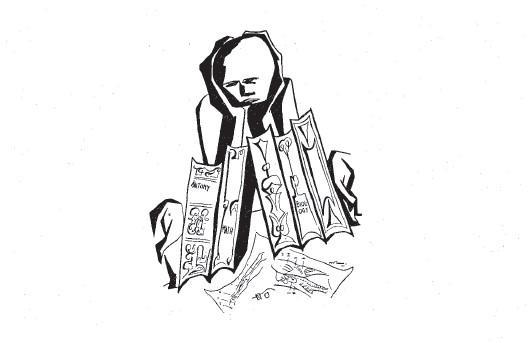
Original and previously unknown drawing by Jacob Lawrence “Student” that accompanied the first publication of Langston Hughes’s poem “Theme for English B” when it appeared in Common Ground in 1949.
Nina Simone
Hughes woke up on Tuesday, February 8, 1949, needing to arrive in Asheville, NC, by 1:30 PM for three separate events featuring him as speaker.[44] He could not know that his time at Asheville’s Allen High School would become the spark that began a pivotal mentoring relationship with singer Nina Simone. Without Bobbie Dreier, Langston Hughes would have never met sixteen-year-old Eunice Waymon— years before she changed her name to Nina Simone.
Hughes eventually established Nina Simone’s national reputation in 1960 and directly prompted her to take on the title The High Priestess of Soul by personally suggesting she sing one of his songs about casting spells. A full summary of their relationship can be found online in the digital humanities project Backlash- Blues.com and in the book Don’t Let Me Be Misunderstood: Nina Simone, Langston Hughes, and the Birth of Black Power (UNC Press 2026).
Nina Simone’s high school roommate vividly remembers her time with Nina. At age ninety, Mary Burnette told Lauren McKenzie (a graduate student I was mentoring) that Eunice woke at 5:30 a.m. to practice piano. Mary recalled that classmates were “a little jealous of Eunice because of her talent. But they couldn’t touch her: if they’d have practiced all night and all day, they couldn’t touch Eunice. She was just a tremendously gifted person.”[45]
At Glee Club events, Mary and her classmates sang while Eunice played: “We were inspired by her confidence and flawless performance at the piano. I assure you I was watching the pianist more closely than our director.”[46]
How good was Eunice? Mary asserted, “I believe she could have played ‘Moonlight Sonata’ blindfolded.” One Sunday visit to a country church was particularly memorable. With Eunice playing a piece by Bach, her classmates noticed the floor beneath her upright piano was warped. Noting her undeniable force and energy, the church hostess declared: “that girl’s a-gonna turn that piano over on herself!”[47]
Chicago Defender
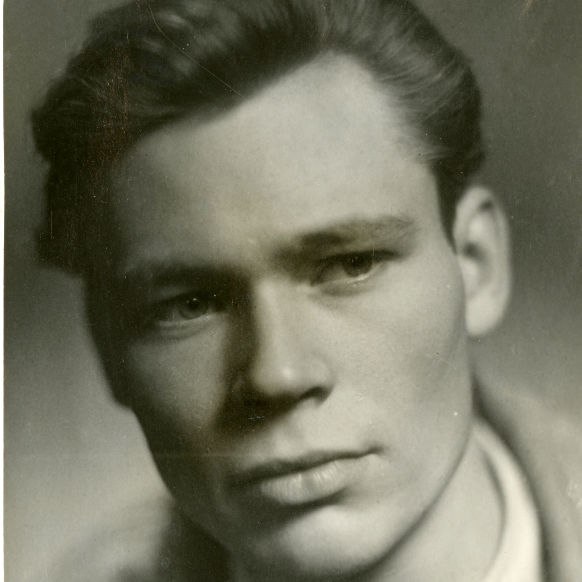
The photograph Ulrich Heinemann-Rufer included with his student application in 1948. Courtesy of Western Regional Archives, State Archives of North Carolina.
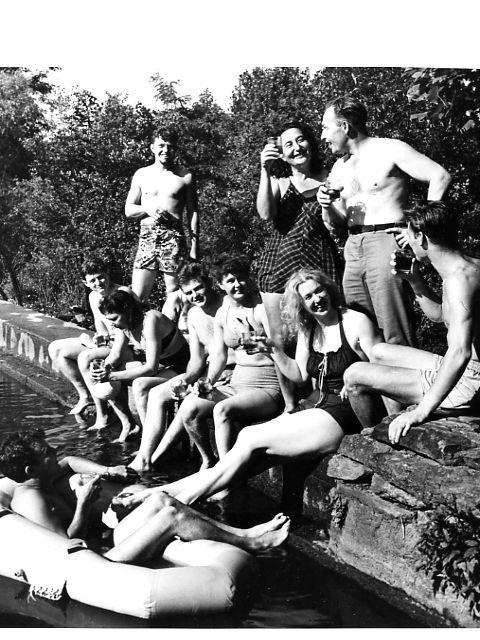
Standing: Eric Renner, Natasha Goldowski, Joseph Manulik; Seated: Donald Richter, Jane Walley, Robert Richter, Evelyn Bullock, Pat Pearman; on boat: Ulrich Heinemann-Rufer, William McKee, BMC Collection. Western Regional Archives, State Archives of North Carolina.
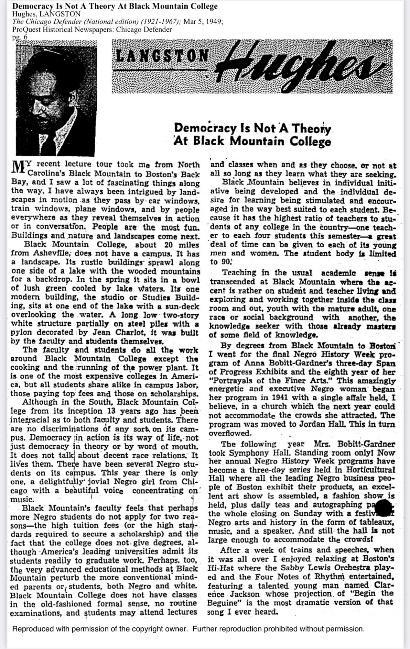
When Hughes returned to Harlem, he unconditionally lauded Black Mountain College publicly in his weekly newspaper column published in the Chicago Defender. Two things stand out. First, Hughes was typically quite critical of academic institutions, perhaps his most famous statement being his essay “Cowards from the Colleges.”[51] Second, it was highly unusual for Hughes to dedicate so much space in one of his articles to a single topic, but Black Mountain College deeply impressed him.
Because his pieces often ran nationally in the American Negro Press (ANP), Hughes’s article drew national attention to the college. He wrote: “There are no discriminations of any sort on its campus. Democracy in action is its way of life, not just democracy in theory or by word of mouth. It does not talk about race relations. It lives them.”[52]
It is hard to ignore that Bobbie Dreier served as the college’s best ambassador. Clearly her devotion to the school elevated Hughes’s admiration for its highly innovative practices.
As such, Hughes recalled that “Black Mountain does not have a campus. It has a landscape. Its rustic buildings sprawl along one side of a lake with the lush mountains for a backdrop.” Built by the faculty themselves, “Its one modern building, the studio or studies building, sits at one end of a lake with a deck overlooking the water.”[53]
Nothing was lost on Hughes. He even notes that the Studies Building, the beating heartbeat of campus, has been decorated by artwork created by Jean Charlot.[54]
Unconditionally praising the college in every possible way, Hughes summarized its instructional style. He wrote: “Teaching in the usual academic sense is transcended at Black Mountain College where the accent is rather on student and teacher living and exploring and working together inside the classroom and out, youth with the mature adult, one race or social background with another, the knowledge seeker with those already masters of some field of knowledge.”[55]
When it came to Black Mountain College, Hughes was its newest fan.
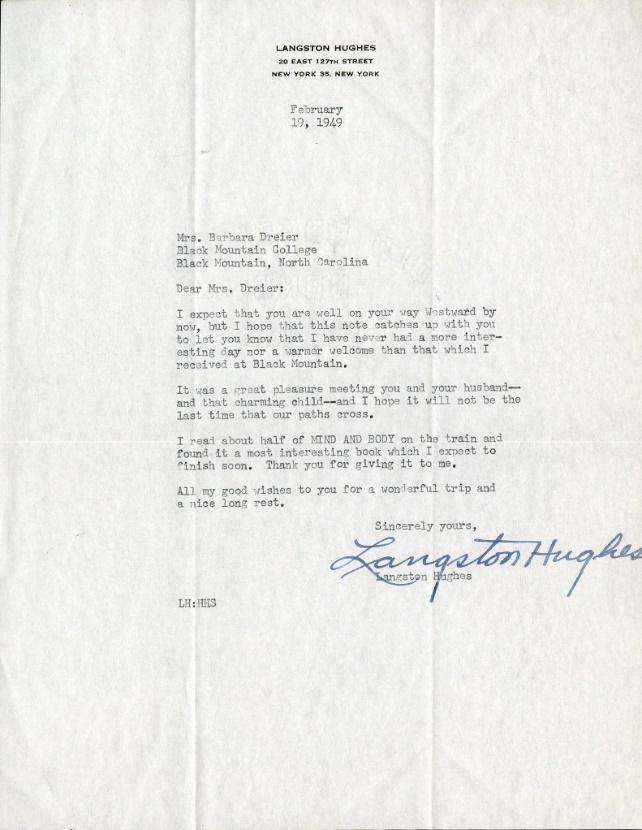
February 17, 1949, letter sent from Langston Hughes to Barbara Dreier wishing her family a safe trip “Westward” and confirming the reading of one of her book suggestions. Western Regional Archives, State Archives of North Carolina, DC 1956.50 General correspondence, Dreier, Black Mountain College, Hughes, Langston, 1948-49.
Though the majority of Hughes’s letters were signed in green, he had recently been experimenting with the blue ink he used here.
It appears that Langston Hughes was the very last Black outsider to experience Black Mountain College before the Dreiers, and Josef Albers, abandoned the college only a few months later in April of 1949, ultimately leading to its slow demise. As such, both Hughes’s overlooked visit and personal impressions of the college add to our understanding of the school at this critical time in its history.
Thanks to Bobbie Dreier, Hughes’s visit not only launched his connection with Nina Simone, it may also have shaped one of his most famous poems.
[1] I would like to thank Lauren McKenzie and Heather South for locating all the archival evidence in the Western Regional Archives, State Archives of North Carolina. Clare Grant earns my thanks as well for tracking down Hughes’s full correspondence to Claire Lennon housed at Yale University. Their collaborative work definitively fills in so many of the details about my discovery of Hughes’s February 7, 1949, visit to Black Mountain College. Clare’s research began as part of my Introduction to Literary Study course in the spring of 2025. Lauren began conducting her remarkable work in Spring of 2020 when she was made aware of this visit as a graduate student in my Langston Hughes seminar. She later completed her exemplary MA capstone project under my direction in 2021. Throughout these endeavors, Heather consistently demonstrated inexhaustible generosity and expertise. Both David Silver and Mary Emma Harris so kindly offered expert insight and guidance as well. This full story of Hughes’ visit simply would not have been possible (in any way) without all these exceptional people. Thank you all.
[2] This estimation of Hughes’s travel comes directly from his own personal itineraries located at Yale University, Beinecke Rare Book and Manuscript Library, James Weldon Johnson Collection, Langston Hughes Papers, Box 480, Folder 12048.
[3] Thomas Calder, Mountain Xpress, February 12, 2021. https://mountainx.com/arts/new-digital-archive-exmaines-nina-simones-relationship-with-langston-hughes
[4] Between Form and Content: Perspectives on Jacob Lawrence and Black Mountain College, Black Mountain College Museum + Arts Center, 2019, 15.
[5]At the time of Hughes’s visit to the capital city, the library was located at 1411 East Jones Street in Raleigh. Because of detailed notes completed by James H. Browning (in the form of his own poem), we know that Hughes read poems such as “Merry-Go-Round” and “Freedom’s Plow.”
[6] Winston-Salem Journal, “Langston Hughes Reads Poems Before Large Audience Here,” February 7, 1949.”
[7]Langston Hughes, letter to Barbara Dreier, January 2, 1949, Western Regional Archives, State Archives of North Carolina, DC 1956.50 General Correspondence, Dreier, Black Mountain College, Hughes, Langston, 1948-49.
[8] For more on this concert, see Black Mountain College Bulletin, August 1945, page 1 and David Silver, The Farm at Black Mountain College, Atelier: Black Mountain College Museum + Arts Center, 2024, 70. [Roland Hayes actually sang Hughes’s famous poem “Mother to Son” during his 1945 performance.]
[9] Langston Hughes, letter to Barbara Dreier, January 2, 1949.
[10] Between Form and Content, 16.
[11] Nathan White’s initial (but misdated) letter of interest to Black Mountain College, January 5, 1949, Western Regional Archives, State Archives of North Carolina, DC 1956.50 General Correspondence, Dreier, Black Mountain College, Hughes, Langston, 1948-49.
[12] Nathan White’s postcard to Black Mountain College, January 6, 1949, Western Regional Archives, State Archives of North Carolina, DC 1956.50 General Correspondence, Dreier, Black Mountain College, Hughes, Langston, 1948-49.
[13] These three documents are located in the Western Regional Archives, State Archives of North Carolina, DC 1956.50 General Correspondence, Dreier, Black Mountain College, Hughes, Langston, 1948-49.
[14] Dreier to Hughes, January 15, 1949, Western Regional Archives, State Archives of North Carolina, DC 1956.50 General Correspondence, Dreier, Black Mountain College, Hughes, Langston, 1948-49.
[15] Hughes’s personal itineraries for traveling through North Carolina during Negro History Week in 1949, Yale University, Beinecke Rare Book and Manuscript Library, James Weldon Johnson Collection, Langston Hughes Papers, Box 480, Folder 12048.
[16] Langston Hughes, “Democracy is Not a Theory at Black Mountain College,” Chicago Defender, March 5, 1949, 6.
[17] Hughes’s personal itineraries, Yale University, Beinecke Rare Book and Manuscript Library, James Weldon Johnson Collection, Langston Hughes Papers, Box 480, Folder 12048.
[18] Dreier to Hughes, January 15, 1949, Western Regional Archives, State Archives of North Carolina, DC 1956.50 General Correspondence, Dreier, Black Mountain College, Hughes, Langston, 1948-49.
[19] Silver, The Farm, 159-60.
[20] Hughes to Dreier, February 20, 1949, Western Regional Archives, State Archives of North Carolina, DC 1956.50 General Correspondence, Dreier, Black Mountain College, Hughes, Langston, 1948-49.
[21] According to Charles Olson’s chronology, it seems he began his first appointment as a visiting lecturer at Black Mountain College on October 12-16, 1948. This was followed by “seven more one-week visits during the academic year.” According to this chronology, it seems Olson was not made a full-time faculty member at Black Mountain College until July of 1951. https://charlesolson.org/Files/chronology2.htm. Moreover, no personal letters were ever exchanged between Olson and Hughes.
[22] Neither Hughes nor Dreier noted any details about the accommodations. During our phone conversation on March 24, 2025, David Silver so very kindly suggested both of the two possibilities noted here. I thank him for loaning me his time and expertise in shaping this article.
[23] Three days after Hughes was on campus, Josef Albers officially thanked Hughes for “giving us a lecture on your poetry,” February 10, 1949, Yale University, Beinecke Rare Book and Manuscript Library, James Weldon Johnson Collection, Langston Hughes Papers, Box 15, Folder 343.
[24] In his letter of January 17, 1949, to Barbara Dreier, Hughes writes: “I would be happy to meet with some of your English classes, and to give a reading of my poems in either the afternoon or evening to any group that you might desire.” The open nature of this gesture suggests to me that the details of precisely what Hughes might actually have read or performed while he was at the college was extremely open ended and ultimately uncertain.
[25] Mary Emma Harris, “John Cage at Black Mountain College,” Journal of Black Mountain College Studies, Volume 4, April 2013. https://www.blackmountaincollege.org/mary-emma-harris-john-cage-at-black-mountain-a-preliminary-thinking/
[26] Langston Hughes to Claire Lennon, January 5, 1949, Yale University, Beinecke Rare Book and Manuscript Library, James Weldon Johnson Collection, Langston Hughes Papers, Box 5, Folder 101.
[27] Hughes notes this in his January 17, 1949, letter to Barbara Dreier.
[28] None of Hughes’s books are located in what remains of the Black Mountain College library holdings held at North Carolina Wesleyan University. I thank Instructional and Assessment Librarian Vincent “Chip” Larkin for kindly assisting me in my search.
[29] Elizabeth Jennerjahn to Nate White, March 29, 1949, Yale University, Beinecke Rare Book and Manuscript Library, James Weldon Johnson Collection, Langston Hughes Papers, Box 15, Folder 343.
[30] My thanks to Mary Emma Harris for reaching out to Barbara Dreier directly and learning this information via an email exchange on October 26, 2025.
[31] Hughes also notes this in his January 17, 1949, letter to Barbara Dreier.
[32] Salem College librarian Donna Rothrock kindly searched both the manuscript and published music archives at an offsite storage location in December of 2025 to no avail.
[33] The following summary of Hughes’s exhaustive drive to have his songs recorded comes from his own files found in the Yale University, Beinecke Rare Book and Manuscript Library, James Weldon Johnson Collection, Langston Hughes Papers Box 511, Folders 12668-12676.
[34] “The Negro Speaks of Rivers” is a musical setting for Hughes’s most famous poem from 1921. It had even been recorded by Marian Anderson. “At the Feet of Jesus” is a spiritual song adapted from Hughes’s poem “Feet o’ Jesus” (1926), and “This is My Land” was written in 1945. The songs (along with an article about Negro History Week by Carter G. Woodson and a chapbook of Hughes’s long poem “Freedom’s Plow”) are listed at the bottom of Hughes’s personal copy of a letter from Allen School Superintendent Claire Lennon, January 5, 1949, Yale University, Beinecke Rare Book and Manuscript Library, James Weldon Johnson Collection, Langston Hughes Papers, Box 5, Folder 101.
[35] These documents are located in the Yale University, Beinecke Rare Book and Manuscript Library, James Weldon Johnson Collection, Langston Hughes Papers, Box 511, Folder 12680.
[36] Ibid.
[37] Winston-Salem Journal, “Langston Hughes Reads Poems Before Large Audience Here,” February 7, 1949.”
[38] For more discussion on “Theme for English B,” see W. Jason Miller, Langston Hughes: Critical Lives (Reaktion Books: London, 2020), 131.
[39] Langston Hughes, “Theme for English B,” line 33.
[40] Hughes, “Theme for English B,” lines 7-8.
[41] The fully completed poem was submitted for publication on July 19, 1949, and is located in the Yale University, Beinecke Rare Book and Manuscript Library, James Weldon Johnson Collection, Langston Hughes Papers, Box 385, Folder 7034.
[42] Hughes’s personal notes refer to this image as “an original decoration” titled “Student,” Yale University, Beinecke Rare Book and Manuscript Library, James Weldon Johnson Collection, Langston Hughes Papers, Box 385, Folder 7034.
[43] See, Michelle DuBois and Peter T. Nesbett, editors, The Complete Jacob Lawrence: Over the Line: The Art and Life of Jacob Lawrence AND Jacob Lawrence: Paintings, Drawings, and Murals (1935-1999), A Catalogue Raisonné, University of Washington Press, 2000.
[44] For a full overview of Hughes’s relationship with Nina Simone, see www.backlash-blues.com. For a detailed account of Hughes’s activities in North Carolina in 1949, see https://www.backlash-blues.com/allen-school-1949
[45] Interview with Lauren McKenzine, February 1, 2021.
[46] Ibid.
[47] Ibid.
[48] Langston Hughes, “Democracy is Not a Theory at Black Mountain College,” Chicago Defender, March 5, 1949, 6.
[49] For one example of Ulrich Heninemaan-Rufer’s artwork, see https://collection.ashevilleart.org/objects-1/info?query=mfs%20any%20%22%22%22Heinemann%22%22%22&sort=9
[50] Hughes’s personal typed notes, Yale University, Beinecke Rare Book and Manuscript Library, James Weldon Johnson Collection, Langston Hughes Papers, Box 480, Folder 12048.
[51] Hughes’s scathing essay was first published in Crisis (vol. 41, no. 8, August 1934), and it can be located here: https://revolutionsnewsstand.com/2025/01/07/cowards-from-the-colleges-by-langston-hughes-from-the-crisis-vol-41-no-8-august-1934/
[52] Hughes, “Democracy is Not a Theory,” 6.
[53] Ibid.
[54] Ibid.
[55] Ibid.
[56] February 17, 1949, letter sent from Langston Hughes to Barbara Dreier, Western Regional Archives, State Archives of North Carolina, DC 1956.50 General correspondence, Dreier, Black Mountain College, Hughes, Langston, 1948-49.
Jason Miller is a Distinguished Professor and public scholar at NC State University. His work has been featured on the ABC and NBC National Evening News, CNN, BBC, NPR, and The Rachel Maddow Show. Supported by a Fellowship at the National Humanities Center, his fourth book is Don’t Let Me Be Misunderstood: Nina Simone, Langston Hughes, and the Birth of Black Power. His film Origin of the Dream (about MLK’s first “I Have a Dream” speech in Rocky Mount, NC) is airing on PBS.