

It’s March of 2026, and I’ve been watching my collaborator in the studio. We’re overseas, at LAKE Studios Berlin, a dance research and residency center. It’s luxurious, thanks to my collaborator’s tenured university job and sabbatical funding. We have time, for once. When I watch her, her eyes are closed. She is in a low, crouched position, balancing precariously on forearm and thigh. Her head lists away from her shoulders, as if listening to a low sound. Slowly, she shifts her weight, tectonically. At the last moment before she would have to topple, she catches her weight with an outstretched leg, foot-bones elongated. Weak spring sun warms the floor of the bright studio. I hear novel sounds of Eurasian birds. I refocus, moving my eyes from the diffuse and peripheral to zoomed-in, and notice the particular hang of her fingertips creating arched pathways of negative space, simultaneously reaching and slack.
We’ve been cycling through rounds of a practice called “authentic movement.” Framed by and introduced to postmodern dance practice primarily through the work of Janet Adler, and Mary Stark Whitehouse before her, authentic movement involves two roles, a “mover” and a “witness.” In the “mover” role, one is tasked with attending to and following internal movement impulses, which is both simple and infinitely complex. The “witness” does just this, with the invitation to consider the task broadly. Aligned in a tradition of contemplative and meditative practice, this witnessing role includes, perhaps even primarily so, witnessing oneself—thoughts, judgements, desires, sensations, discomforts—and the ongoing interplay of these observations with the present.
As I witness myself witnessing my collaborator, I start feeling like what I’m really witnessing is history. And when I say history, I mean a fragmented embodied archive that I sense with me while dancing, grounded less in factual understanding and more in a sense of ghostly accompaniment. Where do these movements come from? Dancing is always a practice of remembering that we are part of a constellation—there is no movement without those who taught it to us, try as we might to invent “new” movements. Though I know this to be true on some level, I am still subject to the fantasy of reinvention, often appearing in a strong, albeit somewhat unconscious, desire to split myself off from the histories that formed me—as if I could sever familial ties like some kind of cantankerous child. But mostly, in true ghostly fashion, I can’t escape these hauntings. The more I try, the more particular danced-histories pop into the studio in March of 2026, seemingly uninvited. The ghosts of dance legends past seep into our literal bodies, which act as resistant but persuadable hosts.
As I watch my collaborator, one of the histories I’m thinking about is the Buddhist ethic of “action through non-action” and the ways this tradition runs through a lineage of postmodern movement and performance practice, and my head gets a little tight. I think about how contemplative practice became intertwined with western postmodern dance practice, and what relevance that has for my dancing today. We’ve been lightly invoking postmodern choreographer Deborah Hay in the studio, following her example in framing “what if” propositions and improvising the answers.[1] As I become slowly more conscious of the ghosts that haunt our current studio practice, I begin to wonder how to square this ethic of “action through non-action” in an aesthetic realm. What does it mean to align artistically with a lineage of “action through non-action” when, simultaneous to our sunny studio practice, there’s war and genocide happening, and ongoing accelerating global catastrophes?
It seems that finally the process of unwitting mediumship has worn me down. Or, maybe, my reaction to seemingly endless crises and the ongoing conditions of global depravity and emergency appears as an increasingly urgent need to reckon with the past—or at least, to reckon with this tendency to split myself off from the lineages that shaped me. I understand that this habit is a colonial one, and one that serves a false and insidious idea of never-ending, future-facing progress without critical engagement with history. But a linear, causal understanding of history doesn’t exactly function either. Walter Benjamin writes: “It’s not that what is past casts its light on what is present, or what is present its light on what is past; rather, images is that wherein what has been comes together in a flash with the now to form a constellation.” [2]
In my reckoning, part of what I’m seeking is a more grounded understanding of how my current practice is constellated with the company of many postmodernists that I find both difficult and, increasingly undeniably, profoundly influential. Benjamin writes as though he had some experience with contemplative, embodied, or somatic study—anyone who has spent time dancing, moving with eyes closed, or even walking in the woods may be familiar with the kinds of memories, connections, and remembrances that can appear in these states. Influences and recollections come together in flashes, in images, and in fragments, more so than in a comprehensive view of linear historical progress that arrives at a logical present. Accordingly, I offer here some flashes and fragments of visits from reclaimed dance parents and grandparents—in our communing, there is more understanding of the proximity and affinity that binds us, as well as, like any parental relationship, intimacy forged through criticism. Perhaps in this process, I’ll be able to trade the invasion or interruption of unwitting hauntings for more conscious and collaborative steering of these legacies toward active mobilization in the current context of 2026, in conversation with the ongoing concurrent catastrophes that shape our daily conditions.
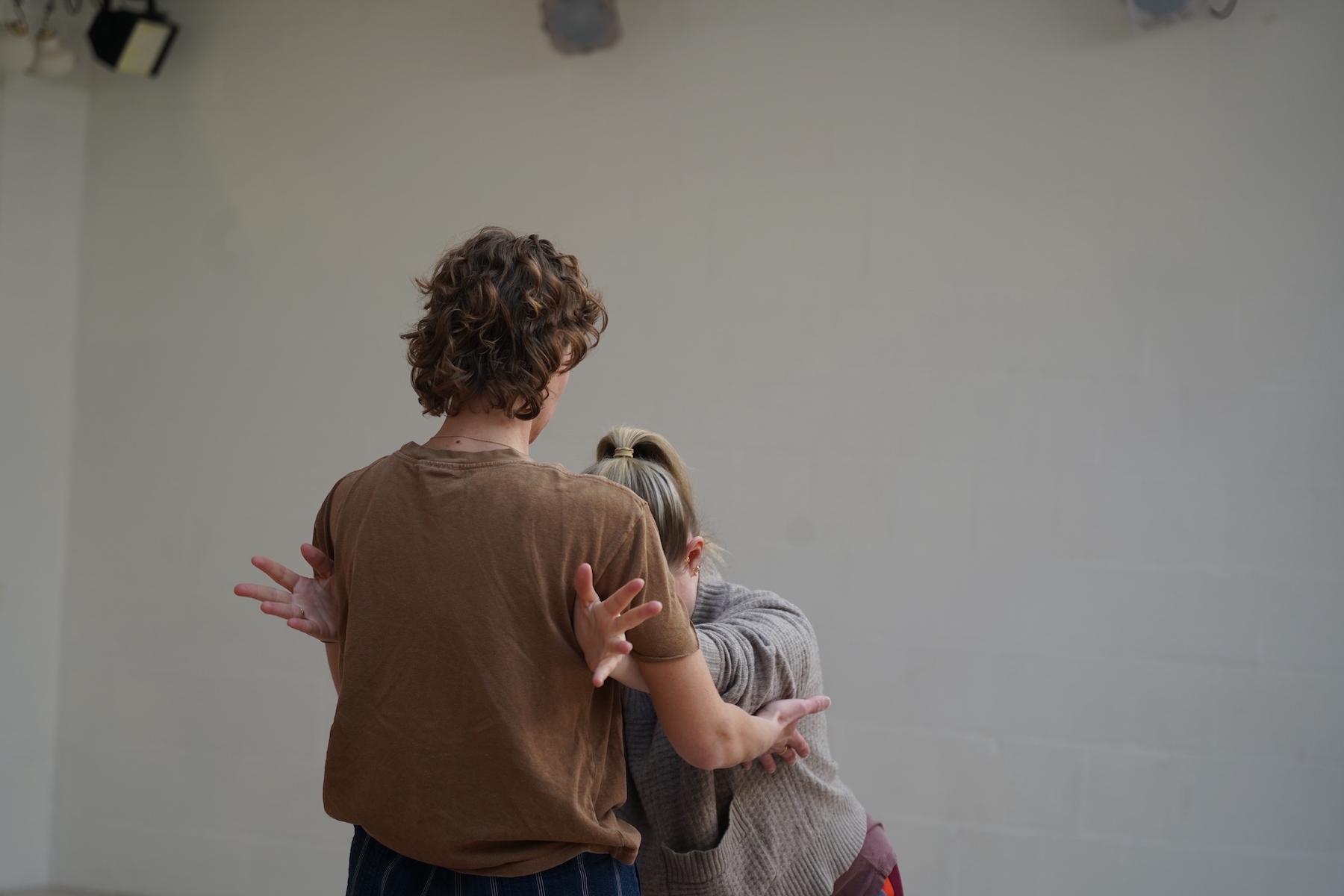
Figure 1. (left to right): Meredith Bove and Barbie Diewald, rehearsal, Lake Studios Berlin, March 2026. Photo Credit: Maria Kousi.
Art’s obscured the difference between art and life….Where there’s a history of organization (art), introduce disorder.[3]
John Cage, A Year from Monday, 19.
74 years ago, in 1952, John Cage’s compositional experiment Theater Piece #1 premiered at Black Mountain College. Today, it is often looked back on as the first “happening,” even though the term may be used more broadly in association with Cage’s student, Allen Kaprow. Written descriptions of Theater Piece #1 document it as a collection of discrete activities taking place in overlapping time signatures. There was poetry by Black Mountain College Rector Charles Olson and faculty member M.C. Richards, projected slides and paintings by then BMC student Robert Rauschenberg, dance by Merce Cunningham, piano by David Tudor, and readings by Cage from his lectures on Zen and Meister Eckhart.[4] Leading up to Theater Piece #1, Cage had been experimenting with methods for creating conditions that would produce unpredictable experiences in art and performance. These aleatory procedures had the effect of sublimating authorial control in artistic production, resulting in indeterminate performances characterized by unforeseen events and anarchic modes of expression and action (and non-action).[5] Cage frequently consulted the I Ching, translated to The Book of Changes, in creating compositional parameters, “asking a question” about the score in development, and then making coin tosses or casts of yarrow sticks to assemble hexagrams in the divinatory tradition of the ancient text. The “answers” Cage received would then determine things like duration of events in a score or composition. Of this time, Cage writes, “My work became an exploration of non-intention. To carry it out faithfully I have developed a complicated composing means using I Ching chance operations, making my responsibility that of asking questions instead of making choices.”[6]
The simultaneity of multiple events occurring side-by-side in Theater Piece #1 had the effect of de-centering attention from a logical, narrative-based theatrical unfolding in favor of intermittent, intermedia experiences. This emphasis probes the tidy art/life divide upheld in previous theater trends—the audience was situated so that the various actions took place in their midst, requiring them to turn their heads or move their bodies, rendering them more active participants in the framing of the work. After the premiere, Cunningham reflected: “Life itself is all these separate things going on at the same time. And contemporary society is so extraordinarily complex in that way. Not only things going on right around you, but there are all the things that you hear instantly on the television, that are going on someplace else…they’re happening at the same time.”[7]
In the year 1952, a partial list of major and noteworthy contexts happening “at the same time” or contemporaneous to Theater Piece #1 included: Cold War threats and the accompanying “Red Scare,” fueling political repression and anti-communist hysteria across the U.S., and an ongoing and entrenched Korean War stalemate.
Critical reception of Theater Piece #1 was mixed—largely, the feedback reflected an effect that was disorienting, chaotic, and provided “sensory bombardment” to the spectator.[8] Cage’s own writings suggest that this was largely the point.[9] Collapsing an art/life divide in 1952 must have meant allowing an increasing consciousness of global fascism, and threat of nuclear annihilation into creative practice. Additionally, Cage was heavily influenced by the Zen philosophy of D.T. Suzuki and Shunryu Suzuki, which describes “void-like” events that reveal the underlying true nature of reality and experience as one that is rooted in randomness, and the ultimate transitory nature of all phenomena.[10] In using chance-based compositional methods, Cage could side-step to a degree, his own authorial control in the making process, and craft “happenings” that more closely resembled something like “nature,” in all its concurrent cacophony, and in its randomness and indeterminacy.
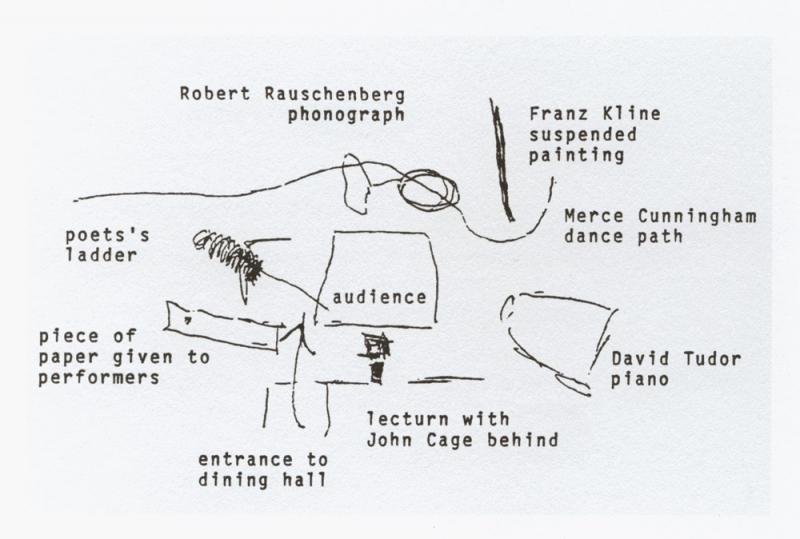
Figure 2. M.C. Richards, floor plan of John Cage’s “Theater Piece No. 1” (1952), drawn for William Fetterman in 1989.
The subsequent generation of postmodern dance makers following in the footsteps of Cage and Cunningham continued to unfold Buddhist influence in their work and experimentations. Barbara Dilley, who performed in Cunningham’s company from 1963 – 1968, later developed the technique of “Contemplative Dance Practice,” or CDP while on faculty at Naropa University.[11] Dilley was invited to create a dance program at Naropa by Chögyam Trungpa Rinpoche in 1974, where the context of “Buddhist-inspired contemplative education” at Naropa intermingled with her dancing and teaching during her tenure. She describes contemplative focus in the Buddhist tradition as “…prajna, defined as ‘best knowing.’ It is that deep and wide knowing that gives rise to insight and compassion.”[12] Concurrently, Deborah Hay was unfolding an improvisation practice rooted in a rigorous discipline of questioning, as detailed in her book My Body the Buddhist. In the vein of Hay, my collaborator and I have been formulating questions in the studio like, “What would change if I could experience my body in deep time and time lapse at once?” and improvising the “answers”—situating us squarely in a legacy of postmodern explorations interested both in “asking questions instead of making choices,” and in contemplating and complicating our understandings of perceived reality by studying bodily perceptions and experiences through which said reality is filtered through.
It is through tracing these direct lineages that I can start to approach criticism through intimacy (or vice versa). The underpinnings of Buddhist influence in post-modern dance has contributed to movement always acting on me as a para-spiritual practice of widening awareness and contemplation of ephemerality and chance as inescapable aspects of embodiment. And though my work with my collaborator looks nothing like a “happening,” many of the methods we use can be traced to Cage’s early experiments in chance-based compositional methods, as well as an aesthetic that collapses an art/life divide. In performance, we have set a timer in the form of a teakettle on a hotplate to determine the length of sections. We improvise dialogues directed at the audience, and we use found materials—often grasses or plant matter growing near the site where we’re working, and arrange or “cast” them intuitively during performances. We have recorded improvised conversations about our friendship and collaboration over the last 10 years and used them as sound scores, or semi-randomly selected words from these conversations and repurposed them as song lyrics. We make dance phrases through improvisation, and reorder things in sequence at random. Mostly, I take these compositional methods for granted, and not as particularly unique or radical. In looking back to Theater Piece #1, and in examining some of our current compositional methods that would seem directly linked to Cage and later generations of postmodernists, I have several nagging worries—perhaps primary amongst them is the ways a practice of “asking questions instead of making choices,” and indeterminate compositional methods may contribute to an aesthetic of nonintervention—one that risks shirking the responsibility of a point of view for a supposed observational, even “neutral” vantage point.
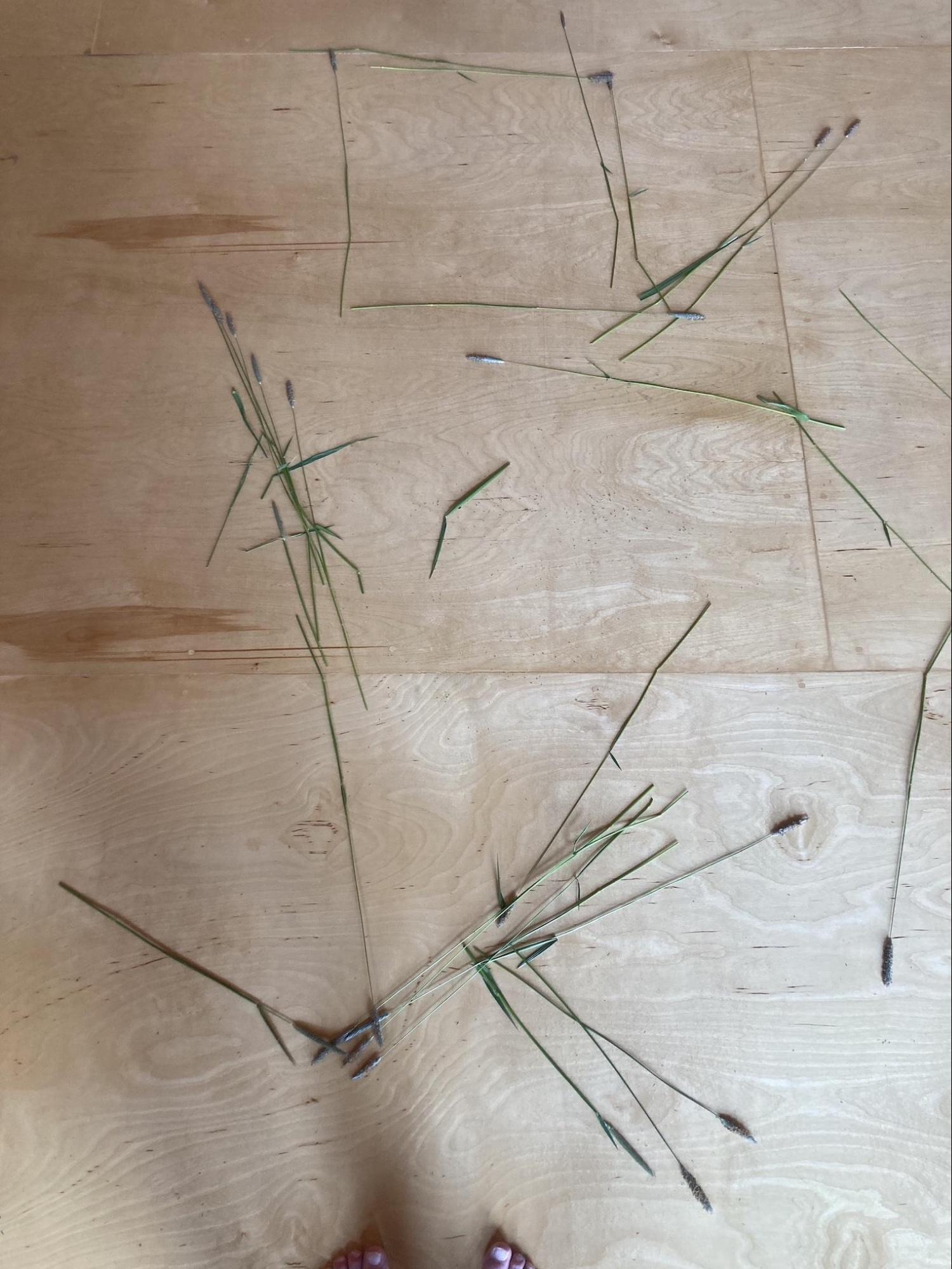
Figure 3. Grass Portrait, from “Ongoing Duet,” by Meredith Bove and Barbie Diewald. May 2024, Subcircle Residency, Portland, ME. Photo Credit: Meredith Bove.
Part of what haunts me in my dance practice is an ongoing tussle with control and disorder. One way of telling the history of 20th century concert dance in the U.S. is that the chance-based experiments of Cage and Cunningham exploded the conventions of performance art, paving the way for later experiments in the 1960s and 70s such as those undertook by performance ensembles like the Judson Dance Theater and Grand Union.[13] These later movements expanded definitions of dance to include “everyday” movement, which further ruptured the conventions of an art/life divide. The term “everyday movement” always requires examination, as the generalization begs the question, “everyday” for who? Movements like walking, sitting, lying down, and running became incorporated into a postmodern dance lexicon in the 1960s and 70s. But deeming these movements “everyday” is of course exclusionary for many whose bodies move differently. Yet, despite the problematic generalization of “the pedestrian” that became canonized as a “neutral” or “natural” aesthetic in postmodern dance, I have to acknowledge that my encounter with these frames was liberatory for me as a young (white, able-bodied) dancer whose relationship to bodily control was veering dangerously toward evermore obsessive, punitive, and militant training practices that ultimately viewed my body as something to coerce towards mastery. It was around my 2nd year of college that I was exposed to practices that showed me an alternative pathway of embodied study, one that was intertwined with a more liberated, “zoomed-out” way of relating to my body that allowed for an understanding of embodiment as a relational practice—dancing was not just about competing with myself to achieve greater and greater ability, but rather was a practice of embodied study of many kinds of interrelationship—with humans, with space, with history, with the more-than-human, and perhaps even with spirit. Instead of individualist striving for transcendence beyond ordinary human limits and conditions, postmodern dance allowed me the possibility to consider how present conditions of embodiment and reality are the fabric of art itself—there is no separation.
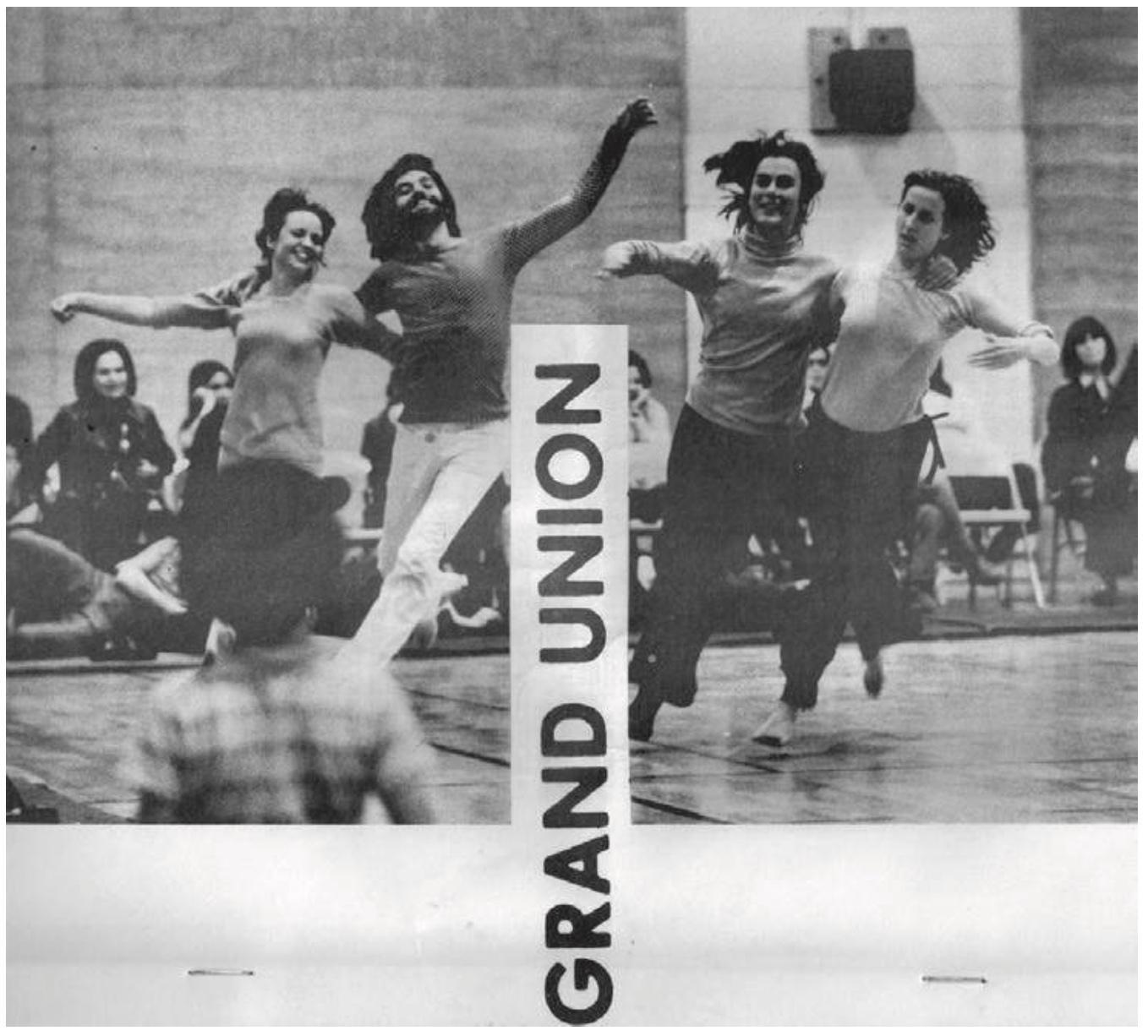
Figure 4. Publicity pamphlet, The Grand Union, c. 1971. (left to right): Barbara Dilley, David Gordon, Yvonne Rainer, Trisha Brown. Photographer unknown.
In reclaiming my dance + creative relations of Cage, Dilley, Hay, and their postmodern peers, I can perhaps be more accountable to the shadow-side of this artistic legacy, rather than surprised when its persistent haunting shows up in the studio in 2026. Indeterminate and chance-based procedures that shift creative responsibility to “asking questions” instead of “making choices” can appear laissez-faire, and liberatory embodied practices can swing all the way around to privilege personal comfort and ease over collective consciousness and critical inquiry. Historian Judith Rodenbeck astutely illuminated the inherent passivity embedded in the word “happening,” as in ‘it is happening to me.’[14] As a beneficiary of the many liberatory frames afforded by the experiments of Cage and others, how might I also mobilize and re-contextualize some of the original propositions so that radical attunement to the possibilities of the present also helps illuminate the ways in which that present is always entangled with a wider field?
In response to this question, the next time my collaborator and I are in the studio together, I propose we try another experiment. If the practice of authentic movement affords us an experience of time travel, and an illumination of ghostly accompaniment and collaboration with those who came before us, then might it also be possible to hold more and widening awareness of the of the ways in which the present is always connected to the past and to the future? In contemplative Buddhist tradition, can we cultivate “wider and deeper knowing” through acts of witnessing each other? And, in the tradition of Theater Piece #1, might we increase our capacity for observing and being with “sensory bombardment,” and thus our capacity for response when confronted with multiple concurrent crises unfolding moment-to-moment?
Indeterminate practices hold a particular kind of magic that opens a portal into awareness of multiple possibilities of unfolding in any given moment. The current conditions of “the everyday” in 2026 may demand making choices alongside asking questions, (as did the conditions in 1952), but perhaps just as important is staying open to multiple possible courses of action. There is no choreography without ghosts, just as there is no movement without those who taught it to us. I’m considering that the ghosts who pop into the studio in 2026 are not to here to haunt me with their specters of “non-intention” or with a tacit acceptance of present conditions, but instead with an auspicious reminder that to truly dissolve the art/life barrier is to move towards evermore awareness of the ways each present moment is entangled with interrelationship. The conditions of 2026 and beyond are a profound test in overwhelm, in “sensory bombardment,” and in chaos, disorder, and unraveling. To continue in the tradition of asking questions not necessarily instead of making choices, but rather as propositions for response: How might indeterminate practices of making art reveal endless possibilities in any given moment—for collaboration, for archival excavation, for choice, for disorder, for simultaneity? What else can we bear witness to?
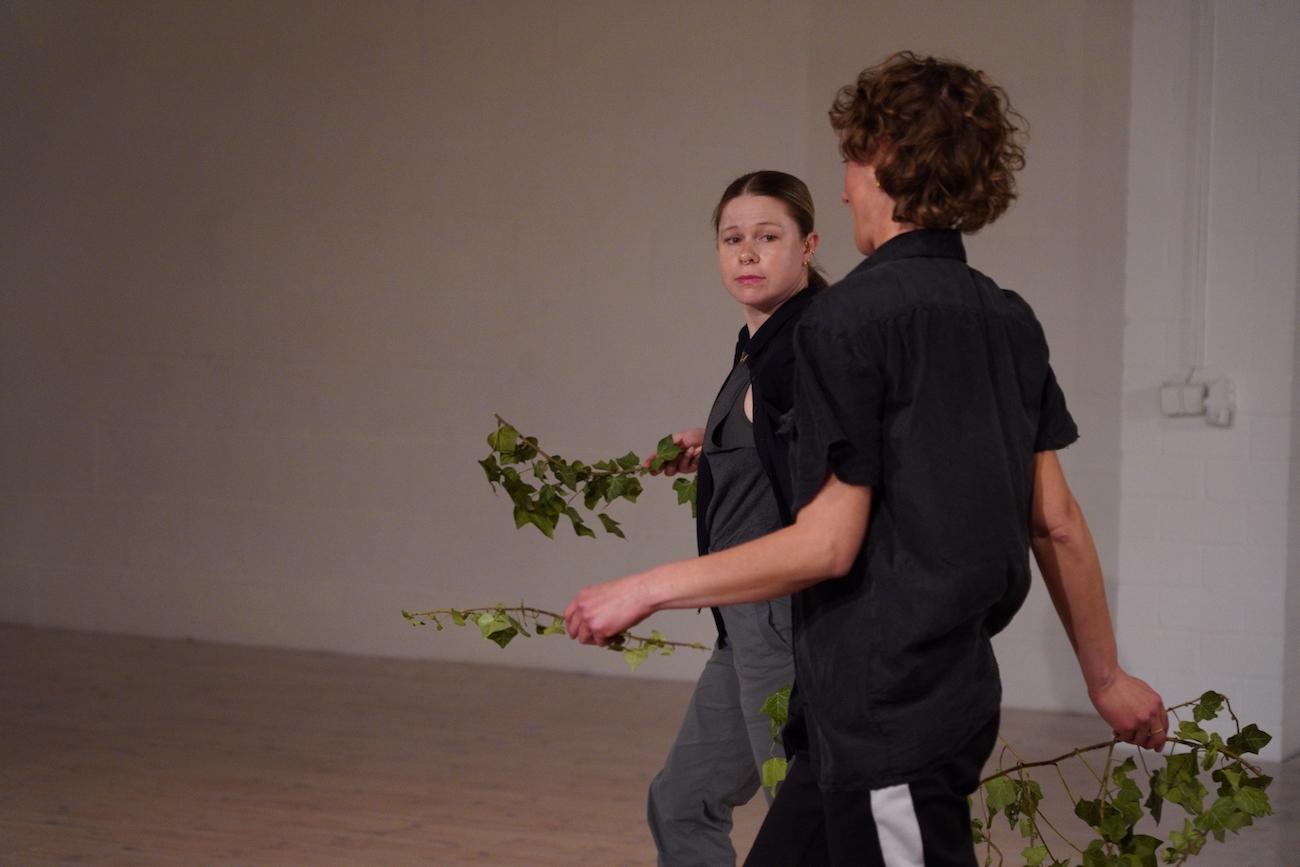
Figure 5. (left to right): Barbie Diewald and Meredith Bove, performance of “Ongoing Duet,” Lake Studios Berlin, March 2026. Photo Credit: Maria Kousi.
[1] Deborah Hay. My Body, The Buddhist. (Wesleyan University Press, 2000) xxiii-xxiv.
[2] Walter Benjamin. The Arcades Project. (Harvard University Press, 1999), 462.
[3] John Cage. A Year From Monday: New Lectures and Writings. (Wesleyan University Press, 1963), 19.
[4] Eva Díaz. The Experimenters: Chance and Design at Black Mountain College. (The University of Chicago Press, 2015), 79.
[5] Ibid., 82.
[6] John Cage. “An Autobiographical Statement,” Southwest Review 76 (Winter 1991), 59-76.
[7] Cunningham quoted in Martin Duberman. Black Mountain College: An Exploration in Community, (Northwestern University Press, 2009) 377.
[8] M.C. Richards quoted in William Fetterman, John Cage’s Theater Pieces (Routledge, 1996), 101.
[9] Cage. A Year From Monday: New Lectures and Writings. (Wesleyan University Press, 1963), 19.
[10] Díaz, 88.
[11] Barbara Dilley. This Very Moment: Teaching Thinking Dancing (Contact Editions, 2020), 75.
[12] Ibid, 137.
[13] Ninotchka Bennahum and Bruce Robertson. Radical Bodies: Anna Halprin, Simone Forti, and Yvonne Rainer in California and New York, 1955-1972 (Art, Design & Architecture Museum, University of California, Santa Barbara, 2017). 29.
[14] Rodenbeck quoted in Díaz, 98.
Meredith Bove is a dancer and dramaturg based in western Massachusetts. Her practices move between and across performance, writing, dance, and audio. Through each of these mediums, she is devoted to engaging the tensions between language and embodied experience. She approaches her work in writing, performance, and dramaturgy as possible sites for the excavation of embodied archives, the destabilization of hierarchies, and for the cultivation of increased care, interdependence, and creative kinship. Meredith has taught dance & performance studies at Hollins University (2011-2012 & 2016), Montgomery College (2014-2016), Springfield College (2016), Keene State College (2017-2020), Smith College (2021-2022), and most recently as Visiting Artist in Dance at Mount Holyoke College (2022-2025) where she leads seminars on dance writing, dramaturgy, and queer & feminist performance. Currently she is Special Programs Coordinator at A.P.E. in Northampton, Massachusetts where she collaborates with co-directors Kathy Couch and Mollye Maxner to curate and steward a number of programs, including Making Ground: Dialogues and the newly formed Workroom Cooperative.
Cite this article
Bove, Meredith. “Re-visiting Traditions of Embodied Interconnection through Indeterminacy.” Journal of Black Mountain College Studies 17 (2026). https://www.blackmountaincollege.org/journal/volume-17/bove/.