
Photopia is about the fine line between visibility and invisibility, existence and nonexistence, places and non-places, physical presence and dematerialisation. It explores the blending of timeframes, their suspension and denial, the impossibility of defining the future, and the idealization mediated by the most widely used medium of today – photography. Photopia is about photography and utopia.
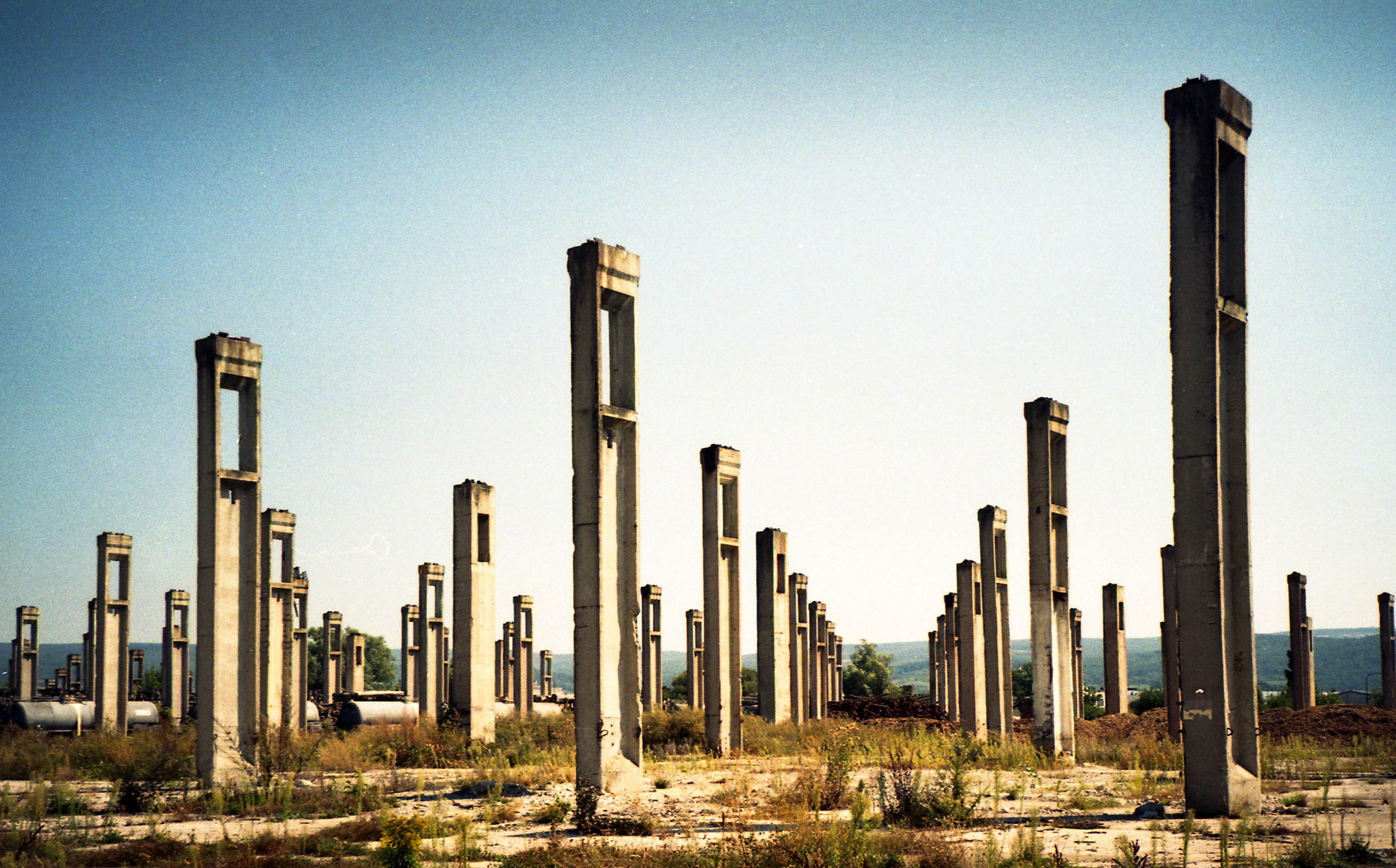
Ema Lančaričová, from series Utopia, 35mm film photography, 2018
On Memory and Melancholic Ruinisation
I discovered the site of the colonnade in 2016. I began visiting it intensively in 2018, which grew into an active obsession. It lies halfway along my daily train route, and each stop there offered a temporary escape from reality. The colonnade belongs to a wider typology of post-industrial ruins scattered across the Eastern Bloc—the region I come from—though I deliberately withhold its precise location and former function. What interests me is not what the place was, but what it has become: a site suspended outside of time. I captured my fascination with the colonnade in the extensive collection of visual and film material I accumulated, forming a personal archive.
Each visit brought an intense sense of timelessness. Being in that space felt like a return to lived memories charged with a great dose of nostalgia, or rather a sorrow that felt foreign to me; a sorrow arising from the topography of the place. The factory building and its colonnade complex have passed their peak. After an active life comes a phase of invisible flow—a phase of inertia. This phase is characterised by corrosion, degradation, erosion of mass, and the impossibility of fulfilling its potential. The place enters a state I call melancholic ruinisation—a slow disappearance and forgetting that is simultaneously a process of transformation. The memory of the place doesn’t dissolve into oblivion entirely, it shifts. New modes of existence begin to emerge—silent, unbounded, fascinating in their unpredictability.
Every stay at this place was accompanied by a strong feeling of déjà-vu, a feeling that echoed past visits. Such an experience of time defies linearity. I was looking at what I had already seen—but differently, at another time, in another place. This experience revealed a deeper, more universal context: the existence of numerous similar sites across the post‑industrial Eastern Bloc. Places imbued with tension between collective hope and historical trauma: between utopia and its transformation into totalitarianism. Ruins are tangible fragments of history. They attract us and permanently occupy our imagination, our past, and most likely our future. As if they were rooted within us—not only the ruins themselves but also what remains of them: unfulfilled dreams. The sight of the abandoned, towering concrete columns evoked a strong sense of anachronism in me. They seemed to exist outside of time, removed from the historical flow. They are physical artefacts awaiting for the new reinterpretation to give them meaning. Interpretation thus becomes a way of survival.
Ruins are remnants of the past, outsiders of the present, and remain a question of the future. Are these columns merely a nostalgic vision of a utopian landscape, or are they a warning of a future in which humanity has become obsolete? I ask this question at a time when it becomes increasingly clear that we must begin to think about the post‑Anthropocene.
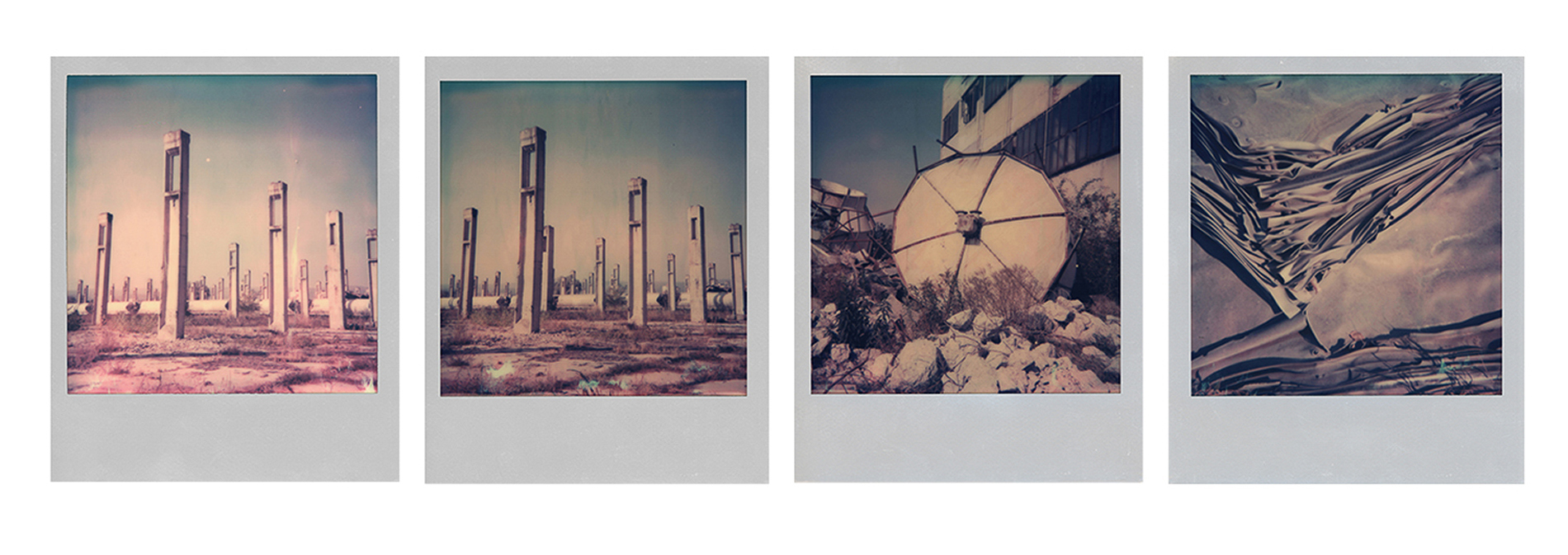
Ema Lančaričová, from series Utopia, Polaroid silver frame edition, 2018
On Photography and the Record of What Was, What Could Have Been, or May Yet Be
The word utopia derives from the Greek words οὐ (not) and τόπος (place)—thus, a non-existent place—a non-place. Within the context of a philosophical reflection on photography, I refer to the fact that the constellation a photographer captures is a mixture of four-dimensional space, the quantity of time, and the flow of light. Through this process, the existence of objects and subjects is transformed into a photographic record. This record becomes a trace, standing independently in opposition to a now-non-existent present. Temporal and spatial coordinates are suppressed in the act of photography, giving rise to a deep penetration into the photographic medium—one that is, by its very nature, utopian.
My interest lies in grasping the very expression non-place. Time frozen in the form of a photograph appears imprisoned, incapable of returning or progressing, and thus, the captured fragment of time and space can be understood as a non-place, as non-time—a rupture in continuity. The documentation of an unbounded and relatively infinite present, which appears only in a certain form—a form that is unstable—can, through photography, be extended into the future in the form of a record. This record is simultaneously true and untrue. For just as photography captures the present, it also captures the presence of the absent.
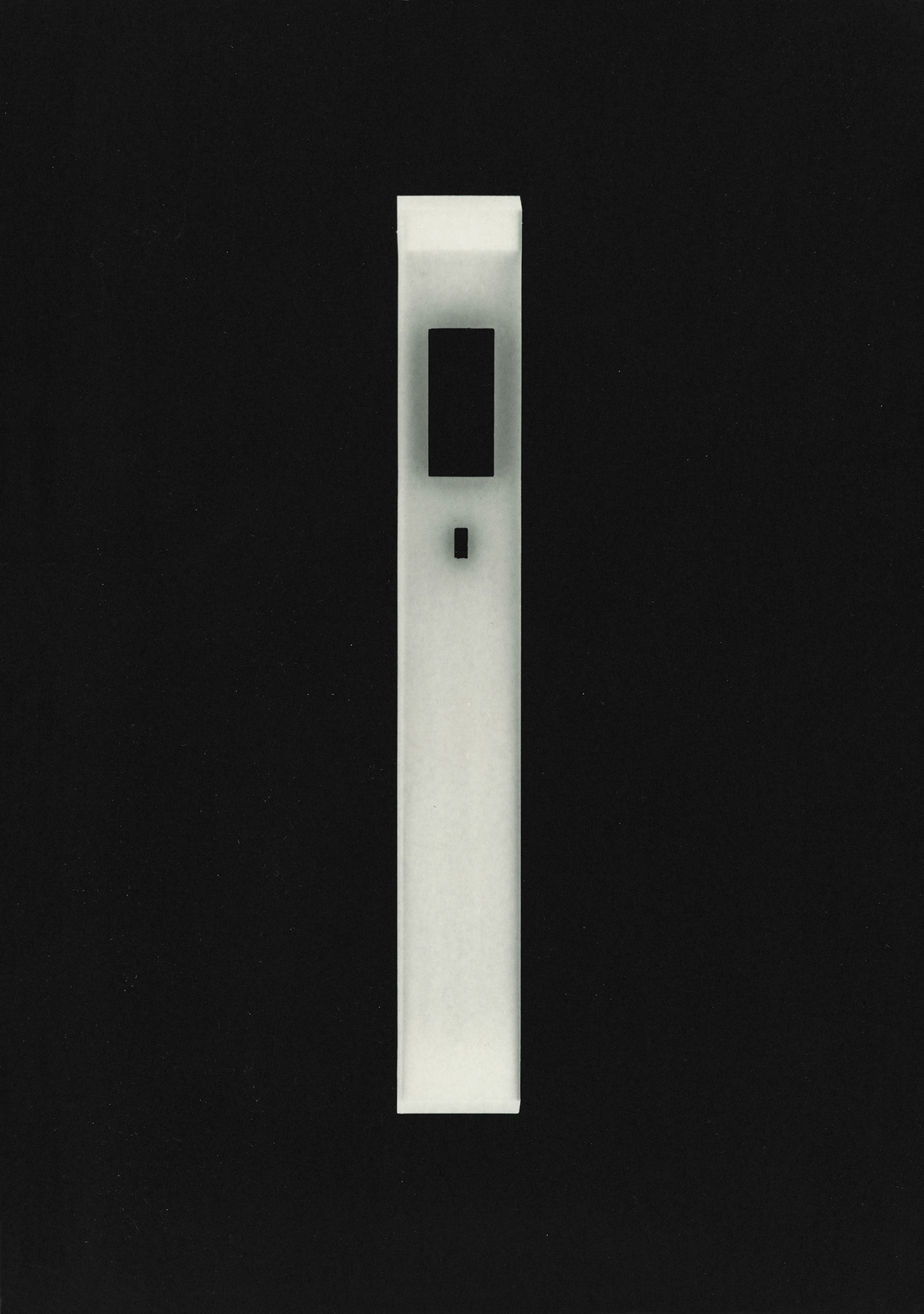
Ema Lančaričová, from series Utopia, Photogram, 2019
The central motif of the work is the column, a fundamental structural element not only of the site’s architecture, but also of the architecture of the emerging image and memory. The repetitiveness of the motif refers to an inexhaustible set of possibilities for capture. Throughout the project, the column accompanies the viewer from static images to subtle recordings of movement made with a stereo camera, to the black-and-white video shot on 8mm film. The variability of formats reflects the shifting understanding of place and time, conditioned not only by the act of repeated photographing, but also by returns to the site, which give rise to new, self-contained chapters of the project. Each frame is a record of sedimentation—the layering of time. Individual photographs emerge from the unconscious layer of history into the conscious present, but their meaning remains open, lacking contextualisation. This context is re-created not only by myself, but also by the viewer’s speculative approach to the possible significance of the captured objects and the potential imagined stories of the place/non-place.
The temporality of the colonnade, the time dimension of its existence and gradual transformation, speaks of a living process of ruinisation. The layers of time overlap, yet also reveal one another. The colonnade is a living organism. The temporality of return and sensitivity to non-linearity evoke the nuances between elapsed time and individual visits. The creation of an archive becomes an act of time accumulation. Analogue and Polaroid photographs affirm the existence of the depicted colonnade, while simultaneously, through their distinctive aesthetics, they gesture toward an idealised world. The Polaroid has its own specific colour palette. This becomes an automatic filter, applied as the photograph emerges directly from the camera. Its colouration naturally encodes nostalgia. It seems the Polaroid restores the aura of the original. As an instant medium, the Polaroid is now obsolete, and may no longer be instant in the true sense of the word. It becomes a historical witness of itself, attempting to restore value to the photographic image. The symbolic connection between the columns and Polaroid photographs takes the form of a mirroring—a fragmented reflection of the world, poised between what is real and what is constructed.
In the project, I also engage with the fragile boundary between reality and fiction, through the creation of my own 3D model of a column and a constructed environment within the darkroom. By doing so, a space opens for parallel timelines. Each photograph, each part of the project, carries its own temporality.
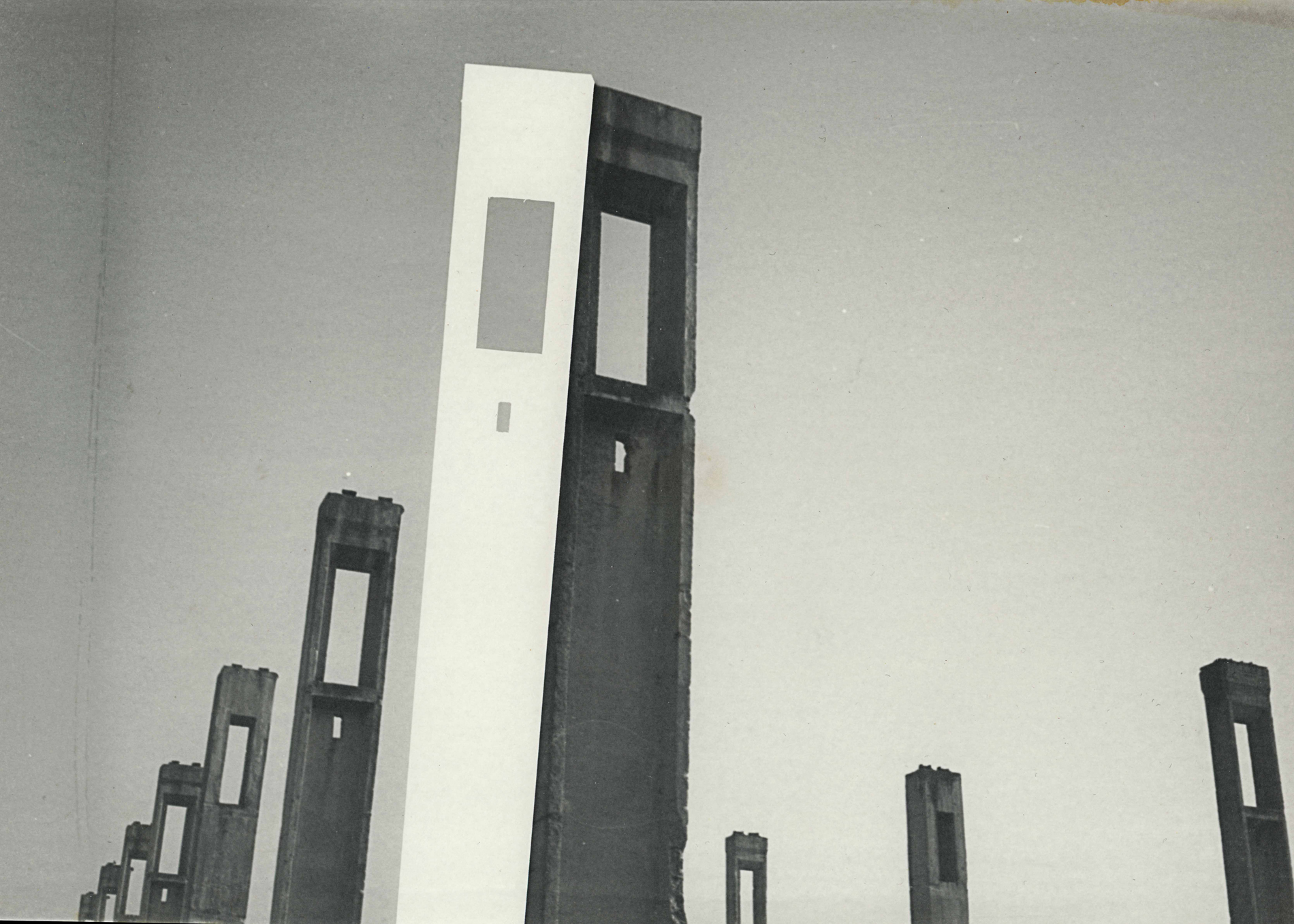
Ema Lančaričová, from series Utopia, Photogram on darkroom print, 2019
The project Utopia evolved over time into meta utopia—something beyond or exceeding utopia. At the same time, it presents a self-realisation on a deeply personal level. The process of working on the project is bound to a fatalistic feeling: that what we are meant to fulfil our lives with lies on the threshold of dystopia. The final form of the project—Photopia concludes in a moment of loss. The columns remain only in memory and in the archive. What follows is nostalgia for nostalgia, for what was, could have been, or may yet be in the space between the pillars. While the project formally ends, as an artwork it continues to live on, detached from the creative process, capable of layering time and moving through it autonomously. What remains, in the end, is the awareness that every gaze, every viewing of photographs from this place/non-place, is nothing more than a repetition of the past. Photography thus becomes a utopia in and of itself, an idealised state, a trace of a world that never existed as we remember it.

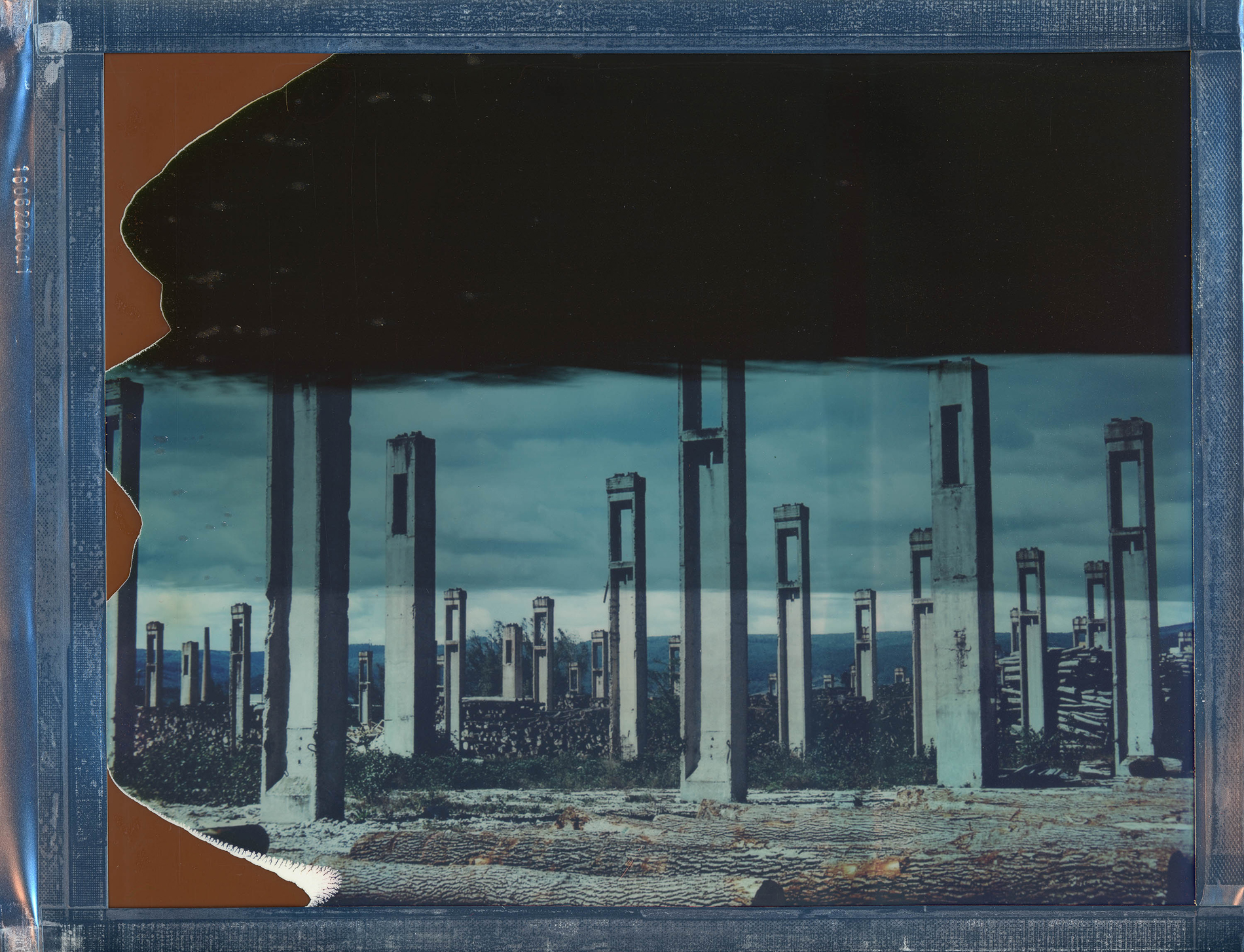
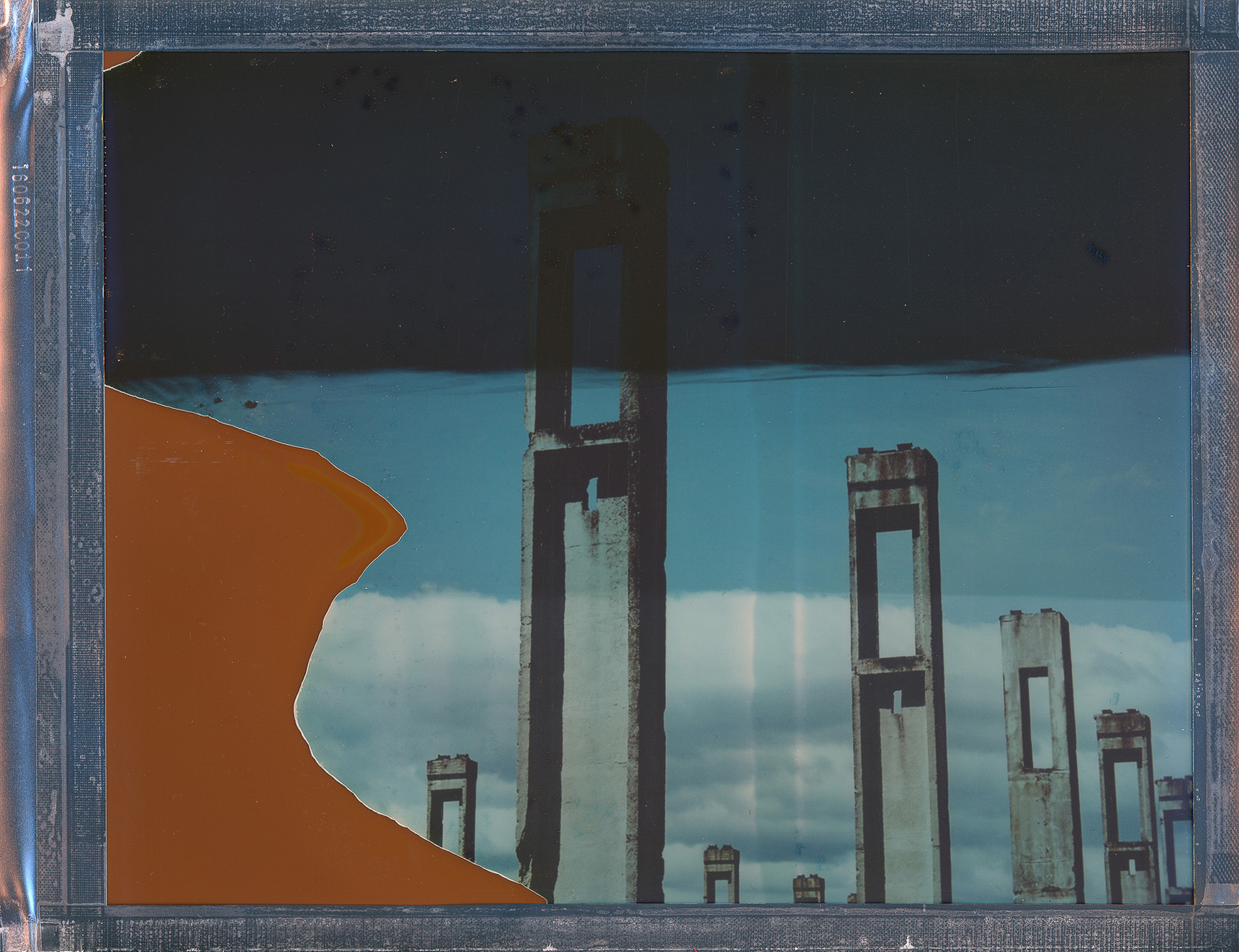
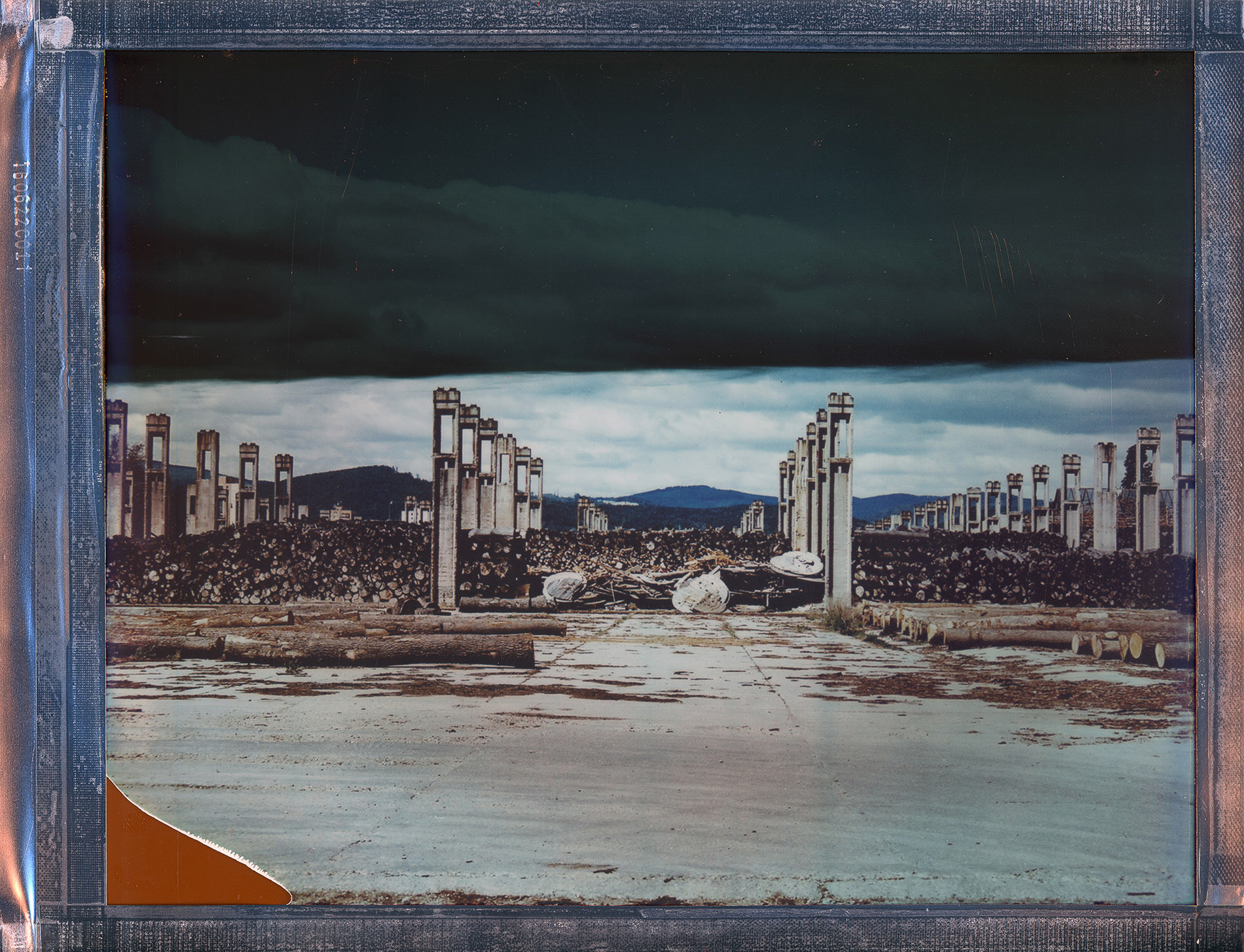
Ema Lančaričová, from series Photopia, Polaroid 8×10 photography, 2025
Archaeology of Place, archaeology of Time
I last visited the site in June 2025. On this occasion, original Polaroid photographs were created, now featured on the covers of each book. The time gap from the previous visit was palpable. The empty space resembled the experience of returning, after decades, to a place where only traces and fragments remain—along with layers of buried memories that need to be uncovered, deciphered, or illuminated. And yet, only three years had passed. The most striking change was the absence of the factory building, which had been demolished sometime between 2022 and 2023.
The archaeology of the place unfolded on two levels. The first was literal, the search for physical remnants of the vanished building. Among these were small fragments of stratified plastic objects that had been stored in a specific spot and once served as a regular photographic stop. The second, more subtle archaeology was the archaeology of memory. The building’s past was confronted by the changed surroundings and the current state of the space. Memory proved to be a structure that bends, distorts, and fades over time. I tried to recall the building’s approximate proportions, its floors, what it felt like to stand within a structure gradually consumed by nature, the shifting rays of light changing with the passing hours. I also created a time-lapse video composed of photographs I had taken there over the course of six hours.
Thus, the archaeology of the place is not only about unearthing the past, but also about becoming aware of the present state on multiple levels: material, mental, emotional. It is a form of knowledge. It is a synthesis of sensory experience, introspection, and visual thinking. Returning to this place brought with it a new impulse. Fresh memories stirred a reflection on the concept and the accumulated material. Behind everything that no longer exists in material form, we must search for the archive and its potential interpretations.
I wonder what my photographs might communicate in one hundred or two hundred years. What would someone from the future say upon discovering them? They might ask the same question: Did this place really exist? Or would the photographs be read as a simulation of the artist’s memories?

Ema Lančaričová, from series Utopia, 35mm film photography, 2019
Manifesto of Utopia
Utopia is the most fundamental concept of imagining the future. It stems from the belief that human beings are, at their core, good—and therefore expect something better, something greater than themselves. Humans are idealists. The future always appears on the fragile threshold between utopia and dystopia. Both are natural and both are possible. Our everyday existence oscillates between these poles, shaped by the decisions we make. The world is not about dualism, and it cannot be defined as one thing or the other. It is about uncovering the layers it offers. At its root, it is neither positive nor negative. It is shaped by our will, and by the way we choose to see, and ignore what we do not wish to see.
The idea of utopia propels us forward, yet at the same time it suppresses the priority of the present. Utopia is idealistic, at times even reckless. It is unattainable, stimulating, and motivating. We live for the future, yet we do not live now, because now is elusive. It is difficult to fully inhabit the present when it immediately becomes the past. The same is true of photography. Its essence lies in the tension between frozen time and the desire to preserve it. It is a cutout, a record, a decision, and a focal point of idealisation. Every image is, to a certain degree, a product of imagination—historical, collective, or individual. Visions, images, and photographs materialise as frozen points in time—as moments. Doesn’t being, in the now, in anticipation of the future, itself become a utopia?
I often imagine future experiences so vividly that the act of imagining precedes the future experience itself. These mental images repeat, reoccur, and are relived again and again in my mind. Yet this reliving is not real. It is physical, but not true. Memories of the future emerge, rich in visual and emotional intensity, and driven by longing. At a certain point, we can no longer tell whether they are mere fantasies, or something that already happened. Imaginary memories of the future rewrite both present and past, as time flows without interruption. The next emotional state that follows is nostalgia. Nostalgia for a future we have already lived in our imagination. Nostalgia for memories of a future that can never truly be experienced in reality.
This kind of experience is at once utopian, nostalgic, and dystopian. It is symptomatic of the entire seven-year period during which this project was developed. Over these seven years, the site itself has remained largely unchanged in my mind: a wondering place, held in nostalgia, returned to again and again. What shifted was not the way I photographed it, but the way I came to think about photography itself. It has transformed into a photopic longing for the reproducibility of images once lived in the future. The core of the project becomes the investigation and unraveling of temporal structures, centered around a single pressing question:
Do we find the future in the past, or the past in the future?
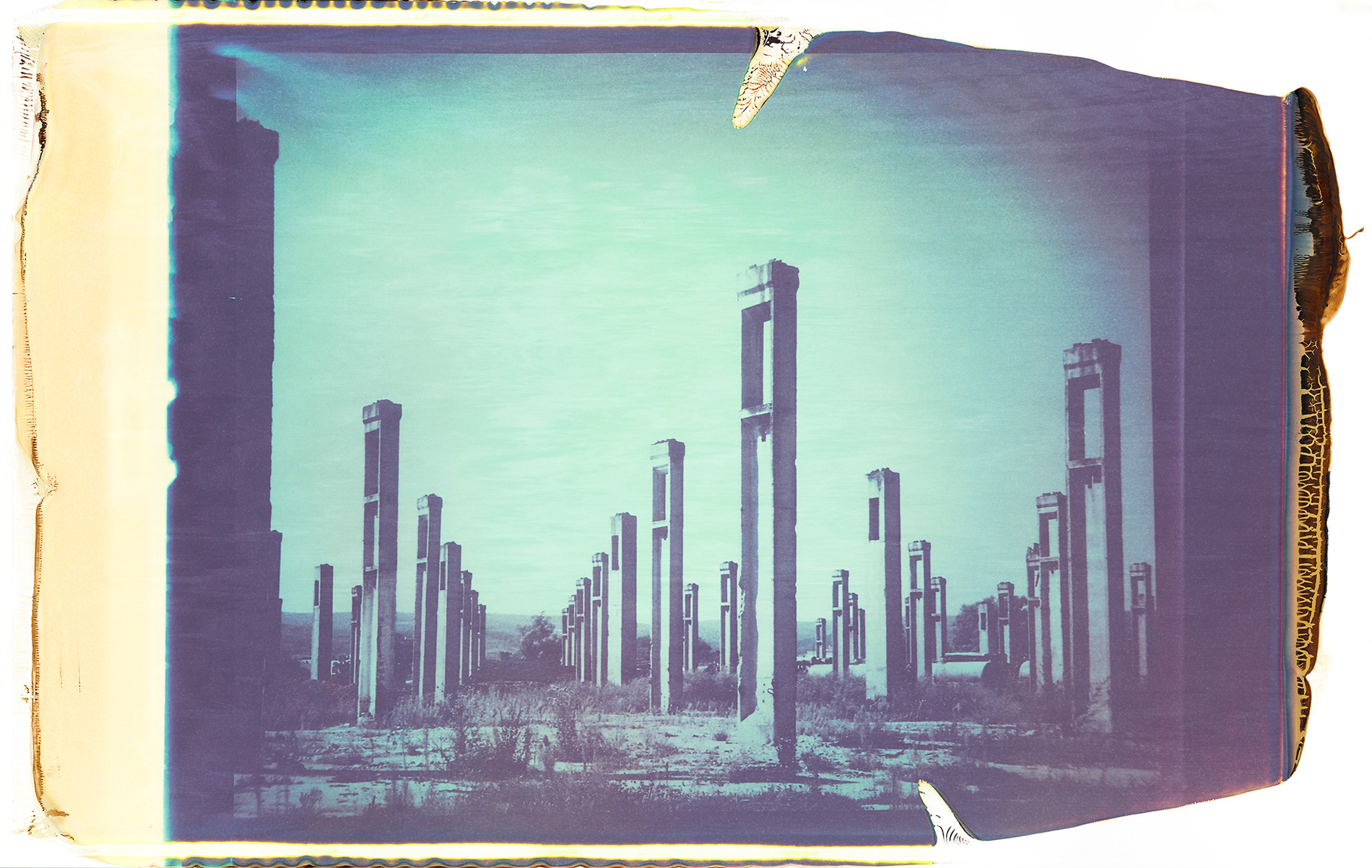
Ema Lančaričová, from series Photopia, Polaroid 20×25, 2025
Born in 1993, Ema Lančaričová works at the intersection of instant photography, experimental practice, and critical theory. Using Polaroid and other analog processes as her primary tools, she investigates the photograph’s fluid character today—its oscillation between presence and disappearance, material trace and ephemeral information.
Her practice consistently returns to themes of visibility and invisibility, image instability, and the temporal fragility of photographic materials. She approaches each work as a small archaeology of the medium, probing how images emerge, erode, and persist. Questions of authorship, material agency, and the limits of photographic evidence run through her projects, shaping an artistic research that blends tactile experiment with conceptual reflection.
Lančaričová completed her doctorate at the Academy of Fine Arts and Design in Bratislava, where she now teaches and contributes to contemporary debates on photography’s shifting ontology. Her work has been exhibited internationally in solo and group shows, including Fotohof (Salzburg), Rotlicht Festival (Vienna), Photon Gallery (Ljubljana), Fotografic Gallery (Prague), and Gandy Gallery (Bratislava).
Cite this article
Lančaričová, Ema. “Concrete Phantoms: Photography at the Edge of Presence – PHOTOPIA.” Photography and Essay. Journal of Black Mountain College Studies 17 (2026). https://www.blackmountaincollege.org/journal/volume-17/lancaricova/.