

I – Introduction
On a wet autumnal evening in West Germany, 1980, the songs of Black Mountain College came to Berlin. The occasion was the opening of an exhibition held at the Bauhaus-Archiv’s new building—an iconic structure whose five rectilinear segments rise up five storeys from the ground before curving back in saw-tooth formation, high windows perfectly designed to guide diffuse north light into its numerous exhibition halls. The building, designed by Bauhaus founder Walter Gropius, was well-suited for a moment of transatlantic cultural exchange. Situated on Klingelhöferstraße in the heart of the Tiergarten neighbourhood, the event was a stone’s throw from Mitte, Berlin’s embassy district, and thus a fitting home for an art and design movement that had, by 1980, become a global enterprise. Famously, the United States played a vital role in the reception and continuation of Bauhaus aesthetics during the political ruptures of the 1930s; the completion of the building might have been seen as a spiritual homecoming after an optimistic moment of Cold War détente.
On this occasion, the American representative was John Evarts, a pianist and founding member of Black Mountain College who had worked alongside Bauhaus luminaries Xanti Schawinsky and Josef and Anni Albers during the first eleven years of the school’s twenty-four-year lifespan. Decades later, Evarts had become a familiar face in West Berlin. Moving there in 1946 after aiding in the Allied radio propaganda effort, the majority of his professional career had been spent at a variety of cultural institutions dedicated to the promotion and organisation of German classical music. Now retired (and performing two days after his seventy-second birthday), he was met with a convivial atmosphere. It was opening night for “Sturm” und Bauhauszeit, a retrospective of German painter and architect Georg Muche, the youngest design master of the Weimar Bauhaus. To begin proceedings, the founder and director of the Archiv, Hans Maria Wingler, advertised “a musical surprise” to inaugurate Muche’s work: a series of piano “chansons” composed by Evarts during his time at Black Mountain. At this institution, Wingler explained, “the spirit of the Bauhaus took on a particularly sensitive form,” linking the “elegiac moods, popular-song and folk-song elements” of Evarts’s music with a “vigorous protest against the fascism that had become a threat to the world.”[1] With singing by Charles Williams and celebrated soprano Paulette Marla, Evarts was thus characterised as an inheritor and caretaker of anti-fascist German modernism, and the symbolic resonance of an evening dedicated to art that had been illegal just fifty years before was not lost on him. Following the performance, he sent tape recordings to fellow College founders Barabara and Ted Dreier. Scrawled on one of the programs, he enthused: “Who could have imagined in 1939 that these songs would be heard in Berlin in 1980? Quite incredible!”[2]
The explicitly anti-fascist content of Evarts’s “chansons” are one reason to see the performance as a particularly potent symbol of political and cultural change, but Evarts had another reason to be incredulous. Wingler’s linkage of Evarts’s and Muche’s artistic sensibilities was not intuitive. When Evarts did start playing, he treated his audience to a roster of songs mostly excerpted from his and William McCleery’s satirical piece of musical theatre Let Me Have Air (1939), a campy melodrama in which a New York cigar adman returns home and is aghast to find his family wheezing from tobacco smoke. Following his quest to restore green spaces and liberty to a proto-fascist America caught in the lures of industrial corporate greed, the songs are a tongue-in-cheek send up of folksy progressivism set to the chord progressions of the Great American Songbook. When put in front of an audience primed for the interwar European avant-garde, it is difficult not to imagine a certain degree of perplexity at the parochialism of ‘I’m a fool for freedom’, whose singer wails that he is “Carazy ‘bout democrasy!”; or the anti-urbanism of ‘Let me have air’, a song bemoaning the lives of “neurotic mice in a piece of steel-and-concrete cheese.”[3] Despite Wingler’s attempt to ground a politically and aesthetically unified lineage, Evarts’ songs might have seemed out of step with the neo-Cubist paintings and clean functionalist designs that were on display around him.
At the same time, this lineup’s apparent eclecticism might remind us of what we lose when institutional legacies are enshrined. Schools as complex as Black Mountain are often made legible through metonymy; their stories are bound up with the contributions of practitioners who would subsequently find fame in discipline-specific canons. Landmark publications such as Helen Molesworth’s Leap Before You Look (2015) and Black Mountain: An Interdisciplinary Experiment (2015) have firmly established the institution’s importance by drawing together its networks of notable individuals and patchwork traditions.[4] Through these publications, Black Mountain has become not simply a unique historical site but a representative one; a lens through which one comes to know radical American art in the twentieth century. And yet Black Mountain was also full of students, amateurs and practitioners who did not find subsequent fame; the archival record of their achievements at the College is necessarily preceded by the renown of their more illustrious colleagues. The question remains how we do service to these practitioners on their own terms. What contexts do we assume in assessing their contributions?[5]
To some extent, it is understandable that the musical legacy of John Evarts has been overshadowed. In histories of the College, his achievements have principally been understood through his role as a facilitator. Beloved by students for his deft hands at the piano, he established an entire department during the College’s founding years, a decade before it would consistently attract world-famous composers onto its staff. As a practitioner, Evarts worked best in group projects which required collaboration: Let Me Have Air involved the participation of practically the entire college; and his score for Danse Macabre (1938) was written under the helm of Xanti Schawinsky’s “Stage Studies” class. The result is that he is often positioned as an accompaniment, midwifing the higher designs of his colleagues, despite archival evidence of thoughtful compositions that were part and parcel of the College’s sonic life. The fact that these projects were largely derivative works unlikely to merit renown on the national stage is perhaps reason enough for musicological neglect, but in this article I use surviving scores and recordings to tell a different story—one which allows us to re-hear the social and interpersonal dynamics of a fledgling College still struggling to find its feet.
Thanks to the efforts of Heather South at the Western Regional Archives, we now have a body of scores and records available to the public which demonstrate Evarts’s flamboyant and tongue-in-cheek style. In what follows, I attempt to ground this style within the story of a developing musical sensibility, contextualising the embedded recordings and recovering Evarts not simply as a facilitator, but as a particularly notable amateur composer in his own right. I argue that Let Me Have Air was an intentional intervention into the social landscape of Black Mountain, emerging at the unstable meeting-point between progressive pedagogy, amateur performance, queer social experience and the contradictory democratic ideals upon which Black Mountain staked its identity. In these songs, I hear conflicted, tonally restless odes to Black Mountain—pieces which owe their poignancy to Evarts’s often fraught struggle to find his place within a community that is now inseparable from his name.
Let Me Have Air
I’m a Fool for Freedom
II – Finding the right tune
John Evarts was born in 1909 in Windsor, Vermont, to a pedigreed family within the liberal political establishment. He would later write that, as a child, “the bigness of the family naturally impressed me—and […] the shadow of the commanding figure of ‘your Grandfather’ was always present”.[6] The career of William M. Evarts (1818-1901), a high-profile Republican who had served as Senator, US Attorney General and Secretary of State under various Gilded Age presidents, was certainly a lot to live up to. Over the generations, his line had produced a small army of WASPish lawyers and academics, almost all of whom were Yale men. Evarts himself would go on to follow this trajectory, if only to a point. As a child, he displayed a natural aptitude for music, but quickly ditched the violin for the piano. In the cover letter for his application to teach at Black Mountain, he told John Andrew Rice that, “to relieve my ears from the horrible noises that the violin often produced, I would play hooky at the piano and work out my own system of playing tunes and accompaniments, imitating the music that my older brother used to play”.[7] So began a life-long romance with the instrument, a vehicle of expression which, for Evarts, was already less a discipline than a refuge from the routines of the classroom.
When it came time for Evarts to enrol at Yale in 1926, these early enthusiasms had morphed into an ambition to become a composer. Packing his schedule with as many music courses as he could, he also served as a critic for the Yale Daily News. His reviews from the period demonstrate a commanding (if naturally sophomoric) voice. Most often, they provided an outlet for the wealth of ideas with which he grappled in class, and opportunities to demonstrate a keen ear for musical complexity. As a writer, his voice was strongest when making cleaving aesthetic judgements: Ravel, or so the young composer argued, has “the necessary more” to compensate for “acute cleverness in technique”; Brahms, he insisted, “was a neoclassicist.” But Evarts would save his most contentious opinions for his “Cadwallader Cadence” columns. In the tradition of British eighteenth-century satirists, Cadwallader was a fictitious correspondent: an epicurean, ironical old Don who had seen it all before and responded with a raspberry. Most often, conversations with Cadwallader were used to report on concerts that Evarts had seen abroad, and he was a persona well-suited for Wildean lampoons:
“[…] as for the ballet itself, it is lamentably poor. The London audience did not know whether to take seriously the allegorical symbols of Apollo as he inspired the Muses; all over the house you saw suppressed grins or blank, bored expressions. I made no effort to suppress laughter at such un-beautiful and ridiculous antics.[…]”[8]
Likely based on Evarts’s own music tutor, James Leyburne,[9] Cadwallader provided an aspirational archetype of mastery during a period in which Evarts struggled with his own self-expectations. Cadwallader’s flourishes exude a playful self-reliance: encyclopaedic knowledge dashed off as an afterthought; an ironical delight in how the pure heights of music abrade the pretentions of the concert-goer’s milieu. Moreover, Evarts developed in this column a parodic technique that also influenced his music. In a “pianologue” script written during this time (“The Cosmopolitans”), Evarts satirized upper-class Americans in Europe by ventriloquising increasingly ridiculous confusions in communication.[10] If Cadwallader was an exaggerated representation of musical expertise, Evarts’s turn to parody seems to imply a kind of alienation from the voice that he, in his “own” articles, was attempting to imitate.
Such ambivalence could often be more straightforwardly directed towards the storied halls of Yale University. As a critic, he would trenchantly defend the oft-maligned New Haven Orchestra against what he saw as Yalie elitism;[11] and while there is some evidence to suggest that he knew and admired members of the Glee Club, his most creatively productive periods occurred during summer vacations, as he transcribed scores and performed with the “Jitney Players,” a semi-professional New England touring group specialising in melodramas and light classics.[12] It was during these tours that Evarts developed a possibly romantic relationship with James L. Shute, a graduate of the Museum of Fine Arts School in Boston who had cut his teeth working at the Provincetown Playhouse as an assistant for experimental playwright Eugene O’Neill. Despite the heightened rhetoric of his Yale Daily News articles, it is significant that Evarts’s creative partnerships developed best within semi-professional ensembles, and in spaces far-flung from gaudy opera houses and concert halls. In Shute, Evarts found a musical and theatrical kindred spirit. In 1929, he accompanied Evarts on the latter’s trip to study piano in Germany, during which they spent a summer busily touring the theatre scenes of Paris and London, swapping notes and honing aesthetic judgements with Cadwalladerian flippancy.
The trip, however, did not begin auspiciously. If Evarts had leapt into his first year at college with youthful abandon, by the close of his junior year an awareness of his own limitations could not be ignored. Judged by his tutors to have insufficient skill in both technique and sight reading, he was advised to spend a year studying in Germany, dedicating himself to the piano in a culturally rich environment. As he and Shute hung around New York waiting for the boat to leave, Evarts was in miserable spirits. A bon voyage letter from his music tutor came, and (although the contents remains unknown) did little to reassure him. Reading it in his cabin as Manhattan faded into the horizon, he later wrote in his diary that, “Though I resented a few things, I realized the truth of much that he said about my future and music and consequently felt depressed.”[13] Evarts’s crisis of confidence dampened his will to produce. He continued to report feeling unenthusiastic, barely able to touch the piano, and Shute—who had just received his own recent string of rejections—could provide little comfort.
A chance meeting in the ship’s First Class ballroom revived his spirits. Although the pair travelled in Third, their demeanours were naturally drawn to that transitory blend of community and prestige synonymous with early twentieth century transatlantic travel. On his first solo trip to Europe two years earlier, Evarts had spent practically every night sitting at the piano, hobnobbing with the voyage’s well-known partygoers and amiably performing whatever song they demanded of him. This time round, Evarts was more reticent, but the penultimate night before docking in Plymouth, the ship organised a makeshift “musicale”, and, as one of a handful of pianists onboard, Evarts was all but obliged to contribute.
“Well,” he reported later in his diary, “my pieces went off like an explosion. I was honestly surprised at the spontaneous and loud applause.” Of course, a warm reception would be enough to give any insecure performer a boost, but present that night was a figure whose opinions Evarts was particularly inclined to take seriously. Over highballs afterwards, he was introduced to Hedi Katz: a graduate of the Royal Academy of Music in Vienna, and co-founder of the Henry Street Music School in New York. During their conversation, Evarts unloaded much of his bitterness and confusion surrounding his Yale education, but Katz encouraged him. Underlined in his diary, Evarts reports her saying “I have the stuff in me”, and that she particularly praised his facility for improvisation. Indeed, their conversation was constantly interrupted by adulatory audience members, who never failed to ask where they could get “those clever arrangements”—referring, of course, to passages spontaneously produced from Evarts’s head.
The meeting with Katz is significant because it is the first documented instance of Evarts coming into contact with an influential figure in the field of progressive education. As one arm of the Henry Street Settlement (a Progressive Era institution founded in 1893 by the feminist reformer Lillian Wald), Katz’s music school aimed to foster a new generation of American musicians with a more authentic sense of national identity. In the early twentieth century, classical music in the United States was still widely understood as an old world import, and the dominance of German Romantic models was often taken as evidence of American culture’s creative dependence. At the same time, distinctly American forms such as spirituals and the blues were frequently categorised as primitive folk materials requiring cultivation before they could enter the concert tradition. Wald’s decision to employ a Viennese prodigy as the head of her music school is symptomatic of these attitudes, but her role was understood in much broader terms than the bestowment of European refinement upon a lumpen American culture.[14] Katz believed that America stood “on the threshold of a musical renaissance”—one whose emphasis on group singing and live chamber music proactively shaped an inclusive environment in which a broader proportion of American voices could participate.[15]
It is easy to imagine the contrast Evarts saw between his own situation and that of the Henry Street Music School. Shipped off to Europe to gain technical proficiency under the cloud of inadequate grades, here before him was a pedagogical tradition travelling in the opposite direction. For Katz, European musical culture could serve as a catalyst for American renewal—one in which Evarts’s homespun facility for improvisation and popular song could be admired in equal measure to his interpretations of Beethoven and Grieg. And while Evarts would spend the remainder of the year honing his classical repertoire in Berlin and Munich, it is nonetheless clear which way the wind was blowing. Cadwallader Cadence, however affectionately performed, was a throwback to another age—one who twiddled with his cosmopolitan refinements but ultimately came off as an ineffectual windbag.
III. Arrival at Black Mountain
After leaving Yale without taking a degree in 1930, Evarts remained determined to become a composer. He spent another year studying in Germany before pressure from his family to find gainful employment drew him back to the East Coast. In New York, he took up a role as music master for the Millbrook School for Boys, where he had considerable freedom to apply the lessons of Hedi Katz. But like many idealistic and unpractised teachers, Evarts found this experience disheartening. Unable, in his words, to get “boys of that age to sing or to enjoy trying,” he left the school after a year, cobbling together a living from newspaper criticism and private tuition instead.[16] Still, his interest in professional teaching had not waned. In the summer of 1933, he attended the Concord Summer School—a national hub for music educators, composers and performers, overseen by the champion of progressive musical pedagogy, Thomas Whitney Surette. Over these weeks, Evarts must have made an impression. When two of Surette’s contacts, John Andrew Rice and Theodor Dreier, approached the veteran musicologist with talk of a new university taking shape in the Appalachian highlands, Evarts was personally recommended as the fresh young talent Black Mountain needed for its music programme.
It is difficult to overstate Surette’s importance for the growth of Black Mountain College during its fledgling first decade. Born in 1862 within the Transcendentalist intellectual elite of Concord, MA, Surette had more reason than many of his neighbours to espouse the doctrine of “self-reliance”. Pushed into destitution by his family’s bankruptcy as a child, he was a musical autodidact. With barely a high school diploma to his name, Surette’s early cultivation of amateur singing groups had, by the turn of the twentieth century, morphed into a life-long crusade for reform in general education.[17] In contrast to Katz, who specifically advocated the cultivation of a new generation of “professional musicians,”[18] Surette came up through The American Society for the Extension of University Teaching, a private organisation dedicated to educating a broader spectrum of citizens in contexts far removed from the conservatory. As Denise von Glahn argues, the Extension Society was rooted in the missionary sensibilities of Christian settlement movements; for its directors, education was as much a matter of moral and spiritual awakening as it was a distribution of practical and intellectual tools.[19]
By the time Surette established the Concord Summer School in 1915, this influence was on full display. In particular, his teachings fused a Deweyan sense of art as a pragmatic social good with the idealism of Romantic and Symbolist poetry. Writing in his diary after a particularly engaging lecture, Evarts fixated most upon Surette’s rhetorical style, a discourse which juggled erudite literary reference, musical description and practical observations. In Evarts’ words, Surette attempted to:
create a kind of confusion in people’s minds from which he helped them to create a more significant order which would encompass more things—a greater sense of the unity of the arts—the importance of poetry; the one-ness of human endeavours—the greater awareness which we should have.[20]
As explored below, this oscillation between confusion and order would become integral for Evarts’s compositional style, but in the short term Evarts took from these lectures a literary field of reference that deepened his affinity for Romantic composers. His first composition at Black Mountain was a setting of William Blake’s “Never Seek to Tell thy Love”—a poem he likely first heard at Surette’s summer school. The choice of text is significant. In the poem, Blake’s speaker mourns his lover’s departure after he over-expresses his love for her; the poem’s titular admonition presents love as an impersonal force that exceeds language’s capacity to represent it. For both Surette and Evarts, the experience of art, as with love, could not be contained by a single representational form; it required a productive “confusion” through which familiar languages of experience were infused with an immanent, “more significant order”.
The affinities between Black Mountain’s holistic pedagogy and Surette’s cosmic pragmatism spoke for themselves, and Surette was tireless in his material support for the College. Between 1933 and 1937, fortnightly letters from Dreier kept Surette afloat on all the campus comings and goings; Concord became a pipeline for prospective students and staff, and Surette’s role as music advisor for the John Simon Guggenheim Memorial Foundation was one pillar of an informal institutional relationship that gave Black Mountain public credibility. For his part, Evarts structured the music curriculum on Surette’s blueprint: his courses, entitled “Music Appreciation,” began with an “emphasis on awakening [the student’s] imagination, sharpening their ears, attempting to relate music to their own experience and life around them.”[21] Such an approach gelled with pedagogical approaches practiced elsewhere in the College. Much like Josef Albers’ matière and design classes, Evarts discouraged an approach centred around the teaching of historical “great works” (a doctrine that had been pivotal to his own education at Yale.) “It would be foolhardy,” he argued, “to begin a study of the history of music when many of the students’ ears are still sluggish and unperceiving”. His introductory classes thus emphasised listening and composition, allowing students to “[begin] almost immediately to work in the medium,” underlining Black Mountain’s central creed that knowledge is best achieved by doing.[22]
Outside the classroom, Evarts was a staunch promoter of the College’s mission. In 1934, he wrote an article for Winston-Salem’s Journal and Sentinel, in which he attempted to drum up sympathetic interest in the College by highlighting its social novelty. His cataloguing of Black Mountain’s innovations echo many of the promotional materials drummed up by College staff during the early years, but Evarts was particularly inclined to stress how Black Mountain challenged the hierarchical relation between teacher and student. “The students are not ruled from above,” he argued. “In the life of the place there are not two groups, with a distinction between faculty and students, but one social unit, a community of individuals who are regarded as mature people.”[23] In daily College life, Evarts took this sense of community seriously. According to the College’s first official student, Anne Chapin Weston, Evarts’ ability to play by ear allowed him to suffuse Black Mountain’s evening dances with a range of genres distinct from those covered in Music Appreciation. Scottish dancing, Polish mazurkas, Appalachian square-dancing and more familiar popular songs combined to give the sense that art “was simply in the air all the time”, providing a musical education whether one took his classes or not.[24] For John Stix, Black Mountain’s first graduate in music, Evarts “was an institution” in himself, shining most through “his great capacity to relate to people. He was a one-man welcoming committee. He was a one-man[…] counseling committee, if you were depressed. He had all kinds of radar.”[25] After many years drifting around the world struggling to find his feet, in the early years of Black Mountain Evarts had found a home—one in which his naturally empathetic bearing and flair for musical improvisation would come to be cherished.
The picture was not always so rosy. Black Mountain’s apparent dissolution of the boundary between student and instructor could be a messy negotiation. In Evarts’ first term, he became infatuated with a student named Ed Jenkins, and the ensuing love triangle between them and another student jeopardized Evarts’ place in the College before he could find his feet. It is easy to see why Jenkins appealed to Evarts. A Harvard dropout who had spent some years as a sailor, Evarts and he bonded over a shared love of Romain Rolland’s ten-part series of novels Jean-Christophe, his naturally romantic and idealistic demeanour inspiring the epithet “handsome Hamlet” in Evarts’s journal.[26] When Jenkins rebuffed his advances, Evarts seems to have suffered a brutal—and very public—nervous breakdown, where the intricacies of the affair were laid bare for the entire college to see. Such vulnerability put considerable strain on his authority as a teacher. In the weeks before the Christmas vacation, Dreier wrote to Surette saying they were considering letting him go,[27] and Evarts returned to New York certain that he had blown the opportunity.
In a certain sense, it is understandable that Evarts’s empathetic “radar” hampered his pedagogical authority. He was, after all, still new to teaching, and likely felt himself to be closer to his students than the much older and more experienced teaching body. In Dreier’s words, “He is so soft and dependent and [the students] feel it, and dislike it, and so they do not have a good feeling about singing under his direction”[28]—although the adjectives “soft and dependent” betray a less reasonable criticism of his character. In his journal, Evarts reports coming under constant fire from Rice’s student acolytes in the wake of the scandal: he is publicly denounced for insincerity, overdramatization and deceptiveness. Frank Rice, recollecting the event some years later, would not bother with innuendo. “They were sceptical of his ability and did not hesitate to say so. […] Added to this, some of the students intensely resented his mild homo-sexual tendencies.”[29] Hauled in by Rice at the end of the semester, Evarts was warned against publicly affirming his sexuality. The issue at stake was not principally his well-being, nor his performance as a teacher, but the risk of reputational damage if it became known that Black Mountain employed openly queer staff.[30] In Emilio Williams’s words, the episode is yet another reminder that “No matter how utopic, the Black Mountain College before the Second World War was still heavily rooted in the limitations of America”;[31] limitations that were another reason for Evarts to seize upon the poem “Never Seek to Tell Thy Love.”
Ultimately, Evarts was too well-liked to eject. According to Dreier, the quality of his classes and his centrality for evening entertainments was essential,[32] and as the student body diversified away from its initial makeup of Rollins-era Rice devotees, Evarts found a voice in a community less inclined towards the group policing of moral “self-improvement.” And yet his struggles were by no means over. Evarts’s apparent deficiencies as a choral director were a constant thorn in his side, especially given the premium placed upon group singing by Surette, who remained the ultimate authority when it came to sanctioned pedagogy. As von Glahn’s painstaking archival work has reconstructed, Evarts was subject to constant scrutiny by Dreier: he was criticised for hammering too hard at the piano, being impatient with the limitations of amateur singers, and hyper-fixating on harmony at the expense of timbre and accent.[33] As we have seen, these purely technical criticisms frequently veered into the personal: whatever Evarts’ faults, it was clear to both Surette and Dreier that they exemplified a wider problem with his character. In the summers of 1934 and 1935, Evarts would again go to Concord to learn at the feet of the master—experiences that he mostly enjoyed, but ones that came under the cloud of severe professional judgement. To compensate, Dreier eventually employed another disciple of Surette’s, Allan Sly, onto the music faculty in 1935. While this appointment might have seemed an affront to Evarts’s authority, in practice it relieved him of the pressures bestowed upon an inexperienced teacher barely out of college. Sly and Evarts would make a good team, and by the mid-1930s the music department went from strength to strength, attracting prestigious guest performers and a greater quantity of musically talented students.
Evarts’ ambivalent first years at the College do nonetheless make clear a wider problem with both Surette’s and Black Mountain’s commitment to educating “the whole man.” When learning stops being a matter of acquiring a set of discrete skills and becomes the holistic emergence of a fully-formed person, what to do when a student or teacher fails to live up to expectations? How can anyone sidestep prejudicial expectations of what that person should look like? In his application to Rice, Evarts spoke of his belief in music as “a living element, not set aside for the special few, not an effeminate ‘high-brow,’ salon enjoyment”—but the denial of such queerly coded language clearly demonstrates a lacuna in Evarts’s expectations of what parts of himself were worthy of inclusion.[34] In this sense, Evarts could be rattled off as a victim of one of Black Mountain’s cruellest conceits: that the “organic” function of its democratised community would necessarily result in fuller, less damaged human beings. But to stop the story here would be to ignore the way in which Evarts responded to his initial struggles and the agency he demonstrated in his continued commitment to Black Mountain’s ever-veering trajectory. During the mid- to late-1930s, he began to compose his first serious musical works, and in so doing he articulated a vision of democratised performance that quietly undercut some of Black Mountain’s louder and more artistically grandiose voices.
IV – Let Me Have Air
Performances at Black Mountain during the 1930s are often framed through the lens of amateurism, although to staff present at the time this would likely not have been an insult. To paraphrase Mary Emma Harris, during these years it was better to be an amateur than a dilettante.[35] For John Dewey, education was “not an affair of ‘telling’ and being told, but an active and constructive process”—amateurism could be understood as a pedagogical virtue, provided it emerged through reflective experimentation.[36] The intellectual challenge of assessing Black Mountain’s amateur productions, however, lies in learning how to read them on their own terms. Often lacking documentation, they were not (on the whole) undertaken for posterity, emerging in contingent social contexts that could prove as changeable as the winds. And while the majority of these performances are not likely to be judged as timeless aesthetic achievements, they do nonetheless come alive within these contexts; through the often dissonant expectations and ambitions of their participants.
Evarts rarely turned down an opportunity to collaborate. Even during the peak of the Ed Jenkins affair, he still found time to practice with students for short performances at the Saturday night concerts, following which he would perform “musical portraits”: light-hearted caricatures aimed at the foibles and intellectual pretensions of his fellow Black Mountaineers. With the arrival of former Bauhausler Xanti Schawinsky in 1936, he provided the soundtrack to the dramaturge’s theatre of “total experience,” and in one case pretty much took over from Schawinsky as the latter recoiled from the direction his students wanted to take the performance.[37] But one of the more mysterious projects in which he was involved came two years later, in the form of Let Me Have Air: a full-length work of musical theatre co-written by students, directed by Drama instructor Robert Wunsch, and with songs by fellow dramatist William McCleery and Evarts himself.
With Let Me Have Air, Evarts found himself in good company. Wunsch had been one of Rice’s supporters during the schism at Rollins University and had taken his place on the permanent teaching staff at Black Mountain in 1935. Out of all the early faculty members, it is fair to say that he showed the most interest in widening Black Mountain’s appeal beyond its cloistered self-awareness as a radical College planted upon hostile terrain. A graduate of the University of North Carolina, Chapel Hill, and former teacher in high-schools across the South, his associations with the Carolina Playmakers and the Carolina Dramatic Association also gave him a keen sense of regional topography. Wunsch was central in obtaining Black Mountain’s weekly slot at the local Asheville radio station, and on many occasions he organised field trips to neighbouring schools and communities. One of these initiatives included a memorable series of trips to Winter Park, Edenville, to encourage and learn from the rehearsals of a Black amateur theatre society founded by Zora Neale Hurston.[38] As a closeted man well aware of Black Mountain’s broader place within a regional community, it is no wonder that Evarts often found in Wunsch a sympathetic ear for criticisms of the college’s often brutal emphasis on group cohesion. “[A]s Bob and I said,” Evarts wrote in his journal after one particularly fractious community meeting, “this intolerance is a defensive thing—damning other people to build up their own feelings of security.”[39]
Let Me Have Air would bear little of the self-seriousness on display at faculty meetings. From the beginning, it was pitched as a comic melodrama, at once satirising and celebrating folksy progressive theatre. Its thematic inspirations can be located in the socially conscious works of the 1920s and early 1930s, such as Kaufman and Ryskind’s Strike Up the Band (1927) and Of Thee I Sing (1932). With music by George and Ira Gershwin, these biting lampoons of American corporate greed and cynical political systems garnered unprecedented success on Broadway, with numbers like “I’ve Got a Crush On You” and “Soon” subsequently entering the Great American Songbook. While many participants would wistfully look back on Let Me Have Air as amateurish or “naïve”, its debts to these plays nonetheless imply an active engagement with self-consciously “middlebrow” traditions that sought to combine sophisticated political satire with accessible popular entertainment.[40] Performing in the aftermath of a bruising factional schism that saw Black Mountain’s founder, John Andrew Rice, ejected from the College, students’ embrace of a political, popular cultural form is an early indication of a shift in College ethos that would further solidify during the early 1940s.
As a production, Let Me Have Air can be difficult to assess. No full script survives, and only half the numbers have been recorded in written or audio form. Of these recordings, most of them were transcribed by Evarts many years later for showcase concerts detached from their original context. The musical’s eponymous theme, “Let Me Have Air”, for example, was repeated throughout the original performance by various student singers; it is unlikely that we will ever get a concrete sense of how Wunsch mobilised the motifs to underline moments of narrative significance. In terms of plot, Mary Emma Harris has provided the most articulate summary:
The play, a spoof on the American dream of materialism and success, on facism [sic.] and on the Nazis, featured a young man [Caldwell Potter] who leaves his hometown of Wide Place, Kansas, to find fame and fortune in New York doing commercials for San Simeon cigars. On his return home to a hero’s welcome, he finds his widowed mother smoking cigars, which she keeps in her sewing basket. Shocked by his influence, he reforms and starts a radio program to sell people on things like clean air.[41]
A closer look at the programme allows us to make further speculations as to the play’s emotional beats. It begins in Mrs Potter’s home in Kansas, with Caldwell’s inciting commercial sung as a radio broadcast, implying a degree of ambivalence about the radio as a liberatory medium. If more responsible programming becomes the play’s narrative silver bullet, the mass medium nonetheless instigates its inciting dramatic irony. Similarly, the song “I’m a Fool for Freedom”, the play’s most explicitly anti-fascist number, is initially sung by Caldwell in his New York office. Caldwell is thus presented to the audience as conceited: his peans to the American system (“You try and make me a Nazi / And a hell of a row you’ll see!”) are ironized by his participation in the institutions that he will later come to know as crypto-fascist. When he realises his dream at the end of the play, the song returns, although this time sung by “Mr. Goldschacht” (played by Bela Martin), a presumably German character, underscoring transnational cooperation rather than jingoistic flag-waving. And of course, the musical has a love story: two numbers, “The Lift of an Eyebrow” and “I want to report a fire (in my heart)” reveal a romantic subplot with Ethel Marlowe (Jane Clark) that affirms the resolution of Caldwell’s political reawakening.
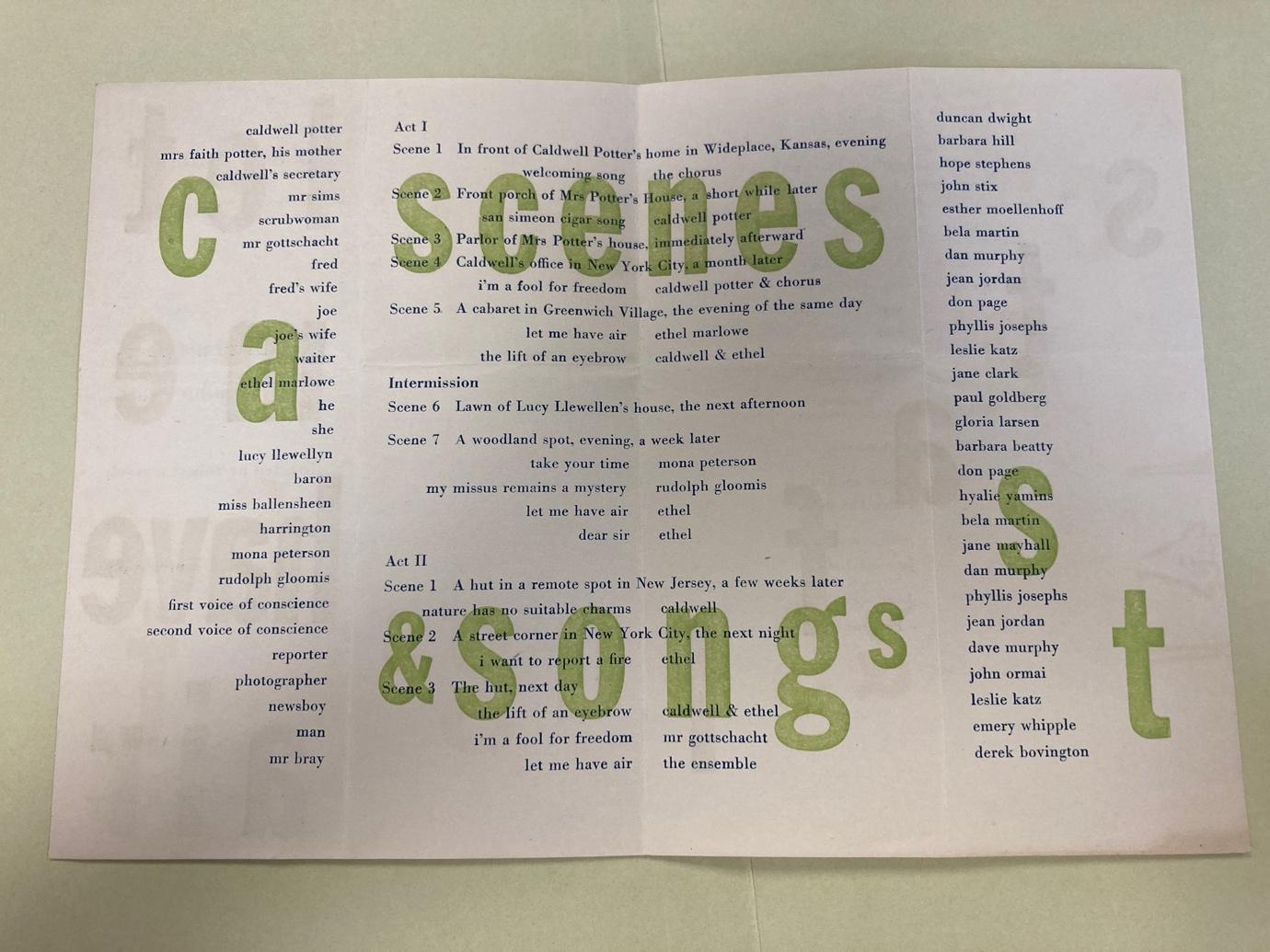
Figure 1. Let Me Have Air programme. Martin Duberman Collection (MDC) (series 1678.12), WRA.
If Let Me Have Air looked outward as a piece of socially conscious theatre, it also looked inwards, thematising the social dynamics of the College itself. In this sense, Caldwell’s journey is a prototypical piece of Black Mountain mythologising: disgusted by corporate capture and a stultifying mass society, he retreats to an isolated rural environment where he can dedicate himself to socially useful artistic labour. The songs themselves are also full of in-jokes: the villainous machinations of the San Simeon cigar corporation nod towards a running complaint made by singers at the College, that ostentatious smoking by audience members in the front rows during choral concerts hampered performance. One song in particular, “The Lift of an Eyebrow”, is titled after a quote from Louis Adamic’s Harper’s article, “Education on a Mountain”—a controversial piece of publicity that had elevated Black Mountain to national fame three years earlier. Adamic’s panegyric had presented the College’s most utopian commitments in strident colours, at one point arguing that community cohesion had been so well developed that “Some of those who had been there longest can[…] exchange complicated communications without saying a word. The lift of an eyebrow to them is a sentence.”[42] Despite the good publicity, many felt that Adamic’s praise had been misdirected: his triumph of “group influence” at the College, combined with his near-total emphasis on the vision of John Andrew Rice as an individual, struck a nerve with College members bristling under Rice’s authority. Staff-faculty meetings following the article’s publication would be dominated by the rhetorical slipperiness of the term “group influence,” and rebarbative suspicions that the utopian horizontalism promoted in College catalogues elided a more coercive cult of personality around Rice.[43]
Evarts and McCleery’s reimagining of this particularly contentious sentence in Adamic’s article was an attempt to reinterpret Black Mountain’s history through the lens of humour. After all, the schisms and debates following the article were three years ago (a veritable lifetime in Black Mountain temporality), in which time Rice had left the College and plans for an entirely new campus were already underway. Recasting one of Black Mountain’s most sacrosanct guiding philosophies into a cheesy love song served a dual purpose: it both released the tension built up over many years of factious squabbling, and encouraged Black Mountaineers to stop taking themselves so seriously:
I see now, in the lift of an eyebrow
A lovely sign that makes this heart of mine
Stop doing what it ought to doo-oo.When you’re near, and your eyebrow is up, dear
I’m far too weak to even try to speak—
But I can lift my eyebrow too.
The lyrics were written by William McCleery, a newcomer to the College employed on a temporary contract, whose outsider perspective might have been a breath of fresh air amid Black Mountain’s often siege-like mentality. And is it any wonder that Evarts and Wunsch—two members of the community who had particular reason to mistrust the harmonious model of organic “group influence”—would centre the song in a performance that so lovingly satirised the naivety of American innocence? While claims of amateurism may make repeat performances of Let Me Have Air unlikely, the play’s significance at the time recasts the function of the amateur. As one who creates out of love rather than experience, the naif can often see through concepts loaded with baggage and reveal the affective pulse giving them life in the first place.
The Lift of an Eyebrow
“Let Me Have Air” and “The Lift of an Eyebrow” would go on to become Black Mountain evergreens, performed regularly at College cabaret nights alongside other McCleery-Evarts collaborations, such as “Black Mountain Fight Song” and “There Ought To Be A Law At Black Mountain Against… Well, Something! Anything!” It is a testament to Evarts’s knack for a melody that these pieces would be so fondly remembered, but surviving records suggest more complex compositions than the general tone of Let Me Have Air might imply. One number, “Take Your Time”, is particularly demonstrative. In the musical, it is a pivotal song that likely convinces Caldwell of the benefits of life outside the city. McCleery’s slick, alliterative lines are playful, as student Jane Mayhall implores her listener to “cultivate a lackadaisical pace”; to “walk [not] run to the ultimate exit”, because they’ll “never live to see another today”. Evarts’s head melody has a similarly lilting, descending feel, reminiscent of seductive standards such as Vincent Youmans’s “Tea For Two”.
[‘Take Your Time’]
However, Evarts complicates the arrangement by upsetting the listener’s harmonic expectations. After a dreamy lead-in of chromatically rising and falling chords, the melody (“Take your time”) enters squarely in C Major, but Evarts immediately lends the phrase an expressive hesitation through accented appoggiatura, momentarily outlining a B-major sonority in the right hand before resolving into a lush relative minor. Then, on bar six, the introduction of dramatic modulation animates the arrangement through a series of tonal feints. For a piece written in common time (with the expectation of motifs beginning then resolving in four-bar segments), the repetition of the theme a bar early—now in Eb Major—at once interrupts our expectations of symmetry and transitions into an unexpected key not typically associated with C Major. The result is a dramatic, harmonically impatient accompaniment that refuses to settle, constantly redefining where we expect home to be. The effect is striking for a song whose lyrics celebrate rootedness and pastoral ease; the singer implores their listener to take their time, but the accompaniment is overeager, rushing through its changes and thus challenging the song’s propositional content. In miniature, the arrangement captures many of the aesthetic tensions that had drawn Evarts to Surette’s pedagogy years earlier: familiar forms animated by tonal restlessness; sound and image intersecting in productive confusion.
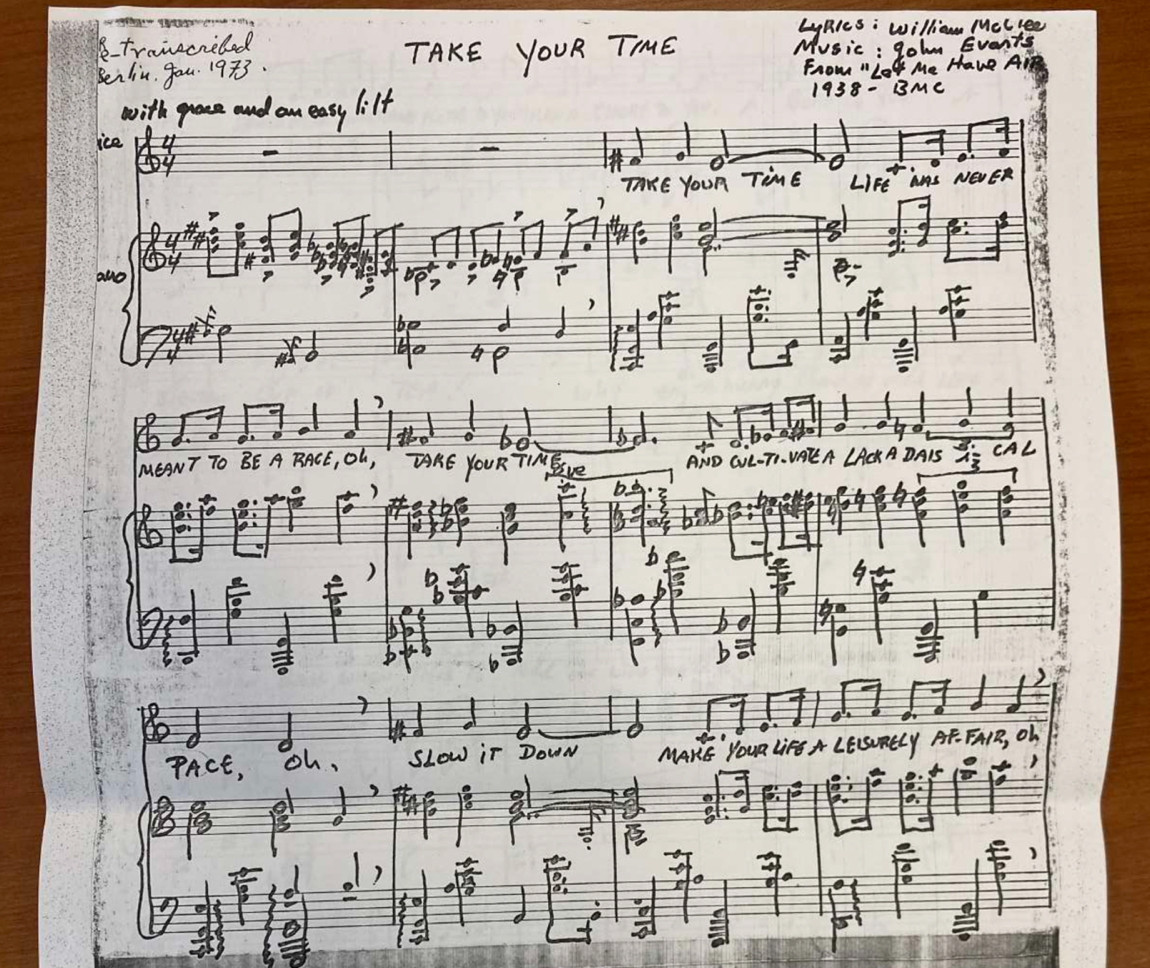
Figure 2. Score from ‘Take Your Time’, arranged by Evarts in 1973. BMCRP, (series 1970.5.70), WRA.
To be sure, none of these techniques can be considered particularly groundbreaking in isolation. The Black Mountain College of Evarts and Wunsch was a long way from the institution that would come to embrace internationally renowned musical avant-gardists such as Heinrich Jalowetz, John Cage or Stefan Wolpe. But heard within its institutional context, “Take Your Time” is indicative of a humorous, self-consciously middlebrow sensibility often lost in the shadow of the College’s more illustrious professionals. Combining the jazz standards that had first drawn him to the piano as a child; the ambitious harmonic languages he had lovingly unpacked in his Yale Daily News articles, and the ironizing spirit of Cadwallader Cadence, Evarts inhabited popular song in a way that was unmistakeably his own. What is more, his parodic approach to accompaniment was decisively pedagogical. Instead of rejecting familiar musical languages outright, Evarts preferred to gently stretch them, encouraging performers and listeners to re-hear ordinary popular song with renewed attentiveness.
Elsewhere in his Black Mountain compositions, Evarts would develop this pedagogical sensibility further. In Danse Macabre (1938)—a modern interpretation of medieval moral allegory, in which archetypal societal figures are confronted by the figure of “Death”—Evarts marks each encounter through a series of graspable yet harmonically distinct transformations. In “The Cardinal,” for instance, Death’s entrance is marked by discomforting chromatic bursts that antagonize a piece that begins in a stable Dorian mode. “The Astrologer,” by contrast, is almost a lesson in harmonic perception. Beginning with a skeletal melody above open fifths and drones, Death’s arrival is accompanied by the sudden appearance of complete triads and richer chromatic colouring. In “The Lady of Great Estate,” meanwhile, Evarts shifts the listener’s attention away from straightforward harmonic progression towards a more impressionistic sound world, where pedal points, instrumental timbre, and modal inflection become increasingly important. Evarts’ scores suggest that the performance functioned as musical pedagogy through drama: an omnivorous parody of compositional styles that demonstrated musical effects through the disjunctive interplay of accompaniment and narrative. “Death,” in Danse Macabre, was not codified through one compositional technique; rather, its presence catalysed a range of musical transformations.
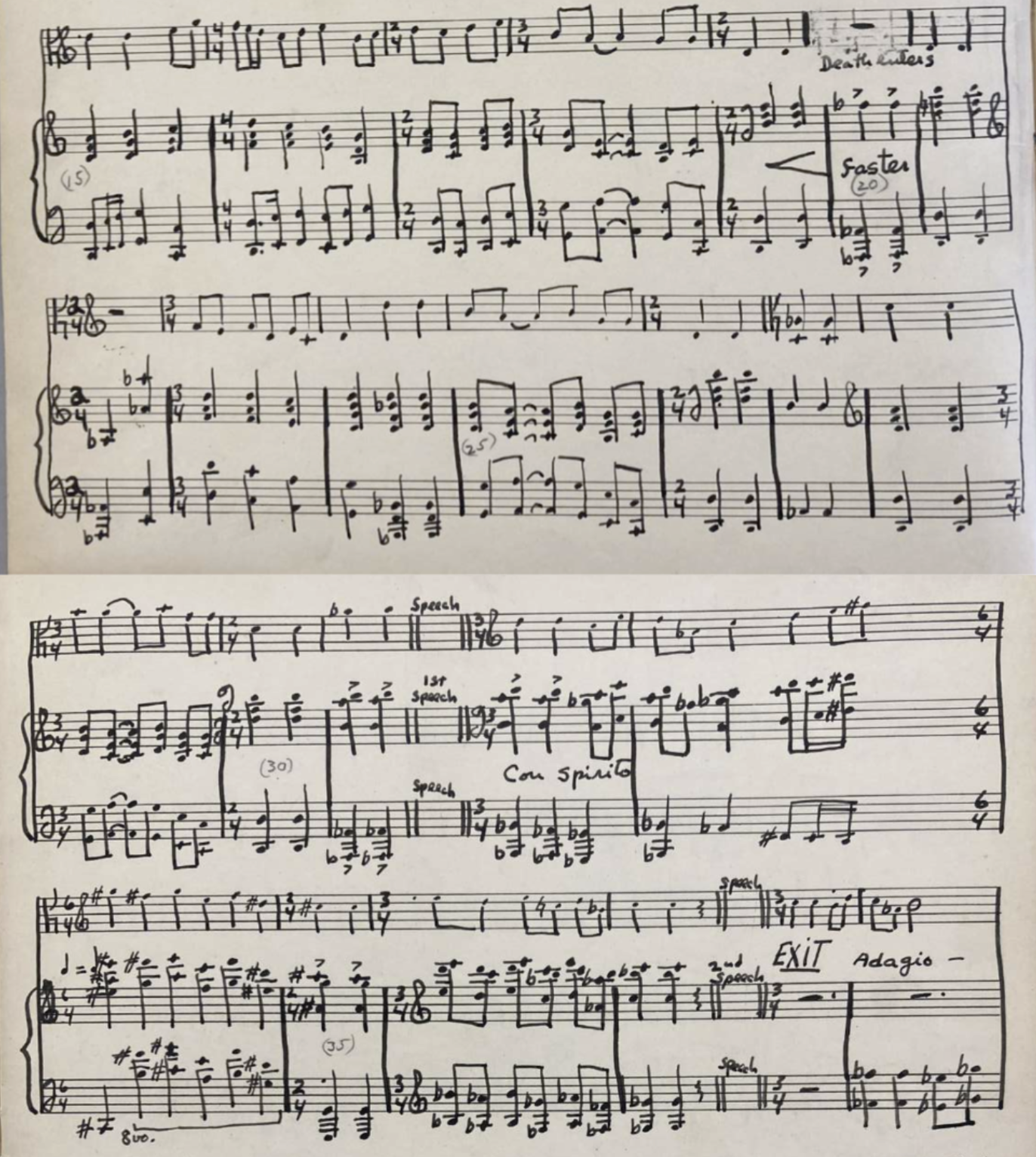
Figure 3. The entrance of “Death” in Danse Macabre’s “The Cardinal” section.
In all of these examples, what becomes clear is that, for Evarts, accompaniment was not simply a matter of straightforward atmospheric reinforcement. In Let Me Have Air especially, the piano was an interposing second voice, one that could recontextualise and subvert the narratives of a college often overburdened by its own sincerity. In “The Lift of an Eyebrow” and “Take Your Time,” Evarts’s piano took aim at both the concept of “group influence” and Black Mountain’s much-vaunted doctrine of patient experimentalism. In allowing students and faculty to laugh at themselves, his compositions promoted a healthy scepticism of the College’s own norms and values—a pedagogical approach that might deepen our understanding of “education outside the classroom.” In this more flexible and interdisciplinary social environment, amateur performance and “extracurricular” collaborations proposed a more pedagogically unruly form of education: one in which the ironies of the College itself were made audible, rebounding upon Black Mountain’s social space in the name of challenging its certainties.
V – Final movements
Following the production of Let Me Have Air, Evarts would remain at Black Mountain for another two years. During this time, the music department continued to grow, but by the early 1940s it had become unrecognisable from the barebones operation that Evarts had once headed. In particular, the College’s continued embrace of German-Austrian refugees suffused its musical life with an aesthetic commitment to modernism, most notably through the influence of Heinrich Jalowetz, who was employed by the College in 1939 and would go on to be one of its most beloved faculty members. Evarts, now a veteran Black Mountaineer with a strong command of German, happily made figures like Jalowetz feel at home, and he was also central in forging relationships between the College and institutions such as New York’s Coordinating Committee for German Refugees. In 1939, he struck up a long correspondence with the modernist composer, Ernst Krenek, who visited the College later that year and directed Evarts towards other notable visitors such as the musicologist Richard Goetz.[44]
One could view Evarts’s activities during this period as a passing of the baton. As Jonathan Hiam puts it, such a drastic change in personnel “established a musical culture at Black Mountain College that espoused the elite musical ideologies of the Second Viennese School, and it was this factor that led to Black Mountain’s hosting of the largest gathering of Schoenberg disciples ever to have been assembled in the United States.”[45] The gathering to which Hiam refers is the 1944 summer school, an occasion celebrating Schoenberg’s seventieth birthday, and one which would set the blueprint for Black Mountain’s expansive international summer schools of the later 1940s. The previous decade, Dreier and Rice had floated the idea of a summer school loosely based on Surette’s model at Concord, but it is striking to note the differences between the event that had drawn Evarts into the Black Mountain fold and the programmes that would go on to establish the College’s international reputation as a global hub for the arts. Concord had essentially been a one-man show, directed towards concrete reforms in general education, framed through the romantic frameworks of Surette, who often spoke with disdain about the pedagogical value of the “professional” musician. At Black Mountain, the post- 1944 summer programmes would be remarkable precisely for their artistic eclecticism, courting a diverse array of international talent that often had little to do with the College’s own pedagogical commitments. Furthermore, with the construction of the new campus already underway, the Black Mountain of the early 1940s was busy looking outwards, scaling up its operation and placing particular emphasis on its collaboration with storied professional artists.
Evarts left a completely different college to the one he’d helped found, and his final two years were spent less at the piano. Wunsch, now serving as College rector, gave him leave to travel around the country, leveraging his connections as he networked with various funding and publicity “prospects”. Despite his efforts, few of these initiatives found concrete success. In letters back to the College, Evarts wrote of feeling drained by the experience: “I’m used to being sent running around a maze. So-and-so sends you to so-and-so who keeps sending you to more so-and-sos who will be a superb contact to so-and-so.”[46] Nonetheless, one hears similarities in tone between these letters and Evarts’s youthful travel journals a year earlier. After almost a decade within the hermetic social world of Black Mountain, Evarts seems to have enjoyed his new life of promoting the College, filling his schedule with concerts and plugging back into the metropolitan lifestyles he had once savoured in Munich. One letter from Wunsch implies that Evarts’s absence from the College was less a practical necessity and more driven by Evarts’s own desire to stay on the road. In April 1941, his former collaborator writes:
The lack of definiteness in your plans has been the reason for your not having heard from me recently. Every day or so there was some fresh news about your return to Black Mountain College. Until now we are of the opinion that it is best for all of us not to expect you until we see you coming into Lee Hall.[47]
Wunsch’s tone is, I think, emotionally fraught. He at once reprimands his colleague, pleads for his return, while at the same time acknowledges that the decision lies, ultimately, in his hands. The next month, Evarts was drafted by the government to aid in its intelligence service, and Wunsch would write a formal request for deferral. Citing Evarts’s efforts at “money-raising and helping to direct a Work Camp” during a time of financial crisis, he states that his services are “practically irreplaceable.”[48] But one wonders if Evarts’s long absences from the College during this period were less a practical necessity and more motivated by a yearning for a change of scene.
Wunsch’s request for a year’s deferment was granted; Evarts ultimately relinquished his position as Professor of Music the following autumn. He was granted leave for the duration of the war, but by 1946 it was clear that his heart rested in Germany. Echoing the patriotic spirit of Let Me Have Air’s broadcaster protagonist, he wrote to the Board of Fellows that,
Because I believe that to a certain extent my present work contributes something towards realizing that hopeful phrase “Winning the Peace”, I think my decision to stay here has been wise. My request should in no way be regarded as a lack of belief or interest in Black Mountain College. I still have great faith and pride in the place.[49]
These were no empty words. Throughout the 1940s, Evarts would keep in contact with his old colleagues, sending them articles about his achievements in Munich, which were regularly pasted onto the College’s bulletin boards. Records also show a continued investment in his old students as they moved on in their professional lives. In its institutional memory, he would become synonymous with the spirit of the College’s pioneering years: a generous and flexible musical educator, whose love for improvisation and collaboration epitomised Black Mountain’s synthesis of learning through living.
But it would be a disservice to hold Evarts to a purely facilitatory role. His time at Black Mountain represented not only pedagogical success but creative productivity; his works indicate a musical sensibility thoroughly bound up with the social space of the College in its founding years. In this, Evarts is distinct. As the youngest and greenest member of the faculty, he did not import a ready-made artistic practice like Josef and Anni Albers, nor could he draw on a wealth of comparative experience in the fields of progressive pedagogy like rectors Rice and Wunsch. Fittingly, his collaborations in Let Me Have Air reveal a harmonically mischievous attitude, one which eschewed both the high concert traditions of his Yale education and bristled with the pedagogical schemas of Surette. In this sense, Evarts’s compositions—perhaps more than any other—give us access to something like the early College’s social sound: a self-aware, pedagogically accessible style inseparable from a fledgling and often dissonant community. As a matter of Black Mountain’s legacy, such works deserve more than remembrance. They must be heard.
Song of Elmar
[1] Musik-Program for Opening of the Bauhaus Archives, Berlin, September 18, 1980. Theodore and Barbara Loines Dreier Black Mountain College Collection (Dreir BMC Collection), 1925-1988, box 67(12), Western Regional Archives, State Archives of North Carolina (WRA). My thanks go to Melanie Sholz at the Bauhaus-Archiv for tracking down the full recording of the 1980 concert, including Wingler’s introductory remarks.
[2] ibid.
[3] Audiocassette of opening at Bauhaus Archives, Dreier BMC Collection, (Series 1956.67.12), WRA.
[4] Molesworth, Helen (ed.), Leap Before You Look: Black Mountain College 1933-1957 (Yale University Press, 2015); Blume, Eugen et. al. (eds.), Black Mountain: An Interdisciplinary Experiment (Spector, 2015).
[5] Recent publications have gone a long way in attempting to answer these questions. Hobby et. al.’s The Anthology of Black Mountain College Poetry (University of North Carolina Press, 2025) showcases an enormous number of student writing between 1933 and 1957; David Silver’s The Farm at Black Mountain College (Atalier, 2024) is notable for the centrality of student testimony in its historical account, and Beggs and Thomson’s Weaving at Black Mountain College (Yale University Press, 2024) makes excellent use of student notes to contextualise practitioners who have been generally neglected in previous histories. This paper sees itself in alignment with this new turn in writing on BMC, insofar as they all use the archive to renegotiate the terms of the College’s legacy.
[6] Evarts, John. “The House of Evarts”, Black Mountain College Journal. Black Mountain College Project Collection (BMCPC), box 7, WRA.
[7] Evarts, John. Staff File. Black Mountain College Records (BMCR) (series 506.3.2.26), WRA.
[8] Evarts, John. “Cadwallader Cadence Converse[s]”, Yale Daily News, Oct. 20 1928.
[9] There are archival reasons for this assumption. In one article, Cadwallader waxes over the beauty of Beethoven’s piano sonata op. 101—a piece that Evarts himself was prompted by his tutor to practice in 1928. Further, Evarts’s travel journal entries make frequent reference of “Herr Leyburne” as a musical authority whose lessons contextualise many of the performances Evarts sees in Europe, such as the one quoted above.
[10] Evarts, John. Handwritten manuscript inserted into Travel Journal. Black Mountain College Project Collection (BMCPC), box 7, WRA.
[11] Evarts, John. “Sunday’s Program,” Yale Daily News, Oct. 27, 1928.
[12] “Jitney Players Act for Summer School”, The Cambridge Tribune, August 6, 1927.
[13] Evarts, John. Second Travel Journal (p.4). BMCPC, box 7, WRA.
[14] For a broad history of the Henry Street Settlement, see: Snyder-Grenier, Ellen M. The House on Henry Street (NYU Press, 2020). Lillian Wald’s ideological positions regarding the school are best expressed in her retrospective account, Windows on Henry Street (Little, Brown, 1934). The most sustained analysis of the music school in particular (along with comparative studies of progressive music institutions) can be found in Green, Shannon L., “Art for Life’s Sake”: Music Schools and Activities in U.S. Social Settlements, 1892–1942 (PhD dissertation, University of Wisconsin–Madison, 1998).
[15] “HENRY STREET SETTLEMENT NOW HAS A MUSIC SCHOOL”, The New York Times Dec. 16, 1928, Section A, p.15. In practice, Katz’s commitments to nurturing American “professionals” brought her into conflict with the College’s American progressivist founders—a schism that mirrors many of the arguments about the purposes of arts education at Black Mountain. For a comprehensive account, see Green, Shannon L. “Controversy and Conflict in the Henry Street Settlement Music School, 1927-1935”, Women and Music: A Journal of Gender and Culture 8 (2004), 73-85.
[16] Evarts, John. Staff File. BMCR, WRA.
[17] For the maturest articulation of Surette’s pedagogical reforms, see: Surette, Thomas Whitney, Music and Life: A Study of the Relation Between Music and Ourselves, (Houghton Mifflin, 1917).
[18] cit. Green, “Controversy and Conflict…”, 76.
[19] von Glahn, Denise. Circle of Winners: How the Guggenheim Foundation Composition Awards Shaped American Music Culture (Oxford University Press, 2023), 60-61.
[20] Evarts, John. Black Mountain College Journal (pp.25-26), BMCPC, box 7, WRA.
[21] Black Mountain College newsletter, vol. 1.4, March 1939. Martin Duberman Collection (series 1978, box 9), WRA.
[22] ibid.
[23] Evarts, John. “College at Black Mountain Operated as an Experiment in New System of Education”, Journal and Sentinel II(26), Winston-Salem, NC, 34-5.
[24] Anne Chapin Weston interview with Mary Emma Harris. BMCRP (series 61.12.4), WRA.
[25] John Stix interview with Mary Emma Harris, April 2, 2000. The Mary Emma Harris and Black Mountain College Project (series 4.265), Appalachian State University Special Collections.
[26] Evarts, John. BMC Journal. p.5
[27] Dreier, Theodor to T.W. Surette, February 14, 1934. Dreier BMC Collection, (Series 1956.60), WRA.
[28] Dreier, Theodor to T.W. Surette, May 31, 1935. Dreier BMC Collection, (Series 1956.60), WRA.
[29] Rice, Frank. Adamic testimonies, BMCR, (Series 506.2, box 1), WRA.
[30] Duberman, Martin (1972), Black Mountain: An Exploration in Community, (Northwestern University Press, 2009) 69-70.
[31] Williams, Emilio, “Fragments of a Vessel: Notes Towards Further Queer Histories of Black Mountain College”, Journal of Black Mountain College Studies 14, (2023) https://www.blackmountaincollege.org/journal/volume-14/williams/
[32] Dreier, Theodor to T.W. Surette, February 14, 1934. Dreier BMC Collection, (Series 1956.60), WRA.
[33] von Glahn, Denise. Circle of Winners, 108-111.
[34] Evarts, John. Staff File. Black Mountain College Records (BMCR) (series 506.3.2.26), WRA.
[35] Harris, Mary Emma. The Arts at Black Mountain College (The MIT Press, 1987), 16.
[36] Dewey, John. Democracy and Education (Macmillan, 1930), 46.
[37] I am referring here to Danse Macabre (1938), the second and final product of Schawinsky’s ‘Stage Studies’ course, for which Evarts composed the scores. It is beyond the scope of this article to give the full treatment that these pieces deserve; a chapter comparing the theatrical and musical sensibilities of Schawinsky and Evarts respectively is a central part of my monograph-in-progress on the practice of interdisciplinarity at Black Mountain College, Unfamiliar Tools. For an excerpt of Schawinsky’s own account of how he came to feel “trapped” by his own class, see Schawinsky and Blume: Play Life Illusion (Hirmer, 2022) pp.142-3, the full version of which is held in the BMCRP archive (series 61, box 12.4), WRA.
[38] Anne Chapin Weston interview by Mary Emma Harris. BMCRP (series 61.12.4), WRA, 14-15.
[39] Evarts, John. Black Mountain Journal, section 2 (‘BMC, September 1936’), 8. BMCPC (box 7), WRA.
[40] For the wider historical context of Broadway musicals as a political form during the 1930s, see Mordden, Ethan, Sing for Your Supper (Palgrave Macmillan, 2005).
[41] Harris, Mary Emma. The Arts at Black Mountain College, p.40
[42] Adamic, Louis, “Education on a mountain: the story of Black Mountain College”, Harper’s Magazine, April 1936. Reprinted in: Adamic, Louis, My America: 1928-1938 (Harper & Brothers, 1938), 632.
[43] Duberman’s treatment of these meetings is still the most critically incisive account of this part of the College’s history. See Duberman, Black Mountain, 116-19. For a comprehensive intellectual genealogy of “group influence”, see: Burns, Lucy ‘“Creative Writing […] has a place in the curriculum”: Robert Wunsch at Black Mountain College, 1933-43’, Journal of Black Mountain College Studies 11, 2020.
[44] Ernst Krenek Letters, 1939 (series 1546), WRA.
[45] Hiam, Jonathan. “Music at Black Mountain College: The European Years, 1939–46.” PhD diss. (University of North Carolina, Chapel Hill, 2005), 3-4.
[46] Evarts, John. Letter to Anne Mangold, June 12, 1941. Evarts staff file. BMCR (series 506.3.2.26), WRA.
[47] Wunsch, Robert. Letter to John Evarts, April 18, 1941. Evarts Staff file. BMCR (series 506.3.2.26), WRA.
[48] Wunsch, Robert. “Statement concerning the importance of the services of Mr John Evarts to Black Mountain College,” John Evarts Staff File. BMCR (series 506.3.2.26), WRA.
[49] Evarts, John. Letter to Bob Wunsch, June 29, 1946. Evarts staff file. BMCR (series 506.3.2.26), WRA.
Tymek Woodham studied English at Warwick University before completing his PhD at University College London in 2021. His first book, The Poetics of Agency (Bloomsbury 2026), traces how post-war anxieties surrounding the nature of human agency led poets to experiment with musical, visual and cinematic media. Currently a Leverhulme Early Career Research Fellow at Queen Mary University of London, his next project is a critical history of interdisciplinarity at Black Mountain College.
Cite this article
Woodham, Tymek. “Let Me Have Air: John Evarts and the Black Mountain College Musical.” Journal of Black Mountain College Studies 17 (2026). https://www.blackmountaincollege.org/journal/volume-17/woodham/.